
Xia dynasty (c. 2100–1600 BCE) — early Chinese dynasty and legend
The Xia dynasty is traditionally regarded as the first Chinese dynasty. Its history blends archaeology and legend, linked to the Erlitou culture and figures such as Yu the Great and King Jie.
Overview
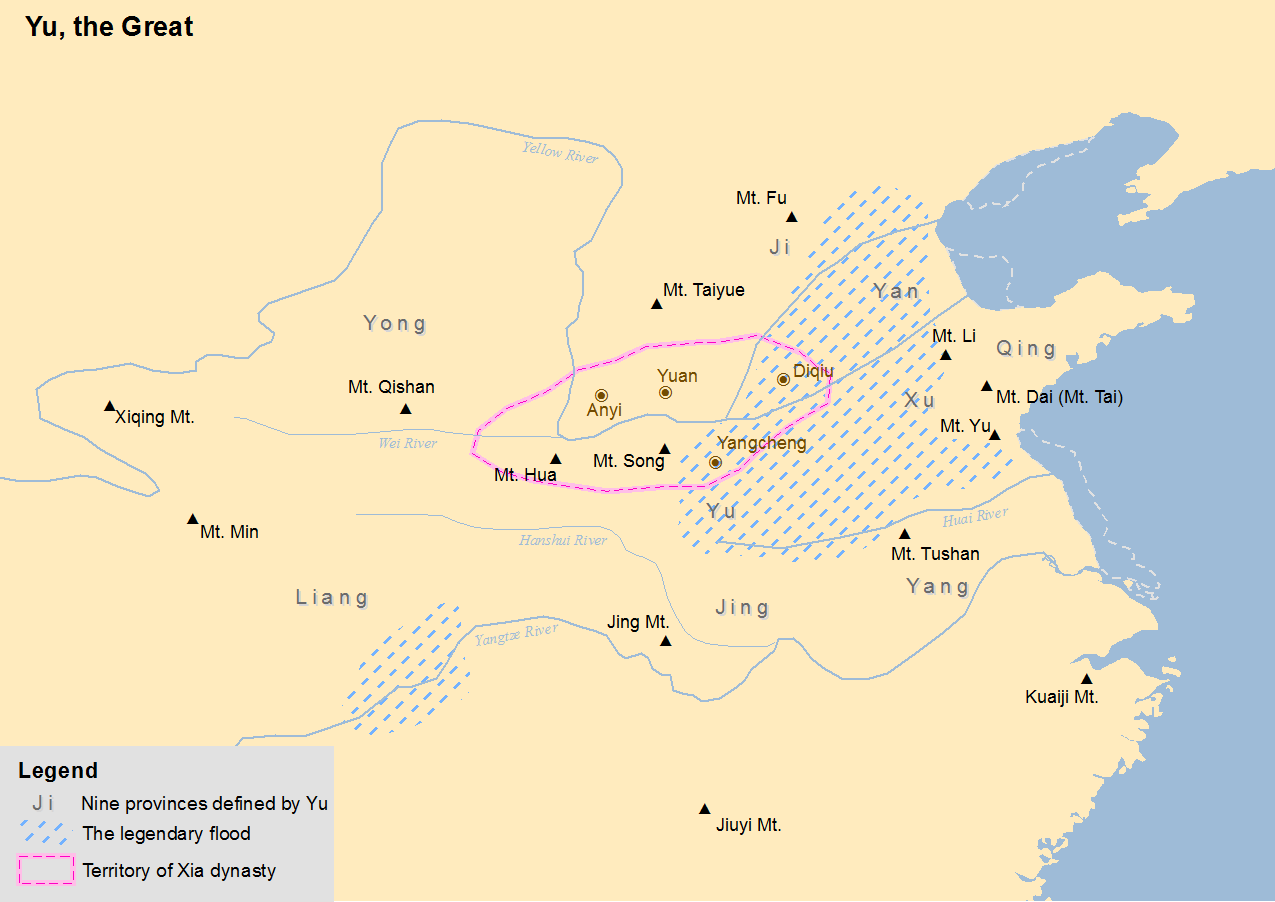
The Xia dynasty is traditionally regarded as the first dynasty of ancient China. In classical Chinese histories it is said to have been founded by the engineer and flood-controller Yu the Great and to have existed for several centuries before being replaced by the Shang. Chronologies based on later historical compilations generally place the Xia at about c. 2100–1600 BCE, though precise dates remain debated.
Image gallery
5 Images



Archaeology and historicity
For many years the Xia occupied a liminal position between myth and history. Excavations at the Erlitou site in Henan province have revealed a Bronze Age urban complex with palatial buildings, workshops and ritual objects dated to roughly the second millennium BCE. Some scholars associate Erlitou with the material footprint of the Xia, while others treat it as a distinct culture that may have been ancestral to the Shang. The question of direct continuity from legend to archaeology is unresolved, and most modern accounts treat the Xia as a historically plausible polity documented by later records.
Characteristics
- Political form: described in tradition as hereditary rule centered on a line of kings.
- Economy: agro-pastoral and increasingly specialized craft production including bronze casting.
- Material culture: evidence at Erlitou for urban planning, bronzes, pottery and jade objects.
- Myth and memory: founding myths emphasize flood control and moral rulership; later narratives highlight failures by the last ruler.
History, rulers and major themes
Traditional histories name a succession of Xia rulers and portray the dynasty as the framework for early state formation in the Yellow River valley. Stories emphasize technologies such as irrigation and measures to restrain floods, as well as moral lessons: the last ruler, often called Jie, is depicted as tyrannical and is said to have been overthrown by leaders of the rising Shang polity. These narratives were recorded and transmitted by historians such as Sima Qian and incorporated into later political thought.
Legacy and significance
The Xia occupies a central place in Chinese historical consciousness as the starting point of dynastic succession and civilization in Chinese tradition. Archaeological discoveries at sites like Erlitou have made the debate more concrete, linking material remains to the period described in texts. Whether treated as myth, proto-history, or early statehood, the Xia period remains important for understanding the origins of Bronze Age culture, social hierarchy and the later development of Chinese historiography.
Notable distinctions
Modern study separates three strands: the literary tradition preserved in classical texts, the archaeological record exemplified by Erlitou and related sites, and comparative analysis that situates early Chinese state formation within wider Eurasian Bronze Age developments. Each strand supplies partial evidence; together they form a multifaceted picture that continues to be refined by research.
Questions and answers
Q: What is the Xia dynasty?
A: The Xia dynasty was the first dynasty of China.
Q: When was the Xia dynasty founded?
A: The Xia dynasty was founded in 2100 BC.
Q: When did the Xia dynasty end?
A: The Xia dynasty ended in 1600 BC.
Q: How did archaeologists prove the existence of the Xia Dynasty?
A: Archaeologists proved the existence of the Xia Dynasty by digging at Erlitou in Henan Province.
Q: Who was the last king of the Xia Dynasty?
A: The last king of the Xia Dynasty was Jie.
Q: How was Jie described?
A: Jie was described as cruel and greedy.
Q: Who defeated Jie?
A: T'ang, the king of the Shang people from the east, defeated Jie.
Related articles
Author
AlegsaOnline.com Xia dynasty (c. 2100–1600 BCE) — early Chinese dynasty and legend Leandro Alegsa
URL: https://en.alegsaonline.com/art/109478