
Xenopus: African clawed frogs and their role in research and ecology
Xenopus is a genus of African aquatic frogs known for fully webbed toes and laboratory importance; includes species such as X. laevis and X. tropicalis and notable polyploidy.
Overview
Xenopus is a genus of aquatic frogs native to sub‑Saharan Africa. Members of this group are commonly called clawed frogs because three toes on each hind foot bear small black claws while all toes are fully webbed for swimming; the fingers on the forelimbs lack webbing. About twenty species are currently recognized, among them Xenopus laevis and Xenopus tropicalis, which are prominent in laboratory research. The genus is distributed across a range of freshwater habitats including ponds, marshes, slow‑moving rivers and seasonally flooded grasslands.
Image gallery
2 Images
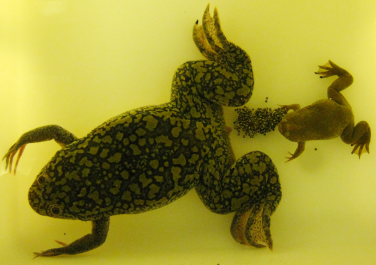
Physical characteristics
Xenopus species are adapted to a fully aquatic life. They have a flattened, streamlined body, powerful hind limbs, and smooth skin. Coloration varies from greenish to brown or gray with mottling that provides camouflage. Instead of vocal sacs used by many frogs, some Xenopus species make clicks or metallic sounds. A distinctive anatomical feature is the presence of keratinized claws on three toes of each hind foot.
Taxonomy, reproduction and polyploidy
The genus has been the subject of taxonomic review and molecular study. Many Xenopus lineages show unusual chromosomal variation: several species are polyploid, possessing multiple sets of chromosomes, and in some cases this reaches high levels compared with most vertebrates. This genetic diversity has made the group interesting to cytogeneticists and evolutionary biologists. Reproduction typically takes place in water; females lay eggs that develop externally, and embryos are accessible for observation from the earliest stages.
Importance in research
Certain Xenopus species are established model organisms. Model organism status arises from large, easily manipulated eggs and embryos, external development, and well‑characterized embryology. Studies using Xenopus have contributed to our understanding of developmental biology, cell biology, toxicology, and neuroscience. Researchers also use Xenopus to model aspects of human disease and congenital defects. Two species are most common in labs: X. laevis, historically used for biological assays and early embryology, and X. tropicalis, often favored for genetic and genomic work because of its shorter generation time and lower ploidy level.
Ecology, distribution and impacts
Native to sub‑Saharan Africa, Xenopus frogs occupy a variety of freshwater environments and play roles as both predators and prey in aquatic food webs. Some species have been introduced outside their native range, intentionally or accidentally, and in such situations they can become invasive, compete with local fauna, or spread disease. Conservation assessments vary by species; habitat loss, pollution and introduced species are common pressures.
Practical notes and notable facts
- Xenopus frogs are strong swimmers with fully webbed hind feet but unwebbed forelimbs.
- The genus exhibits remarkable examples of polyploidy, which has scientific significance for genetics and evolution.
- Historically, X. laevis was used in bioassays such as early pregnancy testing and as a mainstay of embryological research.
- Ethical and regulatory frameworks guide their use in laboratories; humane care and disposal are important to prevent ecological release.
For further reading on classification and research methods related to Xenopus, consult authoritative resources and institutional guidelines. Additional background and specific protocols are available through research networks and species accounts linked from specialist sites: genus overview, technical resources on biology and husbandry, and regional conservation portals provide detailed information for scientists and the public.
Key research topics connected to Xenopus include experimental embryology, toxicological screening, neural circuit development, and comparative genomics—areas in which the genus continues to contribute important insights into vertebrate biology.
Questions and answers
Q: What is Xenopus?
A: Xenopus is a genus of aquatic frogs native to sub-Saharan Africa, and it is commonly known as the clawed frog.
Q: How many species of Xenopus are known?
A: Twenty species of Xenopus are known.
Q: Which are the two best-known species of Xenopus?
A: The two best-known species of Xenopus are Xenopus laevis and Xenopus tropicalis.
Q: What are Xenopus laevis and Xenopus tropicalis studied as?
A: Xenopus laevis and Xenopus tropicalis are studied as model organisms for developmental biology, cell biology, toxicology, neuroscience, and for modeling human disease and birth defects.
Q: What is the polyploidy in Xenopus?
A: The genus is known for its polyploidy, with some species having up to 12 sets of chromosomes.
Q: What are the physical characteristics of Xenopus?
A: Xenopus frogs are all excellent swimmers and have powerful, fully webbed toes, though the fingers lack webbing. Three of the toes on each foot have conspicuous black claws.
Q: What region are Xenopus frogs native to?
A: Xenopus frogs are native to sub-Saharan Africa.
Related articles
Author
AlegsaOnline.com Xenopus: African clawed frogs and their role in research and ecology Leandro Alegsa
URL: https://en.alegsaonline.com/art/109457