
Xenophanes of Colophon: poet, critic, and early Greek philosopher
Pre-Socratic thinker (c.570–c.475 BCE) whose surviving fragments show religious criticism, natural speculation and epistemic caution; remembered for attacking anthropomorphic gods and later influence.
Overview
Xenophanes of Colophon (c. 570–c. 475 BCE) was an Ionian intellectual known both for his poetry and for sharp critiques of traditional religion and culture. He is counted among the pre-Socratic thinkers because his surviving lines show inquiry into the natural world, divine nature and human knowledge. Most of what we possess of his thought survives in fragments quoted by later authors, and scholars reconstruct his views from those excerpts and reports. For a concise biographical introduction see biography.
Image gallery
4 Images
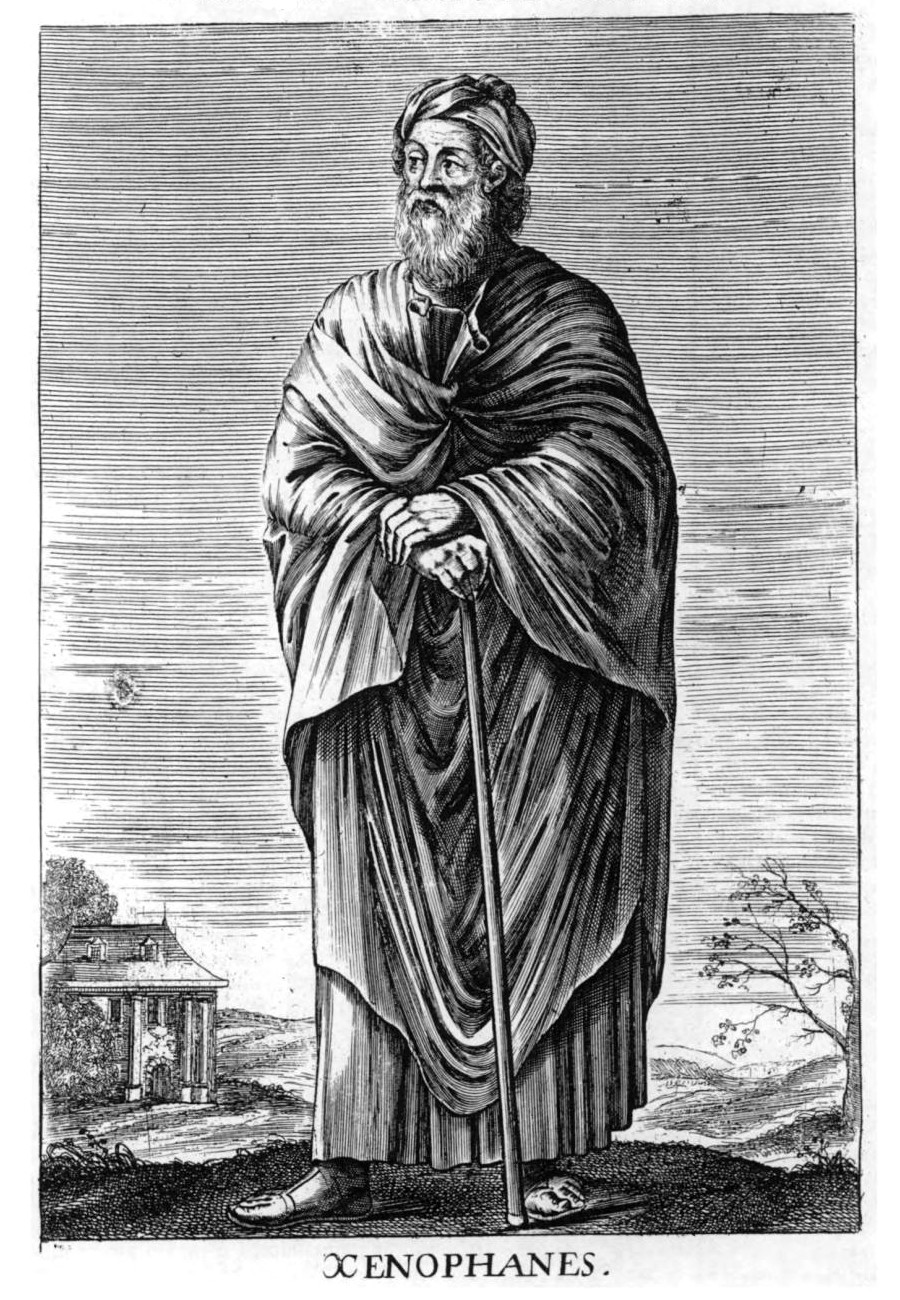


Poetry, style and targets
Xenophanes wrote in hexameter and in iambic and elegiac meters and used satirical tones to address public life. His poems combine moral invective, political observation and philosophic reflection. He attacked fellow poets and popular stories — notably Homer and Hesiod — for presenting the gods as morally flawed and humanlike. He also ridiculed social customs and excesses such as competitive athletic pride; critics of his day recorded that he mocked the Greeks' admiration for athletic achievement. His literary persona is at once combative and reflective, and he famously claimed he wrote verses that would be remembered by future generations.
Religion and theology
A central theme in Xenophanes' thought is a critique of anthropomorphic religion. He argued that mortals fashion the gods in their own image rather than discerning divine reality, and he made the bold move of proposing a single, supreme deity conceived as entirely different from humans. This god, Xenophanes suggested, is supreme in power and thought, immobile and unlike the picture painted by popular myth-makers. His religious criticism and moral concerns are often grouped under the label social and religious critique, and his remarks about gods are some of the earliest explicit challenges to traditional polytheism in Greek literature. See also discussions of gods portrayed with human traits at anthropomorphic god-critique.
Knowledge and natural thought
Xenophanes advanced an epistemic modesty that later readers regard as an early form of skepticism: he suggested that human beliefs are conjectural and that certainty is difficult or impossible to achieve. He used provocative examples — including the claim that if animals could depict the divine, they would depict gods resembling themselves — to show how perception and culture shape belief. He also made naturalistic observations about the world: for example, he noted marine shells found inland, arguing this indicated previous changes in the sea or landscape rather than simple supernatural causes. These remarks place him among early thinkers who sought rational explanations for physical phenomena rather than relying only on myth.
Context, influence and legacy
Xenophanes lived during a period of intellectual ferment in the Greek world. Tradition reports journeys to parts of southern Italy and Sicily, and his ideas influenced later philosophers, including figures associated with the Eleatic school. Because his work survives only in fragments and reports, reconstruction is cautious, but his combination of poetic skill and critical thought made him a distinctive voice. Modern readers find in Xenophanes a pioneer who used verse to advance philosophical claims and to question deeply held social and religious presumptions — a role summed up in later summaries of his poetry and critiques at poetic fragments and other collections (critical themes). For broader reference consult surviving testimonies and scholarly entries at ancient sources and catalogues of pre-Socratic thought at classical studies and religion studies.
Notable facts and distinctions
- Xenophanes is one of the earliest Greek writers to overtly criticize myth-makers for ethical failings and to propose a non-anthropomorphic conception of divinity.
- He combined literary genres — elegy, iambus and epic diction — with philosophical argument, making his work a bridge from poetic tradition to rational inquiry.
- His surviving reputation rests on fragments quoted in later authors; modern reconstructions rely on these testimonies and on comparative study in early Greek thought. For modern overviews and fragment collections see scholarly resources and introductory materials at reference entries.
Questions and answers
Q: Who was Xenophanes?
A: Xenophanes was a Greek philosopher, poet, and social and religious critic who lived between c. 570 – c. 475 BC.
Q: What is the source of our knowledge about Xenophanes' views?
A: Our knowledge about Xenophanes' views comes from fragments of his poetry that have survived as quotations by later Greek writers.
Q: What were some ideas that Xenophanes criticized and satirized in his poetry?
A: Xenophanes criticized and satirized a wide range of ideas such as Homer and Hesiod, the belief in the pantheon of anthropomorphic gods, and the Greeks' love of athletics and athleticism.
Q: What was Xenophanes' goal in writing poetry?
A: Xenophanes' goal in writing poetry was to create "fame that will reach all of Greece, and never die while the Greek kind of songs survives" and to write for future generations.
Q: What did Xenophanes think about the belief in the pantheon of anthropomorphic gods?
A: Xenophanes criticized the belief in the pantheon of anthropomorphic gods in his poetry.
Q: Was Xenophanes only a poet?
A: No, Xenophanes was not only a poet. He was also a Greek philosopher and social and religious critic.
Q: What cultural phenomenon did Xenophanes criticize in his poetry?
A: Xenophanes criticized the Greeks' love of athletics and athleticism in his poetry.
Related articles
Author
AlegsaOnline.com Xenophanes of Colophon: poet, critic, and early Greek philosopher Leandro Alegsa
URL: https://en.alegsaonline.com/art/109453
Sources
- wikidata.org : wikidata.org/wiki/Q131671
- authority.bibsys.no : 90773014
- catalogo.bne.es : XX826406
- catalogue.bnf.fr : cb12309917b
- data.bnf.fr : (data)
- cantic.bnc.cat : a10179793
- d-nb.info : 118635794
- isni.org : 0000 0001 1795 0895
- id.loc.gov : n82105600
- nla.gov.au : 50119506
- data.nlg.gr : 25840
- uli.nli.org.il : 000143774
- data.bibliotheken.nl : 069840865
- data.rero.ch : 02-A000178037
- opac.sbn.it : IT\ICCU\BVEV\010306