
Xenolith (geology)
A xenolith is a fragment of rock trapped inside another rock, most commonly in igneous bodies; xenoliths and xenocrysts offer direct samples of deeper crust and mantle and inform geological processes.
Overview
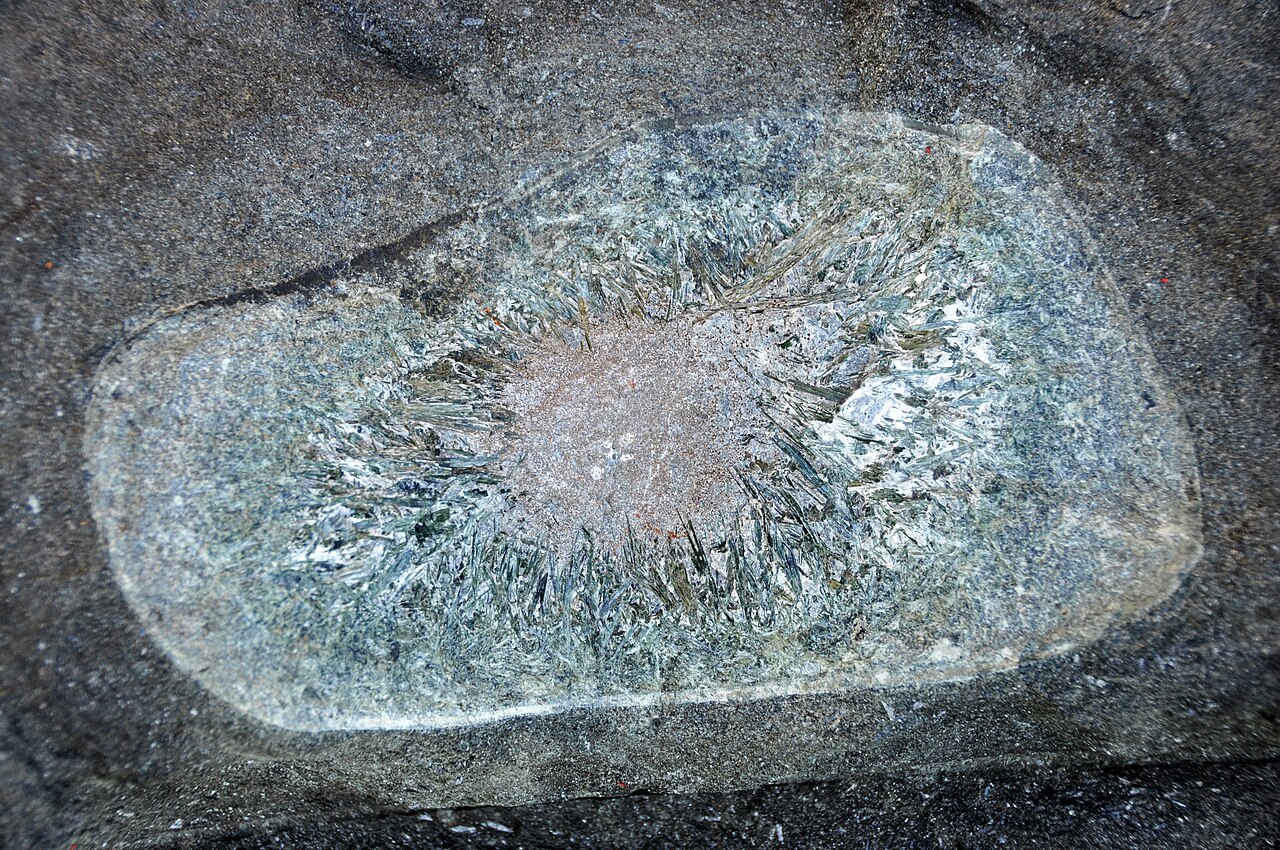
A xenolith, from Greek roots meaning "foreign rock," is a piece of rock that has become enclosed within a different host rock. In simplest terms it is a rock fragment that is not genetically related to the enclosing material. The concept applies most often to igneous settings, where hotter, mobile material engulfs or incorporates cooler blocks, but the basic idea — a foreign clast trapped in a host — can also be extended to sedimentary and even extraterrestrial contexts.
Image gallery
10 Images




Formation and common occurrences
Xenoliths frequently form when magma or lava moves across country rock and tears pieces from conduit walls, chamber margins or the substrate. They appear throughout many igneous rocks such as basalts, kimberlites and other mantle-derived melts. Individual foreign crystals preserved within a host are called xenocrysts; typical examples include quartz carried by low-silica lavas or diamonds transported to the surface in kimberlite pipes. Xenoliths may also enter sedimentary deposits as dropped clasts or roof fragments and thus can be found in sedimentary rock sequences.
Characteristics and types
- Host vs. clast: The host is the enclosing rock; the xenolith is the enclosed rock, typically older or from a different source.
- Igneous xenoliths: Commonly mantle-derived peridotite, eclogite or fragments of crustal rock torn from chamber walls.
- Xenocrysts: Single foreign crystals dispersed through an igneous matrix rather than coherent blocks.
- Meteorite xenoliths: Some meteorites contain inclusions that are compositionally distinct from the main body.
Scientific importance
Xenoliths are valuable because they provide direct samples of rocks from depth that cannot otherwise be observed. Mantle xenoliths carried to the surface in basalts, kimberlites and related magmas preserve information about composition, temperature and pressure conditions of the upper mantle and lower crust. Studies of their mineralogy and chemistry help reconstruct mantle mineralogy, melting histories and mantle heterogeneity. Xenocrysts like isolated quartz or diamonds similarly record growth conditions and transport paths within magmatic systems.
Examples, limitations and notable distinctions
Classic examples include peridotite blocks in basaltic lavas or eclogitic fragments in kimberlite. While xenoliths are powerful probes of inaccessible realms, interpreting them requires care: they may be thermally altered, chemically exchanged with host magma, or non-representative of broader regional rocks. Distinguishing xenoliths from accidental inclusions of similar origin or from autoliths (fragments of the same magma body) is an important part of field and laboratory analysis.
Further reading and resources
Readers seeking basic definitions or field identification guides can consult introductory texts and online summaries at sources indexed by research databases and geological surveys (definition, igneous context, magma processes, lava interactions). For mineral-level details see references on xenocrysts, quartz occurrences and diamond transport in kimberlite studies, or comprehensive discussions of sedimentary clasts and basaltic xenolith suites that inform modern models of mantle mineralogy.
Questions and answers
Q: What is a xenolith?
A: A xenolith is a rock fragment that is surrounded by another rock.
Q: In which type of rock does xenolith occur most often?
A: Xenolith occurs most often in igneous rock.
Q: How does xenolith form in igneous rock?
A: Xenolith forms in igneous rock when magma is fluid enough to flow round more solid rock.
Q: Where can xenolith be found in igneous rock?
A: Xenolith may be found in the margins of a magma chamber, torn loose from the walls of a flow of lava or picked up along the ground by flowing lava on Earth's surface.
Q: What is a xenocryst?
A: A xenocryst is an individual foreign crystal included within an igneous body.
Q: What are the examples of xenocrysts?
A: Examples of xenocrysts are quartz crystals in a low-silica lava and diamonds in kimberlite diatremes.
Q: What does the presence of xenolith and xenocryst provide?
A: The presence of xenolith and xenocryst provides important information about the composition of the otherwise inaccessible mantle.
Related articles
Author
AlegsaOnline.com Xenolith (geology) Leandro Alegsa
URL: https://en.alegsaonline.com/art/109451
Sources
- commons.wikimedia.org : Xenolith