
X.509: Public Key Certificate Standard
X.509 is a widely used ITU-T standard defining the format and validation of public key certificates, revocation information, and certification paths for secure communications such as TLS and email.
Overview
X.509 is a standard that specifies how public key certificates, certificate revocation information, and related structures are represented and validated. It is a foundational component of public key infrastructure (PKI) used to authenticate identities and distribute public keys reliably. Implementations of X.509 are central to secure web browsing (TLS/SSL), secure email (S/MIME), virtual private networks, and many other cryptographic systems.
Image gallery
1 Image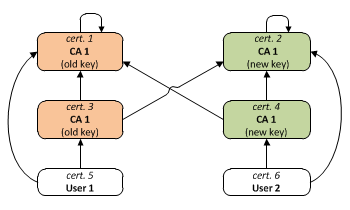
Structure and main components
An X.509 certificate binds a public key to an identity and contains fields such as the subject name, issuer name, serial number, validity period, the subject's public key, and a digital signature from the issuer. Modern certificates (version 3) support extensions that carry additional metadata: key usage, extended key usage, subject alternative name, and certificate policies among others. Certificates are encoded in binary DER form or in the ASCII-armored PEM form used by software tools.
Validation and trust model
Certificates are validated by checking the issuer's signature, the certificate chain up to a trusted root (trust anchor), the validity period, and any applicable extensions and revocation status. X.509 supports hierarchical trust models in which certificate authorities (CAs) issue subordinate certificates. The root CAs are typically distributed and trusted by operating systems and browsers. Revocation information can be published as certificate revocation lists (CRLs) or queried via the Online Certificate Status Protocol (OCSP).
History and development
X.509 originated within standards efforts for directory and security services and evolved to meet practical needs for internet security. Over time the standard has been extended to add version 3 extensions, alternative encodings and mechanisms for revocation checking. Implementations and operational practices have adapted as cryptographic algorithms and threat models changed.
Uses, examples, and important distinctions
- Common uses: securing HTTPS connections, signing and encrypting email, code signing, authenticating devices and users in enterprise VPNs.
- Distinctions: X.509 describes certificate formats and validation rules but does not prescribe a single global trust policy; different applications and platforms may enforce distinct checks and trust stores.
- Operational concerns: certificate lifecycle management, secure key handling, and timely revocation checking are critical for maintaining trust.
Notable facts
X.509 is ubiquitous in internet security but must be used with care: weaknesses may arise from compromised CAs, deprecated cryptographic algorithms, or misconfiguration. Ongoing standards work and best practices continue to refine how certificates are issued, validated, and revoked to respond to new threats.
Questions and answers
Q: What is X.509?
A: X.509 is a PKI or public key infrastructure for managing digital certificates and public-key encryption.
Q: What is the role of X.509 in securing web and email communication?
A: X.509 is a key part of the Transport Layer Security protocol that is used to secure web and email communication.
Q: What is the purpose of X.509?
A: The purpose of X.509 is to specify formatting for public key certificates, certificate revocation lists, attribute certificates and validation algorithms.
Q: What is a public key infrastructure (PKI)?
A: A public key infrastructure (PKI) is a system that uses public key encryption to manage digital certificates and secure communication.
Q: What is a digital certificate?
A: A digital certificate is a digital form of identification that verifies the identity of the user or device.
Q: What is the significance of the certification path validation algorithms specified in X.509?
A: The certification path validation algorithms specified in X.509 are significant for ensuring the accuracy and validity of the certification path for digital certificates.
Q: How does X.509 help with managing security in communication networks?
A: X.509 helps manage security in communication networks by providing a standardized way to issue, validate and manage digital certificates and public key infrastructure.
Related articles
Author
AlegsaOnline.com X.509: Public Key Certificate Standard Leandro Alegsa
URL: https://en.alegsaonline.com/art/109402