
Wrigley Field — Chicago's historic baseball park
Wrigley Field is a century-old baseball stadium on Chicago's North Side, long home of the Chicago Cubs. Known for its ivy-covered walls, manual scoreboard and neighborhood rooftops, it is a celebrated American ballpark.
Overview
Wrigley Field is a well-known stadium and longtime baseball park located on Chicago's North Side. Since 1916 it has been the principal home of the Chicago Cubs, a franchise of Major League Baseball. The ballpark sits on a city block bounded by Addison, Clark, Waveland and Sheffield and is a focal point of the surrounding neighborhood.
Image gallery
10 Images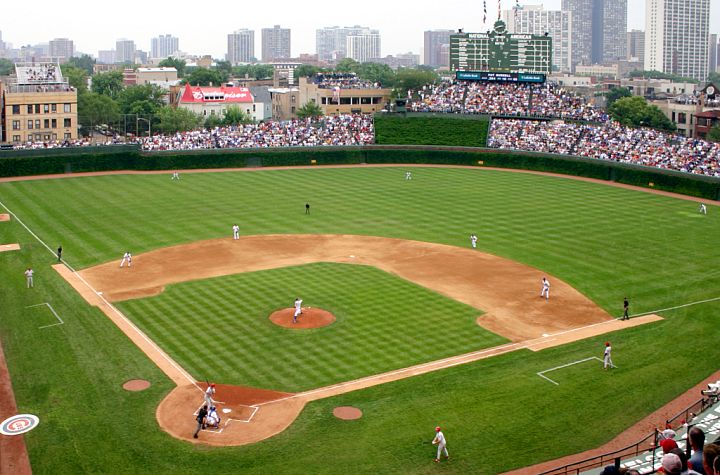


Design and notable features
Wrigley Field retains many traditional ballpark elements that set it apart from modern stadiums. Its most famous visual cues include the ivy that covers the outfield walls, a manually operated scoreboard in center field, and the red marquee over the main entrance. The stadium's intimate sightlines, asymmetrical outfield dimensions and bleacher seating in right field give it a distinct, old-fashioned character. Rooftop viewing areas on adjacent buildings provide an unusual spectator experience that has become part of the park's identity.
History and development
The facility was constructed in 1914 for the short-lived Chicago Whales of the Federal League. After the Federal League folded, the Cubs moved from West Side Park into the ballpark in 1916. Over the decades the park has been incrementally renovated rather than replaced, preserving hand-operated features while adding modern amenities. Night games were uncommon at Wrigley until the installation of stadium lights in the 1980s; the property later underwent further updates to improve infrastructure, sightlines and accessibility.
Other uses and events
While best known for baseball, Wrigley Field has hosted a range of sporting and cultural events. The Chicago Bears of the National Football League held home games there from the early 1920s until their move to Soldier Field in 1971. The stadium has also staged concerts, neutral-site soccer matches and outdoor hockey games, demonstrating its adaptability for events beyond regular-season baseball. Film and television productions have used the park as a location, reinforcing its place in American popular culture.
Significance and recognition
Wrigley Field is frequently described as having a "cozy" atmosphere; fans and players have long referred to it as "The Friendly Confines," a phrase popularized by the late Ernie Banks. The park's name and legacy extend beyond Chicago—there was a separate Wrigley Field in Los Angeles built by the same family associated with the original property. In November 2020 the ballpark received formal protection as a National Historic Landmark, acknowledging its architectural, cultural and sporting importance.
Characteristics and legacy
- Architecture: masonry facade, traditional grandstand and a compact, neighborhood-oriented footprint.
- Atmosphere: intimate seating, fan traditions, and game-day rituals tied to the adjacent streets and rooftops.
- Preservation approach: cumulative renovations that balance modern standards with historic character.
- Community role: an urban landmark that shapes local commerce, tourism and civic pride.
Taken together, these qualities make Wrigley Field one of the most recognizable and cherished ballparks in the United States. Its blend of historical features, neighborhood setting and continued use for major league games preserves a direct connection to the early 20th-century origins of professional baseball.
Additional background and specific event records are available through primary sources and institutional archives for readers who want deeper research into particular seasons, architectural plans or renovation timelines. For an introductory tour of themes and milestones, the park's long-running public presence provides a clear narrative of continuity and change in American sports venues.
References and further reading may be sought via resources linked from official team and municipal pages as well as sports history collections; examples of institutional pages are identified with reference placeholders throughout this article.
Further event examples and archival materials can illuminate the variety of ways Wrigley Field has been used over time.
Questions and answers
Q: What is Wrigley Field?
A: Wrigley Field is a sports stadium and a baseball park where the Chicago Cubs play in Major League Baseball.
Q: Where is Wrigley Field located?
A: Wrigley Field is located in Chicago, Illinois, on the north side of the city.
Q: Since when have the Chicago Cubs played at Wrigley Field?
A: The Chicago Cubs have been playing at Wrigley Field since 1916.
Q: What was the original purpose of Wrigley Field when it was built in 1914?
A: Wrigley Field was originally built in 1914 for the Chicago Whales of the Federal League.
Q: What other sports have been played at Wrigley Field besides baseball?
A: Wrigley Field has hosted events such as soccer and hockey.
Q: What is the nickname of Wrigley Field and who made it famous?
A: The nickname of Wrigley Field is "The Friendly Confines", which was made famous by former Cubs player Ernie Banks.
Q: When was Wrigley Field designated a National Historic Landmark?
A: Wrigley Field was designated a National Historic Landmark in November 2020.
Related articles
Author
AlegsaOnline.com Wrigley Field — Chicago's historic baseball park Leandro Alegsa
URL: https://en.alegsaonline.com/art/109229
Sources
- ballparks.com : "Wrigley Field"