
Wormhole (Einstein–Rosen Bridge)
A wormhole is a hypothetical tunnel-like connection through spacetime that could link distant points in space and time. It is a theoretical concept from general relativity with no confirmed observational evidence.
Overview
A wormhole is a theoretical feature of spacetime that functions like a tunnel connecting two separate locations or moments. In general relativity such structures appear as solutions to the field equations and are often described as shortcuts through space and time or as connections between different regions of the universe. The term is commonly used interchangeably with "Einstein–Rosen bridge," a name that recalls the early mathematical models that first suggested such connections. Whether traversable, stable, or physically realizable remains an open question in modern physics.
Image gallery
5 Images



Physical description and main types
Informally, a wormhole can be pictured as a tunnel whose two ends (or "mouths") sit at different points in the surrounding spacetime. The interior of the tunnel—sometimes called the throat—could in principle be shorter than the external path between the same two points. Physicists distinguish between several kinds of wormholes according to their mathematical properties and physical behavior:
- Non-traversable wormholes: solutions that pinch off or contain horizons making travel through them impossible for macroscopic observers.
- Traversable wormholes: hypothetical constructions allowing passage from one mouth to the other without encountering horizons or singularities.
- Microscopic or Planck-scale wormholes: tiny topological features that might arise in quantum gravity pictures but would not permit macroscopic transit.
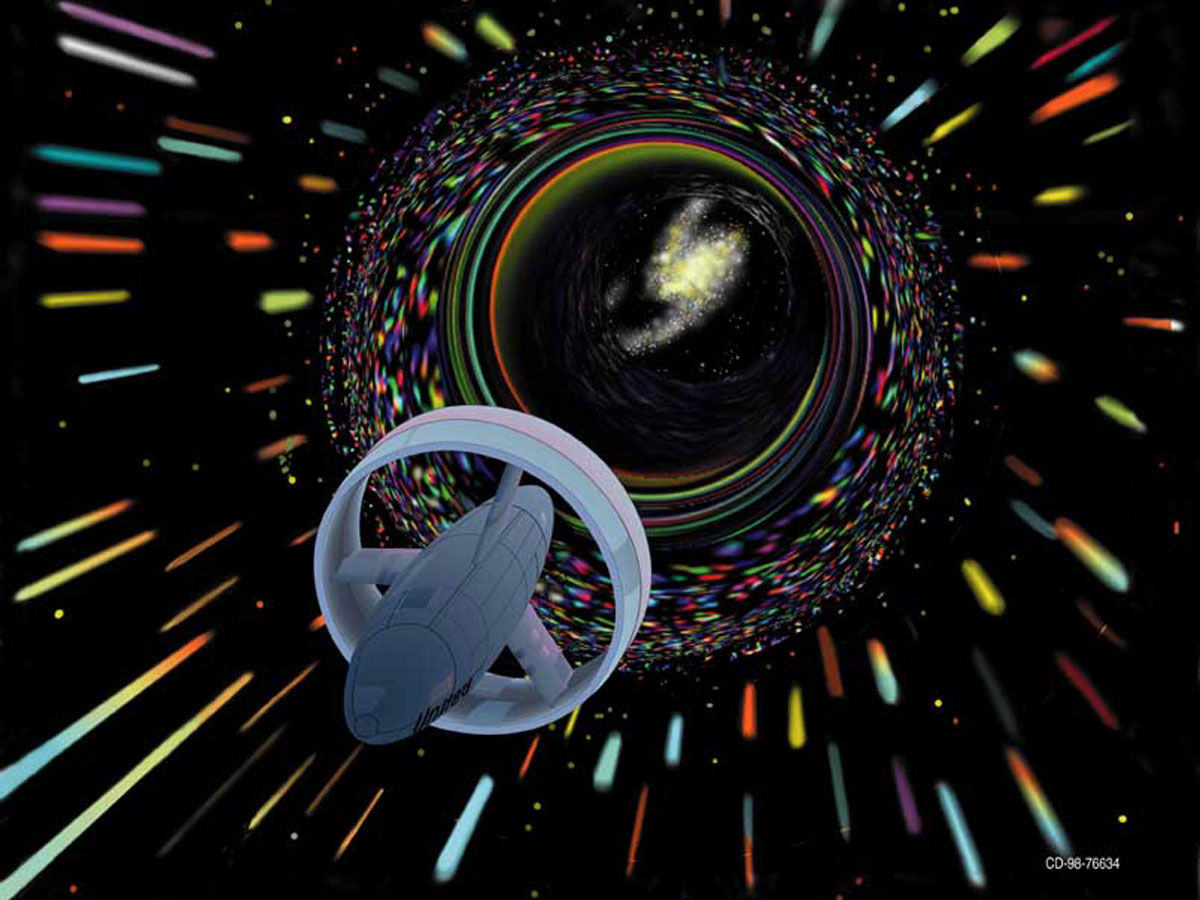
Wormholes may also be classified by whether their mouths lie in the same universe, different regions of the same universe, or in different universes entirely—phrases often used in both scientific and popular descriptions of the concept, and sometimes illustrated as shortcuts between two points in space.
Historical and theoretical background
The idea dates back to attempts to understand solutions of Einstein's field equations. An early mathematical construction known as the Einstein–Rosen bridge arose from work by Albert Einstein and Nathan Rosen, and the evocative popular name "wormhole" was later introduced by physicist John Wheeler. Subsequent theoretical work explored how such structures might behave, and what physical ingredients would be required for them to remain open and traversable. Important contributions include analyses that demonstrated simple wormhole solutions tend to be unstable or hidden behind event horizons, as well as studies proposing ways to stabilize a throat using unusual forms of stress–energy.
Theoretical requirements and stability
One of the central theoretical hurdles to traversable wormholes is stability. Most classical wormhole geometries collapse too quickly for anything to pass. To keep a throat open, calculations indicate one would need matter with unusual properties: negative energy density or negative pressure relative to a local observer. Such material is commonly called "exotic matter". While quantum field theory allows localized negative energy densities in special situations (for example, effects related to the Casimir phenomenon), it is unknown whether such effects can be organized to produce a macroscopic, stable wormhole. Some researchers also study whether quantum gravity or new physics at very small scales could alter these conclusions.
Wormholes and time travel
Wormholes attract attention because they naturally suggest ways to circumvent long distances and potentially connect different times. A popular theoretical scheme imagines taking one mouth of a traversable wormhole on a fast journey or placing it in a stronger gravitational field; time dilation causes that mouth to age differently from the other. As a result, traveling through the tunnel might produce arrival at an earlier or later external time than one would expect by ordinary travel. This possibility raises well-known paradoxes about causality and closed timelike curves, and has led to proposals such as Hawking's "chronology protection conjecture" that unknown physics prevents macroscopic time machines. Explanations and thought experiments about wormhole time-travel commonly invoke concepts like relativistic acceleration, gravitational time dilation, and clock synchronization; readers can find accessible expositions on time-travel mechanisms, the role of time dilation, and issues of synchronization.
Observational status and speculative proposals
To date there is no experimental or observational evidence for macroscopic wormholes. Researchers have suggested several hypothetical observational signatures—unusual gravitational lensing patterns, specific high-energy transient events, or departures from predicted black hole shadows—but none have been identified conclusively. Some theoretical proposals consider primordial wormholes formed in the early universe or quantum-scale structures that might influence particle physics or cosmology. More speculative ideas link wormhole concepts to quantum information and entanglement, suggesting deep but not yet empirically established relationships between quantum mechanics and spacetime connectivity.
Cultural impact and distinctions
Wormholes are a staple of science fiction because they provide a simple device for rapid interstellar travel and narrative time travel. Fictional portrayals often gloss over the formidable physical challenges that genuine traversable wormholes would entail, treating them instead as convenient shortcuts or portals. In scientific discourse, it is important to distinguish between mathematically permitted geometries in general relativity and physically realizable structures: a solution to the equations does not guarantee that nature can produce or sustain the required conditions. For thorough technical introductions and pedagogical overviews, readers may consult textbooks and reviews that treat the Einstein equations, exotic stress–energy, and the broad literature on wormhole physics via further reading links such as popular summaries and reviews.
Although wormholes remain speculative, they continue to serve as a fruitful junction between gravitational theory, quantum physics, and discussions about causality—topics that motivate active research and careful debate among physicists.
Questions and answers
Q: What is a wormhole?
A: A wormhole is a theoretical passage through space creating a shortcut through time and space. It is not known whether or not they exist.
Q: How would a wormhole be created?
A: Scientists believe that if wormholes existed they could not be made following any traditional scientific methods. In order to hold a wormhole open, a form of theoretical exotic matter would be needed. Otherwise the wormhole would simply disappear very quickly after its creation.
Q: How does it appear on a 2-dimensional plane?
A: If plotted on a 2-dimensional plane, the wormhole bends the plane, like folding a paper, so that the two ends would be touching (as seen in the picture).
Q: Who first used the term "wormhole"?
A: The term 'wormhole' was first used by John Wheeler, a theoretical physicist. It is also known as an Einstein-Rosen bridge.
Q: What do researchers have for evidence of their existence?
A: Researchers have no observational evidence for wormholes.
Q: Why are they often featured in science fiction stories?
A: Wormholes are often featured in science fiction stories because they allow rapid interstellar, intergalactic, and sometimes even interuniversal travel which can enable time travel within human lifetimes.
Q: How might one use them for time travel?
A: A proposed time-travel machine using a traversable wormhole would hypothetically work by taking one entrance of the wormhole and moving it to within the gravitational field of an object that has higher gravity than the other entrance and then returning it to its original position near the other entrance; this causes time dilation which makes one end of the tunnel younger than the other as seen by an external observer but synchronized clocks at either end will remain synchronized when passing through it no matter how much movement occurs between both ends.
Related articles
Author
AlegsaOnline.com Wormhole (Einstein–Rosen Bridge) Leandro Alegsa
URL: https://en.alegsaonline.com/art/109141
Sources
- physics.aps.org : physics.aps.org/story/v2/st7