
WorldCat Identities
A descriptive service built on the WorldCat bibliographic catalog that produces summary pages for authors and named entities to aid discovery, disambiguation, and basic bibliographic analysis.
Overview
WorldCat Identities is a descriptive layer built on the WorldCat union catalog maintained by OCLC. It generates consolidated, name‑based pages for people and other named entities by aggregating bibliographic records from the WorldCat database. These identity pages typically present a brief synopsis, a list of works attributed to the name, variant forms of the name, associated subjects, and basic publication and holding information drawn from library cataloging data. WorldCat itself aggregates holdings from thousands of member libraries (OCLC libraries) and serves as the underlying bibliographic index (WorldCat database).
Image gallery
1 Image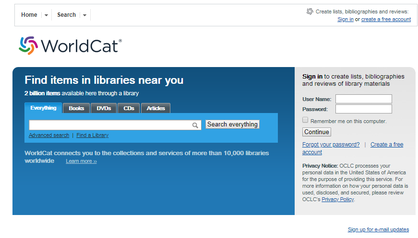
Content and structure
Each WorldCat Identities page is created algorithmically from WorldCat records rather than being a manually curated authority file. Common elements found on an identity page include:
- Canonical or preferred form of the name and known variants;
- Enumerated lists of works and editions attributed to the name, often with counts of editions and translations;
- Subjects, topical headings, and frequently associated subjects drawn from catalog metadata;
- Publication timeline or chronological grouping that indicates active years or the distribution of works over time;
- Links back to individual WorldCat records and library holdings that support further discovery.
History and development
WorldCat Identities was developed as an enhancement to WorldCat to make large‑scale bibliographic aggregation more accessible for discovery and simple analysis. Rather than replacing formal name authorities used by libraries, the service repackages existing cataloguing data into human‑readable summaries. Its design reflects both the scale of WorldCat and the need to present aggregated authorial and corporate identity information to the public, researchers, and librarians.
Uses and audiences
Different groups use WorldCat Identities for varied purposes. Librarians and metadata specialists consult identity pages for quick overviews of an author's corpus and to spot variant forms of names. Researchers and students use the pages as a starting point for bibliographic exploration or to find editions and translations. Librarians involved in collection development or interlibrary loan may consult identity pages to understand an author's publication history and the distribution of works across libraries.
Distinctions, benefits, and limitations
WorldCat Identities should be seen as a discovery and summarization tool rather than a formal authority control system. It complements—rather than replaces—established authority files (for example, national name authority lists or the Virtual International Authority File). Strengths of the service include broad coverage and the ability to surface variant names and work counts quickly. Limitations arise from its automated creation: clustering errors, incomplete biographical details, and uneven coverage that reflect the scope and cataloging practices of participating libraries. Users are advised to verify critical bibliographic details against primary authority sources when precision is required.
Practical notes
WorldCat Identities is publicly visible as part of the broader WorldCat ecosystem and is most effective when used in combination with library catalogs and formal authority files. Because it is generated from the WorldCat index, the content and scope of identity pages evolve as participating libraries add, correct, or enhance catalog records.
Questions and answers
Q: What is WorldCat Identities?
A: WorldCat Identities is a bibliographic database that lists the collections of 17,900 libraries in 123 countries and territories that participate in the Online Computer Library Center (OCLC) global cooperative.
Q: Who operates WorldCat Identities?
A: WorldCat Identities is operated by OCLC, Inc.
Q: How many libraries participate in the Online Computer Library Center (OCLC) global cooperative?
A: 17,900 libraries in 123 countries and territories participate in the Online Computer Library Center (OCLC) global cooperative.
Q: Is access to WorldCat itself free?
A: Yes, OCLC makes WorldCat itself available for free to libraries.
Q: What are some subscription OCLC services that WorldCat is used for?
A: WorldCat is used for other subscription OCLC services such as resource sharing and collection management.
Q: Who uses WorldCat?
A: WorldCat is used by the general public and by librarians for cataloging and research.
Q: What is the significance of WorldCat?
A: WorldCat is the world's largest bibliographic database.
Related articles
Author
AlegsaOnline.com WorldCat Identities Leandro Alegsa
URL: https://en.alegsaonline.com/art/109134
Sources
- doi.org : 10.5860/lrts.58n3.178
- doi.org : 10.5860/ltr.51n4
- doi.org : 10.1080/01616846.2016.1210440
- ssrn.com : OCLC changes its rules for use of records in WorldCat: library community pushback through blogs and cultures of resistance
- worldcat.org : 37492023
- doi.org : 10.5860/ltr.52n6
- oclc.org : "WorldCat data licensing"
- oclc.org : "Data licenses & attribution"