
World line (spacetime trajectory)
A world line is the path an object traces through spacetime, showing its history and causal relations. It is fundamental to relativity, causal structure, and the distinction between timelike, lightlike, and spacelike paths.
Overview
A world line is the record of an object's location through both space and time—together treated as spacetime. Instead of describing motion only by position as a function of time, a world line treats time as a coordinate on equal footing with spatial coordinates and represents an object's full history as a single continuous curve. In relativity this picture emphasizes that different observers may slice spacetime into 'space' and 'time' differently while the underlying world line remains invariant.
Image gallery
3 Images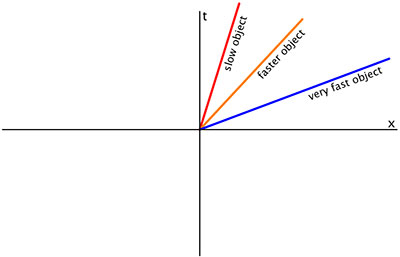


Key characteristics
World lines come in several types based on their relation to light cones. A timelike world line corresponds to a massive particle and always stays inside the local light cone; it can be parametrized by the object's proper time. A lightlike or null world line is the trajectory of massless particles such as photons and lies exactly on the light cone. A spacelike curve connects events that cannot be causally related; physical particles cannot follow spacelike world lines. Tangent vectors to a world line give the object's four-velocity and four-acceleration, quantities that are invariant under changes of inertial coordinates.
Geometry and invariants
In flat Minkowski spacetime the simplest world lines are straight lines, representing inertial motion. Curved world lines indicate acceleration. The spacetime interval measured along a world line is invariant: observers in different frames agree on whether intervals are timelike, lightlike, or spacelike. Proper time—the elapsed time measured by a clock moving along a timelike world line—is the natural parameter for that curve. Diagrams that plot time on one axis and space on another (spacetime diagrams) use world lines to illustrate causality and relativistic effects such as time dilation and simultaneity shifts familiar from special relativity.
History and development
The world line concept arose as part of the rethinking of space and time in the early 20th century. The synthesis of spatial and temporal coordinates into a single four-dimensional arena was formalized by Hermann Minkowski and became central to Einstein's theories. In general relativity, world lines generalize to curves in curved spacetime: freely falling particles follow geodesic world lines determined by the spacetime geometry, while non-gravitational forces produce deviations from geodesics.
Uses, examples, and notable facts
- Spacetime diagrams often show a stationary observer as a vertical world line and a uniformly moving observer as an inclined straight line. Rapid motion tilts the world line closer to a 45-degree angle in units where the speed of light is unity.
- When an object approaches the speed of light (the speed of light) relative to a chosen frame, its world line approaches the lightlike direction; only massless particles achieve strictly lightlike world lines.
- Thought experiments like the twin paradox are most clearly analyzed by comparing the different world lines and counting proper time along each path.
- World lines also encode causal structure: whether one event can influence another depends solely on the relative positions of their world lines and light cones.
Because world lines are a geometric and frame-independent way to represent motion, they form a central tool across theoretical physics. They connect kinematics, dynamics, and geometry: the same curve can be described by coordinates in many frames, but its geometric properties control what physical processes—such as communication or force influence—are possible. Modern discussions of spacetime, causality, and relativistic phenomena routinely use the language of world lines to make these ideas precise.
For introductions and visualizations, many resources explain how world lines are drawn and interpreted on spacetime diagrams; further technical treatments describe how to compute four-velocities and geodesic equations in both special and general relativity. See authoritative texts and lecture notes for detailed calculations and rigorous proofs.
Related concepts and further reading: basic spacetime structure and causality, proper time and four-velocity, and the role of world lines in gravitational theory. For concise introductions consult elementary expositions on space, time, and relativistic kinematics, and for advanced treatments look into mathematical relativity and differential geometry resources (special relativity, general relativity).
Additional online primers and diagrams are available via educational portals and lecture notes for physics courses that present world lines visually and computationally; these materials often include step-by-step examples of world line integration and the role of light cones in determining causality (speed of light).
Questions and answers
Q: What is a world line?
A: A world line is the unique path that an object has as it travels through both space and time, usually called spacetime.
Q: How does special relativity explain how time passes for objects travelling at different speeds?
A: According to special relativity, the faster an object goes, the more time slows down for that object. The slower object has a quicker passage of time than the very fast object, which means that time passes much more slowly for them.
Q: What happens when an object reaches the speed of light?
A: When an object reaches the speed of light, it will be zero on the t axis, meaning that it will have made no progress in the time direction. This means that time stops for the observer.
Q: In what areas are world lines used?
A: World lines are very often used in theoretical physics and special relativity, as well as general relativity.
Q: How can we visualize a world line?
A: We can visualize a world line by looking at illustrations which show how objects travelling at different speeds experience different rates of passing time.
Q: Is there any way to change or alter a world line once it is established?
A: Once a world line is established, it cannot be changed or altered since it represents an immutable path through spacetime.
Q: What does "t axis" refer to in regards to reaching the speed of light? A: The "t axis" refers to progress in terms of time - when an object reaches the speed of light its progress in terms of time is zero on this axis meaning that no progress has been made in terms of passing through space-time.
Related articles
Author
AlegsaOnline.com World line (spacetime trajectory) Leandro Alegsa
URL: https://en.alegsaonline.com/art/109094