
World Bank: mission, structure, history and operations
The World Bank is an international development institution that provides financing, policy advice and technical assistance to reduce poverty and support economic development.
The World Bank is a global development institution that provides financial products, policy advice and technical assistance to low- and middle-income countries. Its stated mission is to reduce poverty and promote shared prosperity by financing projects, advising on policy, and supporting capacity building. The Bank operates from headquarters in Washington, D.C., and works with governments, civil society and the private sector to implement programs that aim to improve people’s living standards and economic opportunities. For an official overview, see the World Bank's home page: World Bank site.
Image gallery
10 Images




Organization and institutions
The term “World Bank” commonly refers to two institutions that focus on public-sector lending: the International Bank for Reconstruction and Development (IBRD) and the International Development Association (IDA). Together they make up the legal World Bank institution. Those two are part of the broader World Bank Group, which also includes three other entities: the International Finance Corporation (IFC), the Multilateral Investment Guarantee Agency (MIGA), and the International Centre for Settlement of Investment Disputes (ICSID). The World Bank Group combines public- and private-sector tools to support development; more on the Group is available at World Bank Group.
History and evolution
The World Bank was created in the context of the mid-20th century effort to rebuild economies after major global conflicts and to promote international economic cooperation. Its origins date to the international conferences that designed post-war financial architecture. Over time the Bank shifted from reconstruction lending to broader development assistance, expanding instruments and programs to address health, education, infrastructure and governance challenges.
Functions, instruments and examples
The Bank uses several tools to support development. These include:
- Concessional credits and low-interest loans for governments, supplied largely through IBRD and IDA.
- Grants and technical assistance for policy design, project preparation and capacity building.
- Guarantees and risk-sharing instruments that mobilize private finance, often coordinated with IFC and MIGA.
- Research, data and analytic work to inform policy and monitor progress on poverty reduction and sustainable development.
It finances many types of projects such as roads, water and sanitation, energy systems and social programs; examples of lending and projects can be found via the Bank's project database and listings: project examples and resources on lending operations: lending and finance. Infrastructure projects are a frequent focus: infrastructure initiatives.
Governance, membership and accountability
The World Bank is owned by its member countries. Decision-making is exercised through a Board of Governors (one governor per member, typically a finance minister), a Board of Executive Directors that oversees day-to-day business, and a President who heads management. The Bank publishes operational policies and safeguards intended to address social and environmental risks and to improve transparency and accountability. Its work is evaluated by independent units and subject to external scrutiny.
The World Bank's primary aim is poverty reduction: programs and strategies are frequently framed in terms of improving incomes, services and opportunity for the poorest populations. For materials focused specifically on poverty reduction strategies, see the Bank’s thematic resources: poverty reduction.
Key distinctions and debates
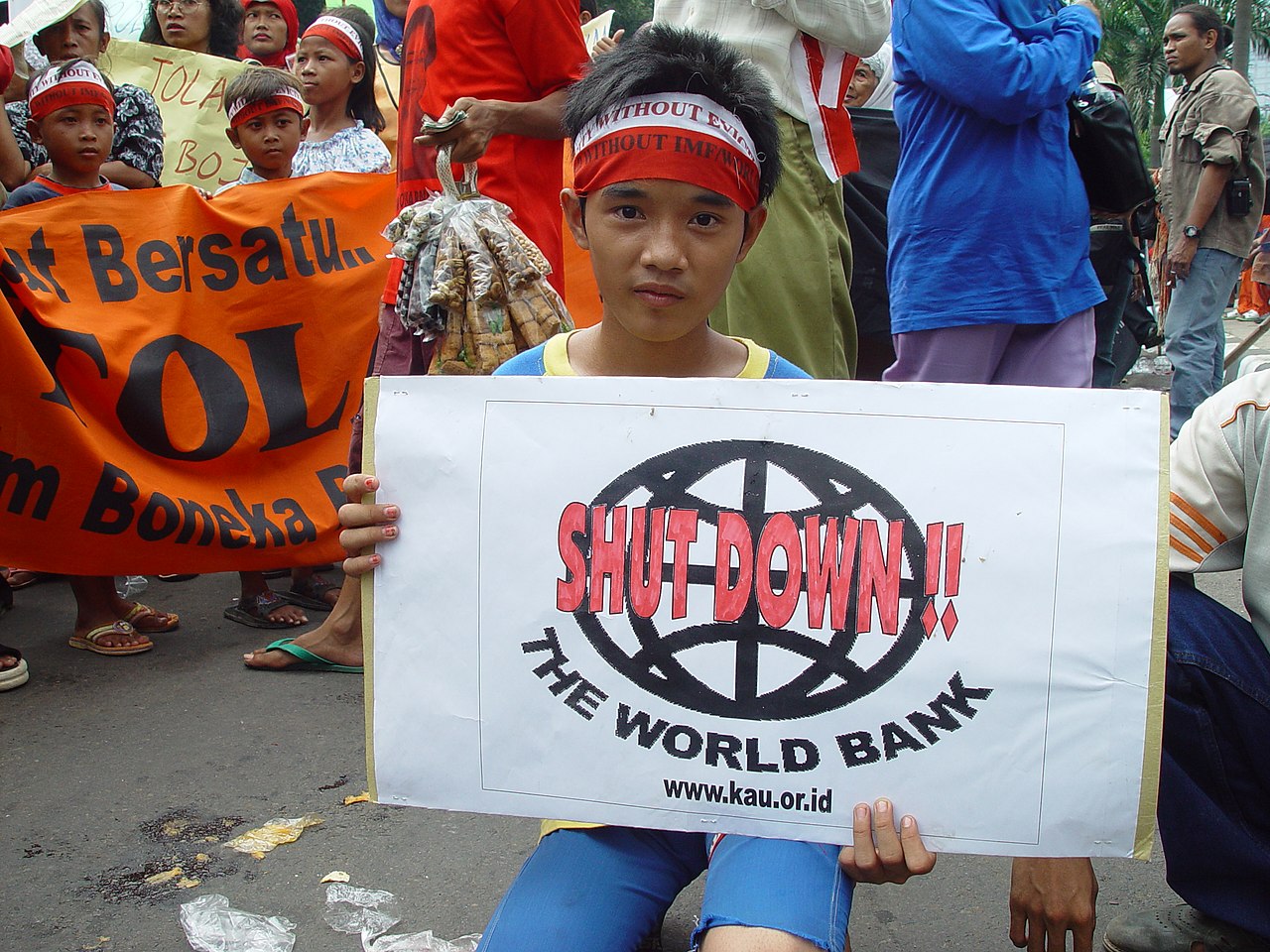
The World Bank is often mentioned alongside the International Monetary Fund (IMF) but the two have different mandates: the Bank focuses on long-term development finance and investment, while the IMF concentrates on macroeconomic stability and short-term balance-of-payments support. Over the decades the World Bank has faced debates about conditionality, project impacts, debt sustainability and the balance between public and private roles in development; these discussions have driven institutional reforms and adjustments to its financing approaches.
For readers seeking more detailed institutional descriptions and the latest programs, consult the World Bank Group resources: World Bank Group.
Questions and answers
Q: What is the World Bank?
A: The World Bank is an international bank that provides financial assistance and other support for developing countries' infrastructure.
Q: What is the World Bank's primary goal?
A: The World Bank's primary goal is to reduce poverty.
Q: What institutions make up the World Bank?
A: The World Bank is made up of two institutions: the International Bank for Reconstruction and Development (IBRD) and the International Development Association (IDA).
Q: How many institutions are in the World Bank Group?
A: There are five institutions in the World Bank Group: two of them are the IBRD and IDA, while the other three are the International Finance Corporation (IFC), Multilateral Investment Guarantee Agency (MIGA), and International Centre for Settlement of Investment Disputes (ICSID).
Q: What kind of help does the World Bank provide to developing nations?
A: The World Bank provides financial assistance and other support for developing countries' infrastructure.
Q: What is the role of the International Finance Corporation (IFC) in the World Bank Group?
A: The International Finance Corporation (IFC) is part of the World Bank Group and focuses on providing financing to private sector businesses in developing countries.
Q: What is the Multilateral Investment Guarantee Agency (MIGA) in the World Bank Group?
A: The Multilateral Investment Guarantee Agency (MIGA) is part of the World Bank Group and provides guarantees to investors in developing countries against damages related to political risks, such as war or expropriation.
Related articles
Author
AlegsaOnline.com World Bank: mission, structure, history and operations Leandro Alegsa
URL: https://en.alegsaonline.com/art/109073
Sources
- worldbank.org : "Boards of Directors"
- web.worldbank.org : "About Us"
- worldbank.org : World Bank
- go.worldbank.org : "About The World Bank (FAQs)"
- nytimes.com : "Britain Overtakes U.S. as Top World Bank Donor"
- web.worldbank.org : "Organization"
- rthk.org.hk : China given more influence in World Bank · archive.is
- bnet.com : BNET Business Network
- findarticles.com : findarticles.com
- fletcher.tufts.edu : fletcher.tufts.edu
- news.bbc.co.uk : "New South American bank planned"
- doi.org : 10.1080/09692290110126092
- nytimes.com : "World Briefing - Europe: Norway: Protests as World Bank Meets"