
Woodward's wallaroo (Macropus bernardus)
Overview of Woodward's wallaroo, a small rock-dwelling macropod of Arnhem Land, covering appearance, behaviour, habitat, and conservation concerns.
Overview
Woodward's wallaroo (Macropus bernardus), also known as the black wallaroo or Bernard's wallaroo, is one of the smaller species in the group commonly called wallaroos. It is a macropod — a family that includes kangaroos and wallabies — adapted to steep, rocky country and is notable for its relatively restricted range and secretive habits.
Image gallery
3 Images

Appearance and sexual dimorphism
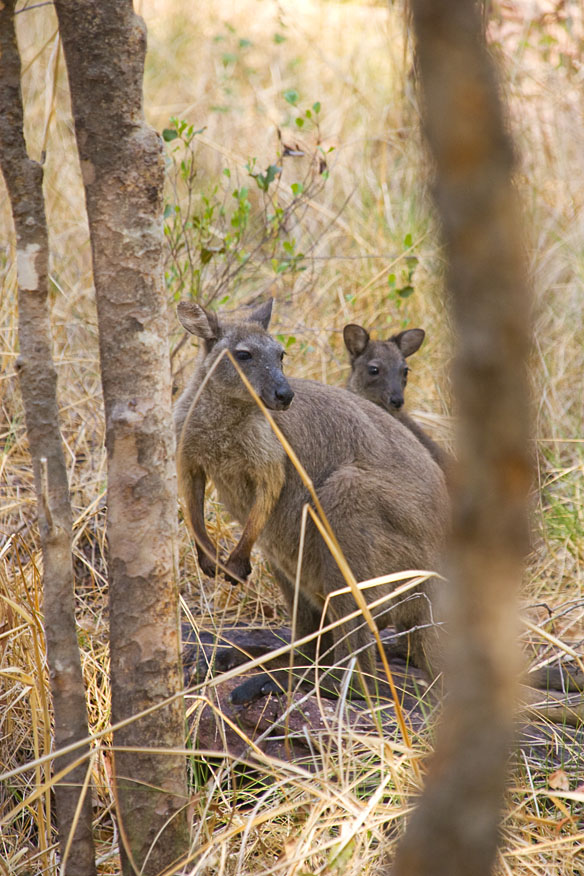
Adult males are markedly darker, typically black or very dark brown, while females tend to be lighter grey-brown. The species is compact and muscular, with strong hind limbs for bounding and short forelimbs for feeding. Like other macropods it has a long tail used for balance, large hind feet, and a head shaped for grazing on tough vegetation.
Distribution and habitat
Woodward's wallaroo is endemic to a small mountainous area of Arnhem Land in Australia's Northern Territory, specifically between the South Alligator River and Nabarlek. Within this range it favors escarpments, rocky outcrops and cliffs where ledges and crevices provide shelter, refuge from predators and cooler microclimates.
Behaviour and diet
This species is mainly crepuscular and nocturnal, feeding in the cooler hours and taking refuge by day; it is described as a shy, nocturnal grazer. Its diet consists predominantly of grasses and other low vegetation available on the plateaus and nearby plains, and individuals usually occur singly or in very small groups rather than in large mobs.
Conservation and threats
Because it occupies a limited area and specific habitat types, Woodward's wallaroo has a vulnerable position; it has been assessed as Near Threatened by conservation authorities. Primary concerns include habitat disturbance, changing fire regimes, introduced predators and limited range that makes populations sensitive to environmental change. Ongoing monitoring and protection of its rocky habitat are important for its persistence.
Notable facts
- The common name "wallaroo" is derived from an Aboriginal term often rendered as "rock kangaroo", reflecting the species' affinity for rocky terrain.
- Its disjunct and localized distribution makes it of particular interest to researchers studying adaptation to rugged landscapes.
- Key localities and traditional land management practices in Arnhem Land influence habitat condition and conservation outcomes for the species; see regional resources for more detail (Arnhem Land information).
For further general information on macropod biology and conservation, consult authoritative sources on Australian mammals and regional management plans for the Northern Territory.
Questions and answers
Q: What is Woodward's wallaroo?
A: Woodward's wallaroo is the smallest of the wallaroos, a shy nocturnal grazer which lives in a small, mountainous area in Arnhem Land, Northern Territory.
Q: What are the colors of male and female Woodward's wallaroo?
A: Male Woodward's wallaroo is black or dark brown in color while female Woodward's wallaroo is grey.
Q: Where does Woodward's wallaroo use to live?
A: Woodward's wallaroo uses rocky cliffs to shelter and hide from danger.
Q: Where can we find Woodward's wallaroo?
A: Woodward's wallaroo can only be found in a small, mountainous area in Arnhem Land, Northern Territory, between South Alligator River and Nabarlek.
Q: Is Woodward's wallaroo living in big groups?
A: No, Woodward's wallaroo does not live in big groups.
Q: What does wallaroo mean?
A: Wallaroo means a "rock kangaroo."
Q: Why is Woodward's wallaroo classified as near threatened?
A: Woodward's wallaroo is classified as near threatened because it is only found in a small area.
Related articles
Author
AlegsaOnline.com Woodward's wallaroo (Macropus bernardus) Leandro Alegsa
URL: https://en.alegsaonline.com/art/108993
Sources
- bucknell.edu : Mammal Species of the World
- iucnredlist.org : Macropus bernardus
- animaldiversity.ummz.umich.edu : Animal Diversity Web.