
Woodpecker (Picidae): characteristics, behavior, taxonomy and conservation
Woodpeckers (family Picidae) are specialized near-passerine birds that forage and excavate in wood. This article summarizes their anatomy, behaviour, distribution, classification and conservation concerns.
Overview
Woodpeckers belong to the family Picidae, a group of near-passerine birds adapted to life on trunks and branches. They occur across much of the world, occupy a range of wooded habitats and are best known for pecking and drumming on wood to locate food, excavate nest cavities and communicate. While many species prefer mature forests, some have adapted to parks, orchards and suburban areas.
Image gallery
10 Images




Distinctive anatomy and adaptations
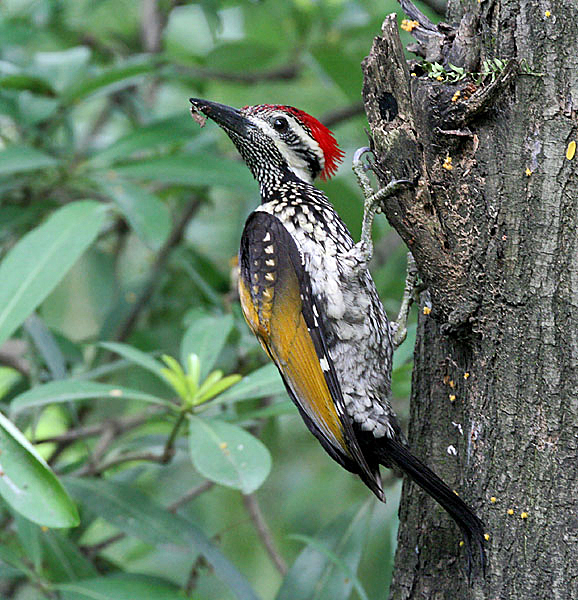
Members of Picidae show a suite of physical specializations for hammering into wood. Their bills are chisel-like and strong, the skull and neck musculature are arranged to reduce impact forces, and their brains are cushioned to limit injury. Many species have long, extensible tongues tipped with barbs or sticky saliva for extracting insect larvae from tunnels. The tail is often stiffened and used as a prop while climbing, and feet are zygodactyl (two toes forward, two backward) which improves grip on vertical surfaces.
Feeding and foraging
Most woodpeckers feed on wood-boring insects, beetle larvae and ants found beneath bark, but diets vary: some take sap, fruit, seeds or even small vertebrates. Foraging techniques include probing, gleaning and chiselling; a subset of species follows insect outbreaks or snags where bark is loose. Several species are known as sapsuckers because they make small wells to access tree sap and the insects attracted to it.
Behavior: drumming, territory and nesting
Drumming — a rapid series of strikes on a resonant surface — serves as a non-vocal signal for territory and mate attraction, distinct from feeding pecks. Most woodpeckers excavate cavity nests in dead or decaying wood; these cavities are reused by other birds and mammals after abandonment and are an important ecological resource. Breeding strategies range from single broods to multiple attempts per season, and parental care is typically shared.
Taxonomy and evolutionary relationships
The family Picidae is part of the order Piciformes, an assemblage of wood-associated bird families. Molecular studies support Picidae as a distinct clade within Piciformes. The family includes woodpeckers proper, piculets, wrynecks and sapsuckers; taxonomic treatments recognize roughly 240 species in some 30–40 genera. Many details of relationships among genera have been clarified by DNA sequencing, but research continues into finer scale divergences and biogeographic history.
Distribution and habitats
Woodpeckers are widespread but absent from some regions of the ancient supercontinent Gondwana. They are not native to Australia, New Zealand or Madagascar, and of course they are absent from Antarctica. Across their range most species inhabit woodland, forest edges and riparian zones, although some occupy savanna, montane forest and urban parks. Range sizes and habitat specificity differ greatly between tropical and temperate species.
Ecological role and interactions
Woodpeckers play key roles as predators of bark and wood-boring arthropods and as engineers that create cavities used by birds, mammals and invertebrates. Their presence can indicate the availability of deadwood and structural complexity important for biodiversity. Humans often admire woodpeckers for their plumage and audible drumming, but conflicts occur when they damage wooden buildings, utility poles or fruit trees.
Conservation
Although many species are widespread and adaptable, others are threatened by loss of mature trees, removal of deadwood and fragmentation of forest habitat. Conservation efforts focus on protecting standing dead trees and veteran trees, maintaining mixed-age forest stands and preserving contiguous habitat to reduce the impacts of habitat fragmentation. Monitoring, nest box programs and targeted protection of rare species' breeding sites are among the practical measures used by conservationists.
Human research and cultural significance
Woodpeckers have been the subject of research into biomechanics, sensory adaptations and the ecology of cavity-nesters. They feature in folklore and art in many cultures, and several species are popular with birdwatchers. Responsible human practices that benefit woodpeckers include retaining snags where safe, using bird-friendly forestry techniques and supporting protections for old-growth stands.
- Family: Picidae
- Order: Piciformes / Piciformes
- Global species estimate: about 240 species
- Typical habitats: woodland, forests, parks and orchards
- Absent regions: parts of ancient Gondwana including Australia, New Zealand and Madagascar (and Antarctica)
- Primary threat: habitat fragmentation and loss of deadwood
For general ornithological context see standard references on birds and treatments of near-passerine groups; further taxonomic summaries and conservation listings may be consulted through specialist portals and organisations that document bird diversity and threats.
Questions and answers
Q: What are woodpeckers and its near relatives called?
A: They are called the family Picidae, which includes piculets, wrynecks, and sapsuckers.
Q: What type of birds are members of the Picidae family?
A: They are near-passerine birds.
Q: Where can members of the Picidae family be found?
A: Members of the Picidae family are found worldwide, except for Australia, New Zealand, Madagascar, and Antarctica.
Q: In what type of habitats do most members of the Picidae family live?
A: Most species live in forests or woodland habitats.
Q: How many families are in the order Piciformes?
A: There are eight living families in the order Piciformes.
Q: What has DNA sequence analyses shown about the Picidae family?
A: DNA sequence analyses have shown that they are a clade.
Q: What are some of the threats to the Picidae family?
A: Many species are threatened or endangered due to loss of habitat or habitat fragmentation.
Related articles
Author
AlegsaOnline.com Woodpecker (Picidae): characteristics, behavior, taxonomy and conservation Leandro Alegsa
URL: https://en.alegsaonline.com/art/108963
Sources
- dx.doi.org : 10.1034/j.1600-048X.2003.03103.x
- nrm.se : PDF fulltext
- doi.org : 10.1642/0004-8038(2004)121[0509:HDWEGW]2.0.CO;2
- dx.doi.org : 10.1111/j.1469-7998.2006.00166.x
- bbc.co.uk : bbc.co.uk/news/science-environment-15458633
- dx.doi.org : 10.1136/bjo.86.8.843
- wikidata.org : Q25439
- species.wikimedia.org : Picidae
- eol.org : 1595
- gd.eppo.int : 1PICIF
- eu-nomen.eu : 10840
- fauna-eu.org : 1f2b2bf1-d885-4769-8d3b-f80159e5ac34
- fossilworks.org : 39438
- gbif.org : 9333
- inaturalist.org : 17599