
Wombat
Short, stocky marsupials native to Australia known for burrowing, backward-facing pouches and distinctive cube-shaped feces; three living species occur in two genera with varied conservation statuses.
The wombat is a compact, burrowing marsupial native to Australia and nearby islands. Belonging to the family Vombatidae, wombats are herbivorous, mainly nocturnal mammals adapted to digging and a subterranean lifestyle. They are recognizable by a low, sturdy body, short legs, strong claws and a thick coat of fur. Wombats occupy a range of habitats from temperate eucalypt forests to grasslands and arid scrub, and their behaviours and anatomy reflect their adaptation to life as fossorial (burrow-digging) herbivores.
Image gallery
10 Images
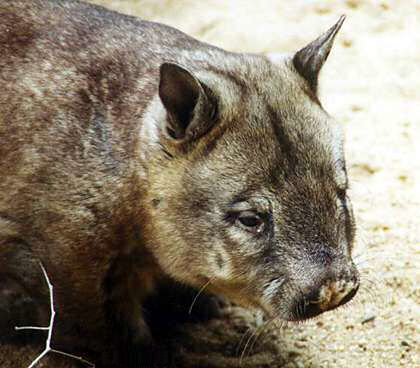


Description and adaptations
Adult wombats are medium-sized, roughly a metre in length for many individuals, with bodies built for power rather than speed. They possess continuously growing incisors similar to rodents, which help with cutting tough vegetation. One unusual marsupial trait is the direction of the pouch: a wombat's pouch opens toward the rear. This backward-facing pouch prevents soil from entering and covering young while the mother digs. Wombats also have a toughened rump — a hardened rump hide and cartilage — that can be used defensively to block and protect the entrance to a burrow.
Behavior, diet and digestion
Wombats are primarily nocturnal or crepuscular, emerging in cooler hours to feed on grasses, roots and other low vegetation. Their digestion is adapted to extract nutrients from fibrous plant matter: a slow passage of food through an enlarged hindgut allows fermentation and water reabsorption. A distinctive and well-known consequence of their digestive system is that wombats produce dry, cube-shaped feces. The biconvex cross-section of their droppings results from firm, rhythmic contractions and the varying elasticity of the intestinal wall; this unusual form helps them mark territory and communicate via scent without the feces rolling away.
Species, range and conservation
There are three living species in two genera. The common wombat and the hairy-nosed wombats differ in appearance, habitat preferences and range. Some species inhabit Tasmania and southeastern Australian forests, while others are found in drier regions of the mainland. Conservation status varies: one species, the northern hairy-nosed wombat, is among the most threatened mammals in Australia and is the focus of recovery programs, whereas the common wombat persists in a wider range and in greater numbers. Threats to wombats include habitat loss, competition with introduced herbivores, disease and road mortality.
Human interactions and notable facts
Wombats are culturally significant in Australia and draw interest from scientists because of their unique biology and specialized burrowing behaviour. They are sometimes seen in wildlife parks and are the subject of conservation and research efforts, including habitat protection, monitoring and captive breeding where needed. Among their notable traits are the rear-facing pouch and the cube-shaped scat, both of which are frequently cited in popular descriptions of the species. Wombats can also alter landscapes substantially through their extensive burrow systems, which provide shelter for other species and influence soil dynamics.
Further information
- Marsupial overview
- Vombatidae family details
- Eucalypt forest habitats
- Wombat genera and species list
- Common wombat (general)
- Size and measurements
- Burrowing behaviour
- Digging and burrow structure
- Herbivorous diet
- Plant species eaten
- Roots and foraging
- Grasses and grazing habits
- Nocturnal activity patterns
- Fur types and colouration
- Ear morphology
- Mammalian characteristics
- Feces and scent marking
- Cube-shaped droppings explained
- Wombat habitat locations
For conservation updates, local management actions and species-specific information consult reputable wildlife authorities and conservation bodies. Scientific studies continue to refine understanding of wombat ecology, health issues and the most effective strategies for preserving these distinctive Australian mammals.
Questions and answers
Q: What is a wombat?
A: A wombat is a marsupial in the family Vombatidae that lives in the Australian eucalypt forests. There are two genera with three living species; the common wombat and the hairy-nosed wombats.
Q: How big are wombats when fully grown?
A: Wombats are usually around a metre (40 in) long when they are fully grown.
Q: What makes wombats unique among other marsupials?
A: Wombats have a pouch on their belly that holds its young, but it faces back instead of forward like most marsupials. This prevents dirt from building up in the pouch and hitting the offspring in the face when digging.
Q: What do wombats eat?
A: Wombats are herbivores so they eat plants, roots, and grasses.
Q: Are wombats active during day or night?
A: Wombats are nocturnal which means they sleep in the day and come out at night.
Q: How much can wombats weigh?
A: Some wombats have thick brown fur and very small ears and can weigh from 20 to 35 kilograms (45 to 80 lb).
Q: How long can wombats live for?
A: Wombats can live up to 7 years.
Related articles
Author
AlegsaOnline.com Wombat Leandro Alegsa
URL: https://en.alegsaonline.com/art/108864
Sources
- departments.bucknell.edu : "Order Diprotodontia"
- google.com : Mammal Species of the World: A Taxonomic and Geographic Reference
- worldcat.org : 62265494