
Wolf's Lair (Wolfsschanze) — Nazi Germany's Eastern Front headquarters
Wolf's Lair was Adolf Hitler's principal Eastern Front command complex during World War II, built in 1941 for Operation Barbarossa and later the scene of the 20 July 1944 assassination attempt.
Overview
Wolf's Lair (German: Wolfsschanze; Polish: Wilczy Szaniec) was one of Adolf Hitler's foremost military headquarters on the Eastern Front during World War II. Constructed in 1941 by Organisation Todt to support Operation Barbarossa, it functioned as a secure command center from which senior Nazi leadership directed large portions of the campaign following the invasion of the Soviet Union. The site sits in dense forest formerly in East Prussia, near the town known then as Rastenburg (now Kętrzyn in present-day Poland).
Image gallery
8 Images




Design and components
The complex was heavily camouflaged and arranged with multiple defensive rings and guarded approaches. It combined hardened concrete bunkers for protected living and working spaces, wooden and temporary structures for staff, and essential infrastructure: a map room, communications facilities, fuel and supply depots, an airstrip and rail spur, power and water installations, and extensive barracks for troops and security personnel. Security was provided by SS and Wehrmacht detachments and by physical barriers that segmented the site into controlled zones.
History and notable events
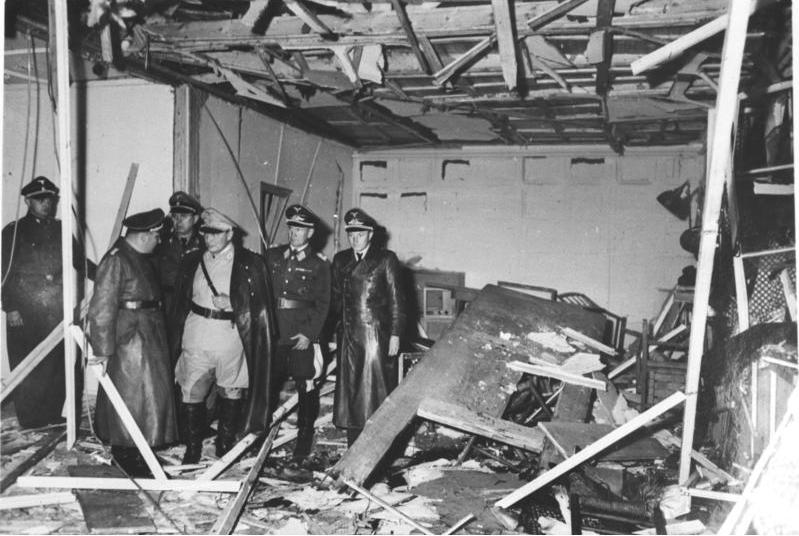
Built as a forward headquarters to coordinate operations on the Soviet front, Wolf's Lair became famous as the location of the 20 July 1944 assassination attempt, when Colonel Claus von Stauffenberg placed a bomb in a briefing room. The explosion injured and killed several officers but Hitler survived, after which the regime instituted even tighter security. The headquarters was used intermittently until the German retreat in 1944–1945; retreating forces attempted to demolish parts of the complex before abandoning it.
Legacy and present status
Today the site is a ruin located in what is now Poland and is preserved as a historical site and museum open to visitors. Interpretive displays and remaining bunker structures convey the scale and function of the headquarters and the wartime events associated with it. The name itself echoes Hitler's adopted nickname "Wolf," a sobriquet he used in several contexts and from which several of his headquarters took their names.
Significance and distinctions
- Wolf's Lair was the first major Führer headquarters established on the Eastern Front and one of several Führerhauptquartiere across Eastern Europe.
- Its construction and operation illustrate German efforts to create protected, logistically self-contained forward command centers during large-scale mobile warfare.
- The failed 20 July assassination attempt at Wolf's Lair became a pivotal event in German resistance to Nazi rule and is widely studied in histories of the period.
For further background on the principal figures and campaigns associated with the site see entries on Adolf Hitler and the broader Eastern Front. Additional resources and guided material at the museum provide on-site context for visitors and researchers.
Questions and answers
Q: What was Wolf's Lair?
A: Wolf's Lair was Adolf Hitler's first Eastern Front military headquarters in World War II.
Q: Who built Wolf's Lair?
A: Wolf's Lair was built by Organisation Todt for the start of Operation Barbarossa.
Q: When was Wolf's Lair built?
A: Wolf's Lair was built in 1941 for the start of Operation Barbarossa.
Q: What was Operation Barbarossa?
A: Operation Barbarossa was the invasion of the Soviet Union during World War II.
Q: What happened at Wolf's Lair in 1944?
A: The site of Wolf's Lair was the location of the 20 July Plot in 1944.
Q: What is the significance of Wolf's Lair?
A: Wolf's Lair was one of several Führer Headquarters in parts of Eastern Europe, and it played a role in the invasion of the Soviet Union and the 20 July Plot.
Q: What is the Polish name for Wolf's Lair?
A: The Polish name for Wolf's Lair is Wilczy Szaniec.
Author
AlegsaOnline.com Wolf's Lair (Wolfsschanze) — Nazi Germany's Eastern Front headquarters Leandro Alegsa
URL: https://en.alegsaonline.com/art/108832