
Wind power in the United States
An overview of wind power in the United States: development, scale, technology, policy drivers, economic impacts, challenges, and future prospects.
Overview
Wind power in the United States is a major and growing component of the country's electricity system. From modest beginnings in the late 20th century, installed wind capacity expanded rapidly into the 21st century, driven by falling turbine costs, state-level renewable targets, and federal incentives. By the early 2010s the U.S. ranked among the world leaders in cumulative wind capacity, with a substantial contribution to the national electricity mix and continued annual additions.
Image gallery
10 Images


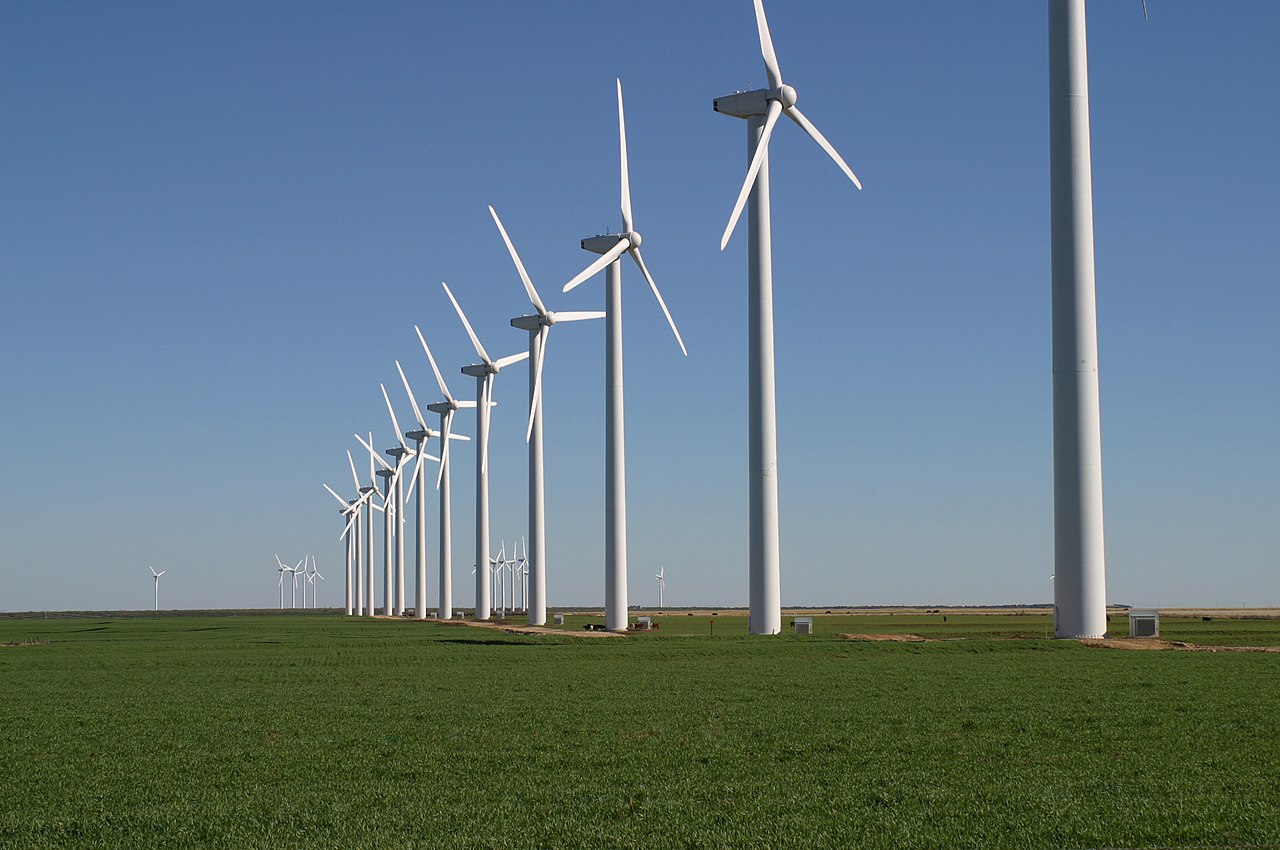


Scale and geography
Large-scale wind farms are distributed across many states. A majority of states now host utility-scale wind projects, with several states installing multiple gigawatts of capacity. Wind resources are strongest on the Great Plains, in parts of the Midwest, and along some coastal and mountain corridors. Texas is notable for having the largest installed capacity among states. Individual projects such as the Roscoe Wind Farm, and many other wind farm developments, exemplify how multiple turbines are aggregated to produce utility-scale power.
History and policy drivers
The industry's growth has been shaped by policy instruments and market signals. State renewable portfolio standards and other mandates helped create early demand, while federal tax incentives and production credits supported project financing. These policy supports, combined with technology improvements and economies of scale in manufacturing, reduced the levelized cost of wind energy and spurred deployment.
Technology and integration
Modern wind turbines are complex electromechanical systems with tall towers and large rotors designed to capture wind energy efficiently. Turbine manufacturing and service form an industrial supply chain that includes blades, towers, generators, power electronics, and control systems; notable companies in the sector include large domestic and international manufacturers described broadly as wind turbine manufacturers. Integrating variable wind output into power systems has driven improvements in forecasting, grid management, and complementary resources such as energy storage.
Economic and local impacts
Wind development produces construction jobs, long-term operations employment, and new revenue streams for landowners and local governments. Projects can increase local tax bases and provide lease payments to farmers and ranchers, supporting rural economies. At the national level, the sector contributes to manufacturing activity and trade in components, while the generation of electricity from wind reduces exposure to fuel price volatility.
Benefits and challenges
- Benefits: low operational emissions, low marginal fuel costs, diversification of electricity supply, and local economic benefits.
- Challenges: variability of wind output, need for transmission expansion to connect resource-rich regions to demand centers, siting and environmental concerns, and the need for supportive market and regulatory frameworks.
Statistics and detailed energy mix information are maintained by national energy agencies and data sources; for summaries of generation and capacity figures see national statistics and analyses of the U.S. electricity mix. The sector continues to evolve, with ongoing investments in technology, larger turbines, offshore projects, and system solutions that aim to increase the contribution of wind power to decarbonization goals.
Questions and answers
Q: What is the capacity of wind power in the United States as of 2011?
A: The total installed capacity of wind power in the United States as of 2011 was 42,432 megawatts (MW).
Q: Which country had more installed capacity of wind power than the United States as of 2011?
A: China had more installed capacity of wind power than the United States as of 2011.
Q: What percentage of electricity generated in the United States in 2010 was accounted for by wind power?
A: In 2010, wind power accounted for 2.3% of the electricity generated in the United States.
Q: How many states have installed over 1,000 MW of wind capacity?
A: Fourteen states have installed over 1,000 MW of wind capacity.
Q: Which U.S. state has the most installed wind power capacity?
A: Texas has the most installed wind power capacity of any U.S. state with 10,135 MW of capacity.
Q: What is the largest wind farm in the U.S. as of 2011?
A: The Roscoe Wind Farm (781 MW) in Texas is the largest wind farm in the US as of 2011.
Q: Which company is the largest domestic wind turbine manufacturer in the U.S.?
A: GE Energy is the largest domestic wind turbine manufacturer in the U.S.
Related articles
Author
AlegsaOnline.com Wind power in the United States Leandro Alegsa
URL: https://en.alegsaonline.com/art/108479
Sources
- awea.org : awea.org
- sciencedaily.com : "Wind turbines: In the wake of the wind"
- momtastic.com : "9 of the World's Most Amazing Wind Farms"
- awea.org : Annual Wind Industry Report, Year Ending 2008