
William Brewster: Pilgrim Elder, Mayflower Passenger and Leader
William Brewster (c.1566–1644) was a leader of the English Separatists, a Mayflower passenger, an elder of Plymouth Colony and a Leiden printer who helped found the Plymouth church.
William Brewster (c.1566–1644) was a central figure among the English Separatists who crossed the Atlantic aboard the Mayflower in 1620. Remembered as a religious elder, adviser and community leader, Brewster helped shape the early governance and spiritual life of Plymouth Colony and was one of the signers of the Mayflower Compact. His life spanned roles as a local official in England, a refugee and printer in the Netherlands, and a respected elder in New England.
Image gallery
10 Images




Early life and background
Born around 1566 in Scrooby, Nottinghamshire, Brewster came from a family long established in that region. He studied at Peterhouse, Cambridge, an environment where religious debates about reform of the Church of England were lively. Those who sought separation from the established church became known as Separatists. Brewster returned to Scrooby and served in local civic posts, including a period as postmaster, while leading a small Separatist congregation that met privately in his household. Persecution for nonconformity—arrests, fines and social pressure—pushed many members of this group to seek refuge elsewhere.
Leiden, printing and controversy
In 1608 Brewster and fellow congregants moved from England to Leiden in the Netherlands to practice their faith with greater freedom. In Leiden he taught English and, later, operated a printing press that produced religious works. The printing activity brought him into conflict with authorities after a controversial pamphlet critical of King James I and the Church of England was printed in 1619. The press was seized and associates were arrested; Brewster went into hiding for a time. These pressures, together with economic and cultural concerns, helped convince the congregation to relocate to North America.
Voyage on the Mayflower and Plymouth role
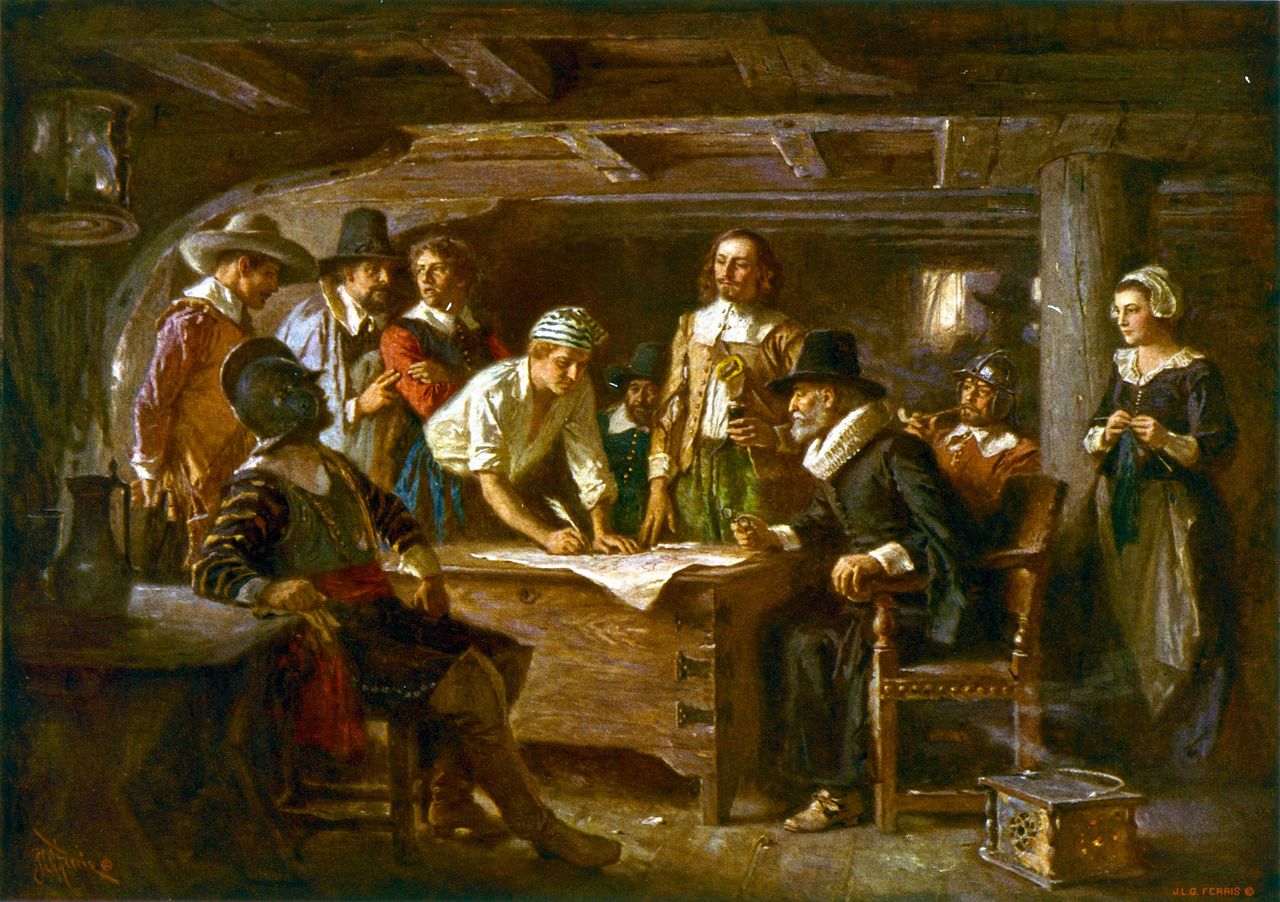
Brewster sailed on the Mayflower in 1620 with his wife and two sons. He is recorded as one of the signers of the Mayflower Compact, a pioneering document for self-governance among the settlers. In Plymouth Colony Brewster served as a spiritual leader and adviser rather than as an ordained minister; he functioned as elder of the Separatist congregation. Over the following decades he offered counsel on religious matters, mediated disputes, assisted with education and helped preserve the congregational identity of the settlement.
Family, later life and death
Brewster's household included his wife Mary and children, among them sons named Love and Wrestling, who accompanied him on the Mayflower. He remained a prominent figure in Plymouth until his death on April 10, 1644. Tradition places his burial at what became known as Burial Hill in Plymouth. Brewster left behind manuscripts and records that informed later histories of the colony and of the English Separatist movement.
Significance and legacy
William Brewster is often remembered for his combination of leadership, pastoral care and practical skills. As a printer he contributed to the circulation of Separatist thought; as an elder and counselor he helped sustain a small, cohesive community through the first difficult decades in New England. His role as a Mayflower Compact signer also links him to a foundational moment in early American self-government. Historians emphasize Brewster's steady presence and his influence on the religious identity of Plymouth rather than on overt political ambition.
Further reading and resources
- Overview of William Brewster
- Mayflower passenger lists and accounts
- Separatist movement and beliefs
- Context: religious refugees in Europe
- Plymouth Colony history and records
- Text and analysis of the Mayflower Compact
- Scrooby and Nottinghamshire background
- England in the late Tudor and Stuart era
- Peterhouse, Cambridge: institutional history
- Universities and religious reform in England
- Church of England: origins and controversies
- Dutch refuge: English communities in the Netherlands
- Early postal services and local administration
- Household congregations and private worship
- Leadership structures in Separatist churches
- Congregational life and organization
- Leiden: city history and English refugees
- English teaching and cultural exchange in Leiden
- Early modern printing and clandestine presses
- Printed controversies and state response
- Royal authority and religious dissent in England
- Diplomatic interventions and press seizures
- Decisions to emigrate to North America
- John Carver, Robert Cushman and other leaders
Note: This article synthesizes widely known historical facts about William Brewster and the early Plymouth community. Some details—such as minor dates or titles—are reported differently in various primary sources and later accounts; historians evaluate these variations when reconstructing events.
Questions and answers
Q: Who was Col. William Brewster III?
A: Col. William Brewster III (1566 – April 10, 1644) was an English official who was a passenger on the Mayflower in 1620. He was a religious leader both in Europe and in Plymouth Colony, and one of the signers of the Mayflower Compact.
Q: What did Brewster study at Peterhouse, Cambridge?
A: At Peterhouse, Cambridge, Brewster studied with people who wanted to change the Church of England. These people were called Separatists.
Q: What did Brewster do when he returned home to Scrooby?
A: When he returned home to Scrooby, Brewster became a postmaster and started a Separatist church in his house.
Q: Why did they leave England for Netherlands?
A: They left England for Netherlands because they hoped that would be able to practice their religion there without persecution or punishment from the Church of England or King James I.
Q: What did Brewster do while living in Leiden?
A: While living in Leiden, Brewster taught English and worked as a printer making religious books for sale in England. In 1619 he also published a religious booklet which disagreed with King James I and the Church of England.
Q: How did Brewster escape arrest by King James I? A: With help from Robert Cushman, Brewster escaped arrest by King James I and was able to get aboard the Mayflower with their friends before being arrested again.
Q: Who accompanied him on board the Mayflower? A:Brewster's wife and two sons - Love and Wrestling - accompanied him on board the Mayflower when they left Leiden for America
Related articles
Author
AlegsaOnline.com William Brewster: Pilgrim Elder, Mayflower Passenger and Leader Leandro Alegsa
URL: https://en.alegsaonline.com/art/108198
Sources
- plimoth.org : "A genealogical profile of William Brewster"
- findagrave.com : William Brewster