
William Blackstone (1723–1780) — English jurist, legal educator and author
Sir William Blackstone was an 18th-century English jurist and judge whose Commentaries on the Laws of England systematized common law and shaped legal education in Britain and North America.
Overview
Sir William Blackstone (10 July 1723 – 14 February 1780) was an English jurist, a judge and a Tory politician. He is best known for the four-volume Commentaries on the Laws of England, a clear and organised exposition of English common law that became a standard reference for lawyers, students and legislators in Britain and the American colonies.
Image gallery
8 Images

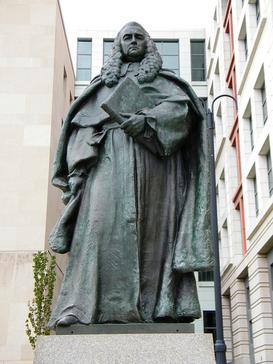



Education and early career
Blackstone came from a respectable middle-class London background and received his early schooling at Charterhouse. He entered Pembroke College, Oxford in 1738 and later proceeded to a degree in civil law. Shortly after completing his studies he was elected a fellow, taking a long association with All Souls College and its governance at Oxford. He also joined the legal profession through the Inns of Court, being admitted to the Middle Temple and called to the bar in the mid-1740s.
Academic posts, lectures and publications
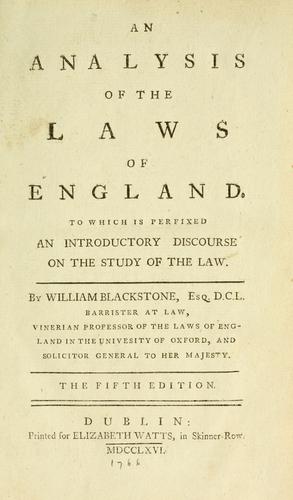
Blackstone combined academia with legal practice. While holding college offices — which included roles sometimes described as treasurer and bursar in college administration — he began delivering public lectures on English law in 1753. These lectures were the first systematic university course in English common law and proved highly popular. He translated his teaching into print: an early outline, An Analysis of the Laws of England, appeared before his larger works. The success of those lectures led to his appointment as the first Vinerian Professor of English Law.
Commentaries and public life
Between the mid and late 1760s Blackstone published the four volumes of the Commentaries on the Laws of England, each covering different branches of the law: principles, private rights, public rights and remedies. The Commentaries presented complex doctrines in a readable order and aimed to make the law accessible to students, practitioners and legislators. The reputation and income generated by these works also helped Blackstone to resume active practice at the bar and to enter Parliament, where he sat for the small borough of Hindon. He later accepted a judicial appointment, taking his place on the bench as a judge.
Major works and themes
- Commentaries on the Laws of England — four volumes, intended as a systematic manual of English common law.
- An Analysis of the Laws of England — an earlier summary that introduced his organization of topics and teaching approach.
- A Discourse on the Study of the Law and other essays — reflections on legal education and the role of lawyers.
Legacy and historical significance
Blackstone's greatest contribution was pedagogical as much as doctrinal: he helped to establish legal study within the university curriculum and produced a compact, logical presentation of English law. His Commentaries exerted wide influence beyond Britain, especially in North America, where they were extensively read by jurists and statesmen during and after the founding period. Scholars since have praised the clarity and organization of his work while also critiquing aspects of his conservative legal philosophy and the limitations inherent in summarising complex precedent.
Notable facts
- He was one of the first to deliver systematic lectures on English law at a university level; those lectures were a foundation for later legal education reforms. Lectures and teaching were central to his career.
- He combined scholarly publication with practice: after an initial slow start at the bar, his academic reputation increased his professional opportunities and led to parliamentary service and a judicial appointment. See records of his membership at Middle Temple and his later judicial role on the bench.
- Blackstone's political affiliation and parliamentary seat reflect the intertwining of legal, academic and political life in the 18th century: he was aligned with the Tory interest and represented a small borough in Parliament. Details of his political career and college offices sometimes appear in contemporary accounts of college management and public service administration.
For readers seeking a concise summary of Blackstone's life and work, biographical sketches and scholarly discussions can be found through standard legal history resources and university law faculties. Further reading on his role in shaping common law doctrine and legal education is available via academic introductions and collections of his writings; see authoritative library catalogues and legal histories for editions and commentary on his jurisprudence.
Additional information and archival material about his life, publications and influence are available through specialized biographies and institutional records at Oxford and in the legal archives of the Inns of Court. Contemporary editions and annotated versions of his principal works continue to be studied for their historical importance and practical insight into the development of Anglo-American law. Biographical resources and scholarly articles provide entry points for deeper study.
Questions and answers
Q: Who was Sir William Blackstone?
A: Sir William Blackstone was an English jurist, judge and Tory party politician of the eighteenth century. He is most noted for writing the Commentaries on the Laws of England.
Q: Where did he grow up?
A: Sir William Blackstone grew up in a middle-class family in London.
Q: What education did he receive?
A: He was educated at Charterhouse School before matriculating at Pembroke College, Oxford in 1738 and then went on to complete a Bachelor of Civil Law degree.
Q: What positions did he hold at All Souls College, Oxford?
A: After completing his degree, he was made a Fellow of All Souls College, Oxford in November 1743 and held the positions of accountant, treasurer and bursar on 28 November 1746 as well as Senior Bursar in 1750.
Q: How successful were his lectures on law?
A: His lectures on law were massively successful and earned him a total of £453 (£71,000) per year which led to the publication of An Analysis of the Laws of England in 1756.
Q: What is his most important work?
A: His most important work is Commentaries on the Laws of England which was published over four volumes from November 1765 onwards and earned him £14,000 (£1,961,000 in 2022 terms).
Q: What position did he hold until his death?
A: Until his death on 14 February 1780, Blackstone held a position as a judge within the judiciary system.
Related articles
Author
AlegsaOnline.com William Blackstone (1723–1780) — English jurist, legal educator and author Leandro Alegsa
URL: https://en.alegsaonline.com/art/108192