
Whitehall — central London street and seat of UK government
Whitehall is a principal street in Westminster, London, known for government departments, historic buildings and national ceremonies. The name is also a metonym for the British civil service and state administration.
Overview
Whitehall is a principal ceremonial and administrative street that runs north from Parliament Square through Westminster into central London in England. Its northern approach leads toward the area traditionally regarded as Charing Cross and the southern side of Trafalgar Square, near the equestrian statue of Charles I. The thoroughfare and its immediate surroundings are often regarded as the institutional heart of the capital; the combined length of Whitehall and the adjoining Parliament Street is roughly one kilometre.
Image gallery
10 Images




Historic development
The street developed beside the medieval and early modern royal residence known as the Palace of Whitehall, which served as the principal London palace for English monarchs until most of it was destroyed by fire in the late 17th century. The Banqueting House is the principal surviving building of that royal complex and retains important architectural and artistic features from its time. During the 18th and 19th centuries the remaining royal and aristocratic plots were progressively replaced by offices and institutions associated with state administration, giving Whitehall its modern character.
Character and principal buildings
Whitehall is widely recognised for its dense concentration of government departments, defence offices and national monuments. It is common to use the name "Whitehall" as a metonym for the UK government and the civil service. Key landmarks along or adjacent to the street include the Banqueting House, the Cenotaph war memorial, Horse Guards Parade and a succession of ministry buildings. Many structures along Whitehall display a mix of 19th- and 20th-century institutional architecture interspersed with the occasional retained historic façade.
Ceremony, public memory and events
Whitehall functions as the principal ceremonial route for state occasions in central London. The Cenotaph stands at the heart of national remembrance ceremonies each November and at other commemorative events. Horse Guards Parade, immediately to the east, hosts military displays such as the annual Trooping the Colour and pageants associated with royal occasions. The street also regularly forms part of processional routes for foreign dignitaries and state funerals.
Politics, protest and media
Because many central departments and ministerial offices are located on or near Whitehall, the street is a frequent site for political demonstrations, media briefings and organised marches. Journalists, campaign groups and lobbyists gather to make public statements or deliver petitions to ministers. Access is generally public, though security measures and periodic road closures are common during high-profile events or when particular buildings require protection.
Access, conservation and visitor information
Whitehall is served by several nearby transport options around central London and is easily reached on foot from neighbouring civic landmarks. Visitors are often drawn to the Banqueting House for its architecture and ceiling painting, to the Cenotaph for its commemorative importance, and to Horse Guards Parade to observe ceremonial activity. Parts of the area are subject to conservation controls intended to preserve historic façades and memorials while accommodating the needs of a working government district.
Surrounding district and common usage
The name "Whitehall" is used in several overlapping senses: to describe the street itself, the immediate governmental district in Westminster, or the central machinery of state. Its proximity to Parliament Square, the entrances to government buildings and the approaches to Trafalgar Square and Charing Cross reinforces its centrality in civic geography. Tourists, students of politics and residents alike recognise Whitehall as both a practical administrative corridor and a symbolic landscape of national memory.
Notable sites (quick reference)
- Banqueting House — surviving part of the Palace of Whitehall noted for its architecture and interior decoration.
- The Cenotaph — principal national war memorial and focus for Remembrance events.
- Horse Guards Parade — parade ground used for ceremonial events and military displays.
- Government offices — ministries, defence offices and the Cabinet Office occupy buildings along the street and its lanes.
Whitehall remains a living administrative and ceremonial avenue: shaped by centuries of royal, civic and political change, it continues to play a central role in the public life of London and the governance of the United Kingdom.


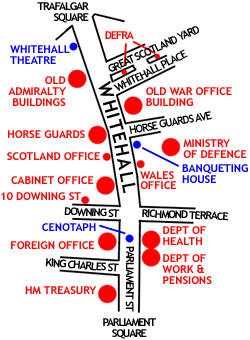
Government Buildings in Whitehall (from north to south).
- Admiralty
- Old War Office
- Horse Guards
- Ministry of Defence
- Wales Office
- Scotland Office
- Cabinet Office
- Foreign Office
- No. 10 Downing Street
- HM Treasury
- Department of Health
Other buildings in Whitehall
Related articles
Author
AlegsaOnline.com Whitehall — central London street and seat of UK government Leandro Alegsa
URL: https://en.alegsaonline.com/art/107870
Sources
- commons.wikimedia.org : Whitehall