
White-headed capuchin (white-faced capuchin)
A medium-sized New World monkey known for a white face and shoulders, high intelligence, varied diet, tool use and an important role in seed dispersal across Central America and nearby South America.
The white-headed capuchin is a medium-sized New World monkey of the family Cebidae, often called the white-faced or white-throated capuchin. Its striking contrast of pale face and chest against darker body fur makes it one of the most recognizable primates in Central American forests. The species occurs primarily in Central America and extends into the extreme northwestern regions of South America, where it occupies a range of forest habitats from lowland rainforests to dry woodlands.
Image gallery
5 Images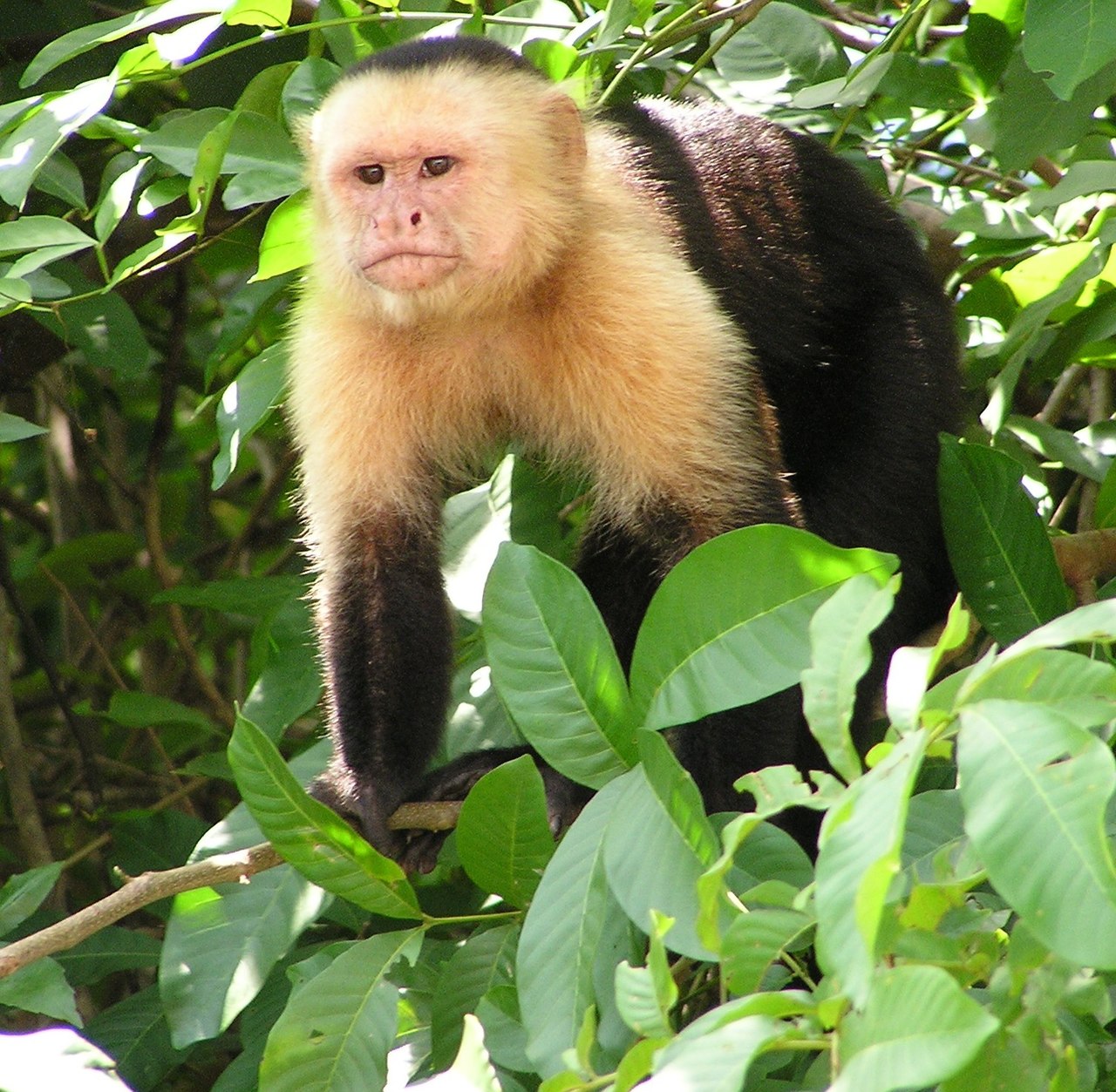


Physical characteristics
Adult white-headed capuchins are medium-sized monkeys with long limbs and a muscular, prehensile tail that they use for balance and occasional support when moving through the canopy. Fur across the back and limbs is generally dark, while the face, throat and shoulders are a conspicuous pale or white color; facial skin is often pink. Typical adult body mass is under 4 kg (around 8–9 lb) for many individuals. Lifespan in captivity can exceed five decades; wild lifespans are usually shorter due to predation, disease and human pressures.
Behavior, diet and ecological role
White-headed capuchins are omnivorous and opportunistic feeders. Their diet includes a wide variety of fruit, seeds, other plant parts, insects and occasionally small vertebrates. This broad diet helps make them effective agents of seed dispersal and pollination in tropical forests, where they move seeds away from parent trees and contribute to plant regeneration. They live in multi-male, multi-female groups often numbering more than a dozen individuals; group size and composition vary with habitat and local resources.
Intelligence, tool use and social behavior
Capuchins are among the most cognitively advanced New World monkeys. They display complex social interactions, problem-solving skills and an ability to learn by observation. Wild populations have been documented using simple tools—stones to crack nuts, sticks to extract prey, and leaves or plant materials in grooming or anointing behaviors. Some capuchins rub certain plants or arthropods on their fur in a behavior interpreted as insect repellent or medicinal anointing. Their intelligence has also led to trained roles assisting people with disabilities and frequent appearances in film and television, which has increased public awareness but also demand for them as pets.
Conservation and human interactions
Although many populations remain relatively widespread and are not immediately endangered, the species faces threats common to tropical primates: habitat loss from agriculture and logging, hunting, and capture for the pet trade. Because taxonomy of capuchins has been revised in recent decades, common names and scientific designations are sometimes used differently by researchers; this can affect how conservation status is reported. Human activities can both harm and help: ecotourism and protected areas offer refuge, while the pet trade and persecution reduce local numbers.
Notable facts and considerations
- They are often observed in studies of primate cognition and social learning.
- Tool-related behaviors set them apart from many other New World monkeys.
- Media exposure has increased their visibility but also driven demand in entertainment and private ownership (popular in media).
- Dietary flexibility—fruit, plants, insects and small vertebrates—helps them persist in fragmented habitats.
Because of their ecological role, behavioral complexity and visibility to people, white-headed capuchins are an important species for conservation, scientific study and public education about tropical forests and primate intelligence.
Questions and answers
Q: What is the white-headed capuchin?
A: The white-headed capuchin is a medium-sized New World monkey of the family Cebidae, subfamily Cebinae that comes from the forests of Central America and lives in the extreme northwestern part of South America.
Q: What is another name for the white-headed capuchin?
A: The white-headed capuchin is also known as the white-faced capuchin or the white-throated capuchin.
Q: What role does the white-headed capuchin play in rain forests?
A: The white-headed capuchin is important to rain forests because of its role in dispersing seeds and pollen.
Q: How has the white-headed capuchin been trained to assist paraplegic people?
A: The white-headed capuchin is a very intelligent monkey and has been trained to assist paraplegic people.
Q: What is the maximum weight of a white-headed capuchin?
A: The white-headed capuchin can weigh up to 3.9 kg (8.6 lb).
Q: What is the maximum age of a white-headed capuchin?
A: The monkey has a maximum recorded age of over 54 years.
Q: What is the diet of a white-headed capuchin?
A: The white-headed capuchin can eat many different types of food, like fruit, other plants, insects, and small vertebrates.
Related articles
Author
AlegsaOnline.com White-headed capuchin (white-faced capuchin) Leandro Alegsa
URL: https://en.alegsaonline.com/art/107820
Sources
- bucknell.edu : Mammal Species of the World
- iucnredlist.org : "Cebus capucinus"
- biodiversitylibrary.org : Systema naturae per regna tria naturae, secundum classes, ordines, genera, species, cum characteribus, differentiis, synonymis, locis. Tomus I. Editio decima, reformata
- capuchinfranciscans.org : "Capuchin Franciscans F.A.Q."
- medical-dictionary.thefreedictionary.com : "Medical Dictionary Capuchin Monkey"
- doi.org : 10.1163/156853909X404420
- doi.org : 10.1016/j.anbehav.2003.04.015
- doi.org : 10.1016/j.anbehav.2003.06.015
- doi.org : 10.1016/j.cub.2006.02.055
- pubmed.ncbi.nlm.nih.gov : 16527729
- doi.org : 10.1016/j.anbehav.2008.01.020
- doi.org : 10.1002/(SICI)1098-2345(1996)40:2<167::AID-AJP4>3.0.CO;2-W
- doi.org : 10.1016/j.anbehav.2003.04.005
- doi.org : 10.1163/156853997X00494