
Whirlpool Galaxy (M51, NGC 5194)
M51, the Whirlpool Galaxy (NGC 5194), is a nearby grand-design spiral interacting with companion NGC 5195, notable for its prominent arms, active nucleus and role in studies of galactic structure.
Overview: The Whirlpool Galaxy, catalogued as Messier 51a (M51a) and NGC 5194, is one of the best known spiral galaxies in the northern sky. It is often described as a "grand-design" spiral because of its clear, well-defined spiral arms and prominent dust lanes. The system includes a smaller companion galaxy, NGC 5195, whose gravitational interaction with M51 has shaped much of the larger galaxy’s visible structure.
Image gallery
10 Images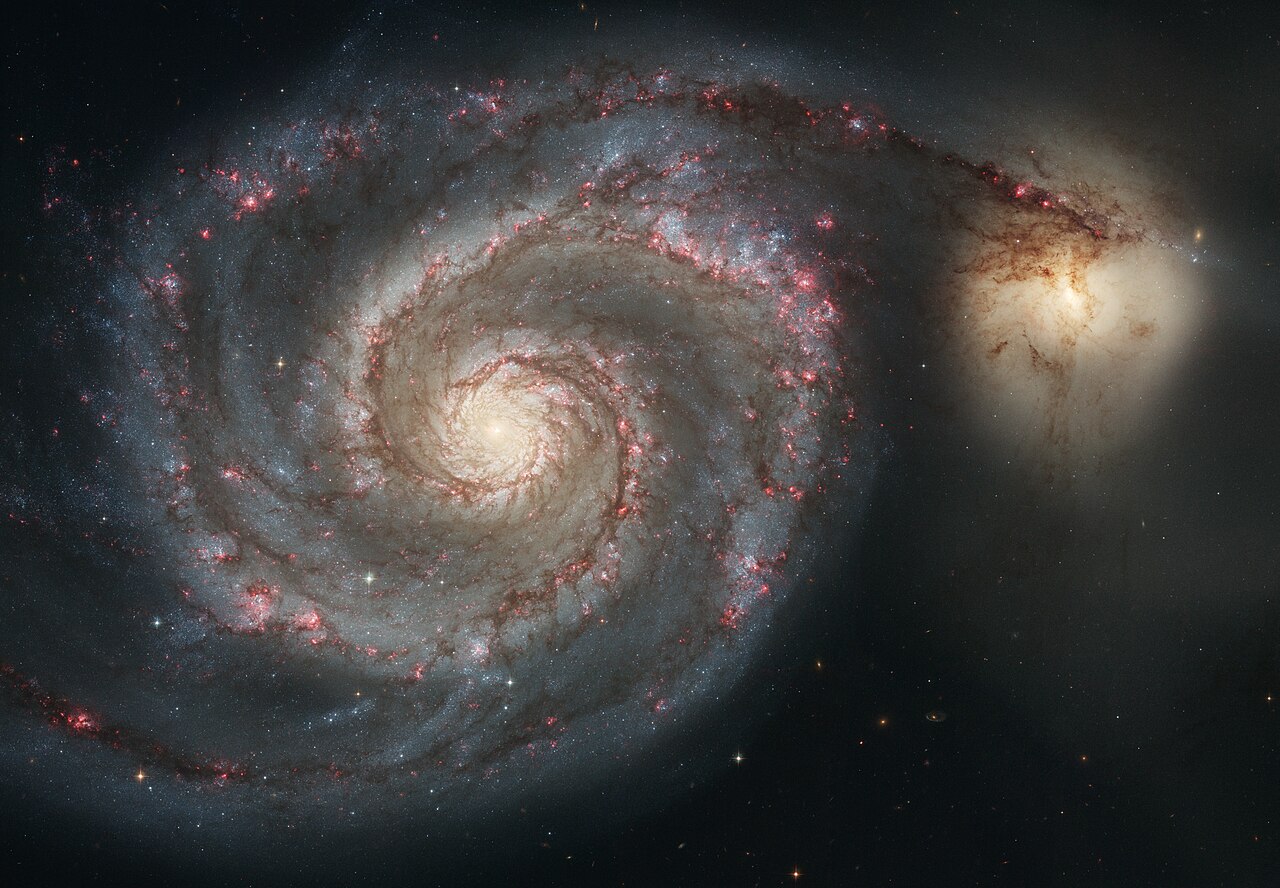






Structure and characteristics
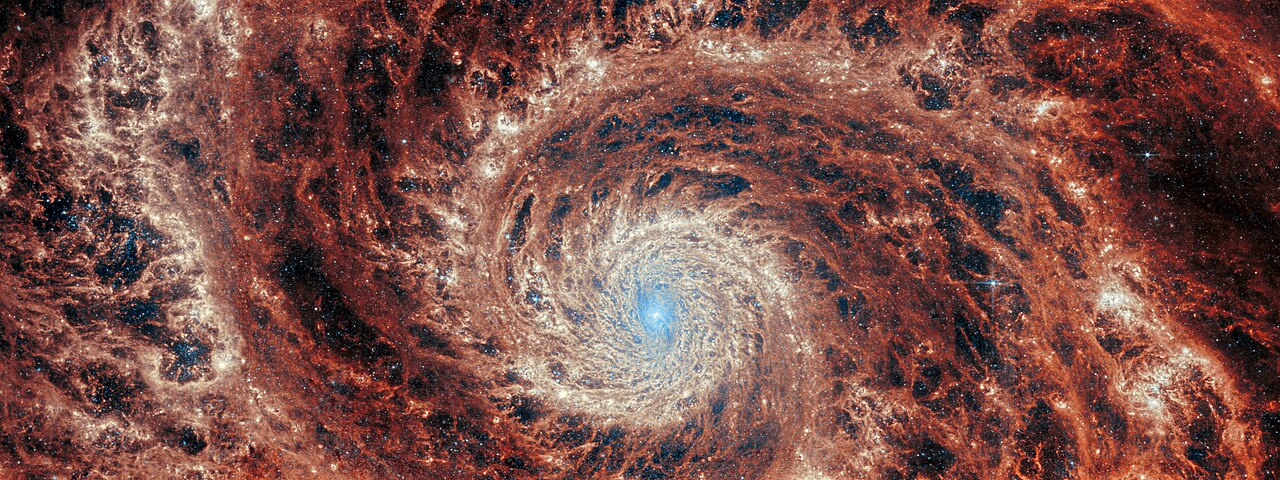
M51 displays bright, knotty spiral arms rich in star-forming regions and ionized hydrogen. These arms contrast with the darker dust lanes and a luminous central bulge. The nucleus of M51 is classified as an active galactic nucleus (AGN), indicating energetic processes near its center that are commonly attributed to accretion onto a supermassive black hole (central black hole). The overall morphology and clarity of the spirals make M51 a key example for studying the mechanisms that shape spiral patterns.
Distance and classification
Historically notable as one of the first galaxies to be recognized as spiral in form, M51 played a part in early classifications of extragalactic nebulae (classification history). Estimates of its distance have varied; different methods have produced ranges broadly between about 15 and 35 million light-years. A recent and commonly cited value places M51 at approximately 23 ± 4 million light-years from the Milky Way, though uncertainties remain depending on measurement technique.
Interaction with NGC 5195
The smaller companion, NGC 5195, is linked to M51 by tidal features and bridges of material. Their close passage and ongoing gravitational interaction are responsible for enhanced star formation in M51's arms and for distortions visible in deep images. This interacting pair is frequently modeled in simulations to explore how encounters trigger waves of star formation and reorganize galactic disks.
Observation and importance
M51 lies in the northern constellation Canes Venatici and is bright enough to be found with modest equipment. The pair can be detected with binoculars (binocular observations) and shows more detail through small to medium amateur telescopes. Because of its conspicuous arms and interaction-driven phenomena, M51 is a popular target for both amateur astronomers and professional studies of galactic dynamics. It appears in many educational images and research programs focused on star formation and spiral-arm theory.
Notable facts and resources
- Alternate names: Messier 51a, M51a, NGC 5194.
- Companion galaxy: NGC 5195, often treated as M51b in observational catalogs.
- Visibility: prominent in the spring sky for northern observers; finders and charts list it among classic Messier objects (observing guides).
- Research relevance: serves as a laboratory for studying spiral structure, tidal interactions, and active nuclei.
For an entry-level observer or a researcher, the Whirlpool Galaxy offers a clear illustration of how interactions and internal processes combine to produce the grand spiral patterns that are a defining feature of many disk galaxies. Further detailed imagery and scientific literature provide deeper views into its star-forming regions, nuclear activity, and dynamical history (black hole research, distance studies).
Questions and answers
Q: What is the Whirlpool galaxy?
A: The Whirlpool galaxy is a large galaxy with well-defined spiral arms and a smaller companion galaxy.
Q: What are some of its other names or classifications?
A: It is also known as Messier 51a, M51a, or NGC 5194.
Q: What sets the Whirlpool galaxy apart from other galaxies?
A: The Whirlpool was the first galaxy to be classified as a spiral galaxy, and its spiral arms are so impressive and well-defined that it is called a "grand design" spiral galaxy.
Q: How far away is the Whirlpool galaxy from the Milky Way?
A: Different methods put its distance as between 15 to 35 million light-years. Recently it was estimated to be 23 ± 4 million light-years from the Milky Way.
Q: Are there any interesting features of the Whirlpool galaxy's nucleus?
A: It has an active galactic nucleus, no doubt fuelled by a massive black hole.
Q: Can amateur astronomers see the Whirlpool galaxy?
A: Yes, the galaxy and its companion, NGC 5195, are easily seen by amateur astronomers, in the constellation Canes Venatici. The two galaxies can be seen with binoculars.
Q: Why do professional astronomers study the Whirlpool galaxy?
A: They study its galaxy structure (particularly the spiral arms) and galaxy interactions.
Related articles
Author
AlegsaOnline.com Whirlpool Galaxy (M51, NGC 5194) Leandro Alegsa
URL: https://en.alegsaonline.com/art/107768
Sources
- commons.wikimedia.org : Whirlpool Galaxy
- ned.ipac.caltech.edu : "NASA/IPAC Extragalactic Database"
- arxiv.org : astro-ph/0608430
- ui.adsabs.harvard.edu : 2006MNRAS.372.1735T
- doi.org : 10.1111/j.1365-2966.2006.10974.x
- nedwww.ipac.caltech.edu : "Distance Results for MESSIER 051"
- messier.seds.org : "M51"
- nasa.gov : nasa.gov/image-article/whirlpool-galaxy/
- adsabs.harvard.edu : adsabs.harvard.edu/doi/10.1086/190147
- universeforfacts.com : "Whirlpool Galaxy: First Spiral Galaxy"
- ui.adsabs.harvard.edu : 1987ApJ...314....3E
- doi.org : 10.1086/165034
- arxiv.org : "Jet-disturbed molecular gas near the Seyfert 2 nucleus in M51"
- ui.adsabs.harvard.edu : 2007A&A...468L..49M