
Westerlund 2: A Young Massive Star Cluster in the Milky Way
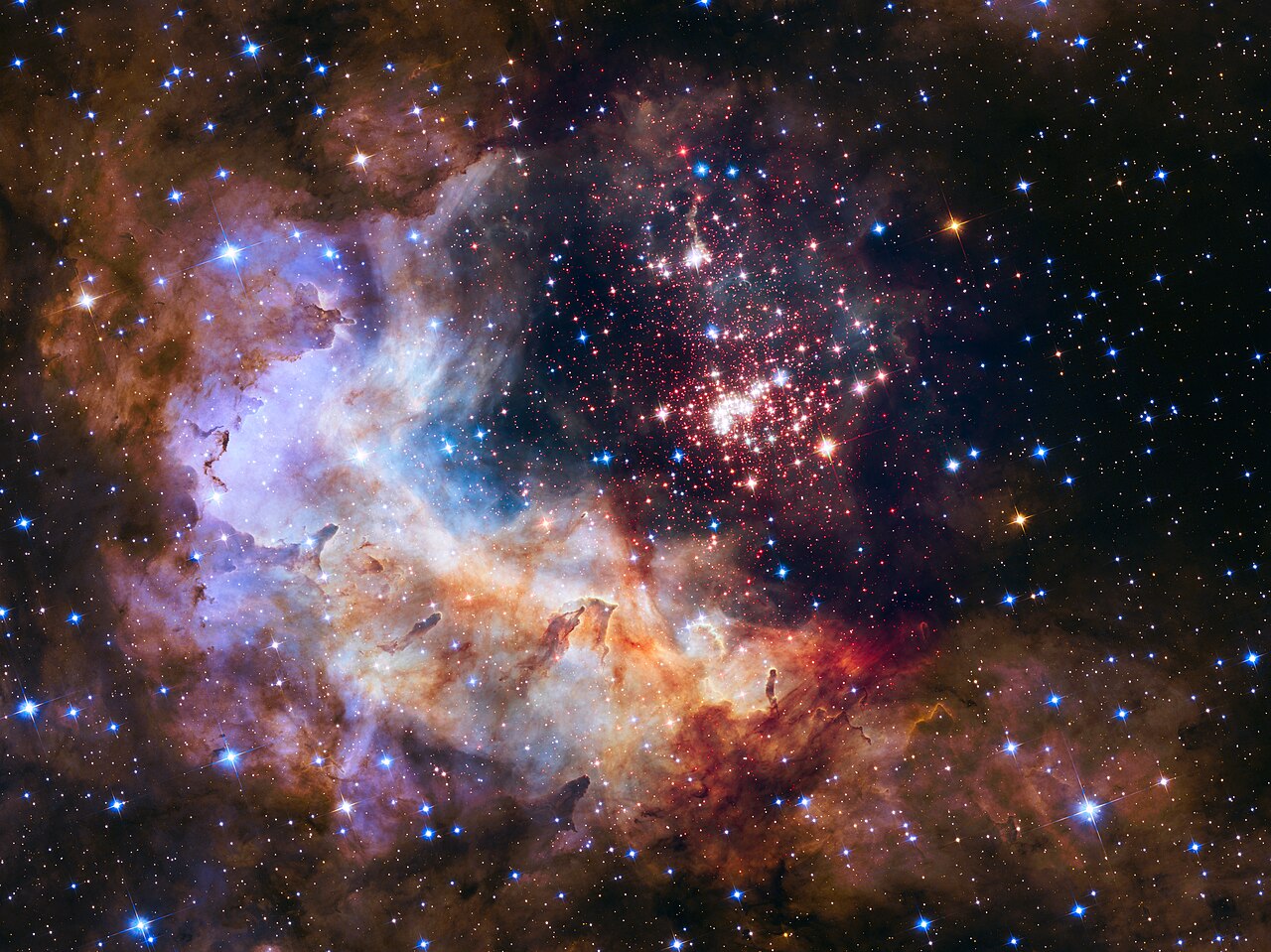
Westerlund 2 is a very young, compact and massive star cluster embedded in the RCW 49 nebula. It hosts numerous O-type stars, pre-main-sequence stars and at least two Wolf–Rayet binaries.
Overview
Westerlund 2 is a compact, massive and very young star cluster embedded in a bright emission nebula. It lies in the plane of the Milky Way and is partially obscured by dust and gas, so much of what is known about it comes from infrared and X-ray observations in addition to optical studies. The cluster is commonly associated with the H II region RCW 49 and is located at a distance of roughly 20,000 light years from the Sun.
Image gallery
5 Images



Stellar content and structure
Westerlund 2 contains a concentrated core of very hot, luminous stars. Among its members are roughly a dozen bright O-type main-sequence stars together with a large population of lower-mass pre-main-sequence stars that are still contracting toward the main sequence. The cluster also contains extreme massive objects classified as Wolf–Rayet stars, which are evolved, highly luminous stars with strong stellar winds. One well-known massive system near the cluster core is the eclipsing binary WR20a, found only a short projected distance from the center.
Key characteristics
- Age: exceptionally young for a massive cluster, on the order of one to a few million years.
- Extinction: significant interstellar dust causes variable reddening and partly hides the cluster at visible wavelengths.
- Massive-star feedback: strong ultraviolet radiation and winds from massive stars have ionized the surrounding nebula and influence ongoing star formation.
Observations and research
Because much of the region is obscured, astronomers have used a combination of wavelengths to study Westerlund 2. Infrared imaging penetrates dust to reveal young stellar objects, while X-ray observations detect hot coronas and shocks around young stars and massive binaries. Radio and optical spectroscopy have been used to classify the hottest stars and to measure wind velocities and chemical signatures. The cluster has attracted attention as a laboratory for studying massive-star evolution and multiplicity, because several members are eclipsing or spectroscopic binaries whose masses can be measured precisely.
History and discovery
Westerlund 2 was first catalogued by the Swedish astronomer Bengt Westerlund in the 1960s, but detailed information about its stellar population and environment accumulated only later, as infrared detectors, space-based X-ray telescopes and larger telescopes made it possible to see through the surrounding dust. Modern surveys continue to refine the census of cluster members and to study their formation history and dynamical state.
Importance and notable facts
The cluster is important for several reasons: it contains some of the most massive stars known in the Galaxy, it is young enough that many members retain characteristics of their formation, and it offers a nearby example of how massive-star feedback shapes an H II region. Studies of Westerlund 2 contribute to broader questions about how massive stars form, how frequently they are found in binary systems, and how they disperse the gas that formed them. For further background and observational datasets see cluster summaries and surveys available through archival resources (cluster overview, spectral catalogs, Wolf–Rayet lists, distance studies, Galactic context).
Questions and answers
Q: What is Westerlund 2?
A: Westerlund 2 is a massive young super star cluster containing some of the hottest, brightest, and most massive stars known.
Q: How old is Westerlund 2?
A: Westerlund 2 is about one or two million years old.
Q: Is Westerlund 2 close to the Earth?
A: No, Westerlund 2 is 20,000 light years away in the Milky Way galaxy.
Q: What are some of the stars found in Westerlund 2?
A: Westerlund 2 contains a dozen of O-type main sequence stars, of which at least three are eclipsing binaries, many very young pre-main sequence stars, and two Wolf–Rayet stars. The core of the cluster contains several examples of rare very hot stars.
Q: Is Westerlund 2 the only cluster discovered by Bengt Westerlund?
A: No, Westerlund 2 was discovered by Bengt Westerlund in the sixties, but its stellar content was assessed only in later years.
Q: Where is the massive eclipsing binary WR20a found in relation to Westerlund 2?
A: The massive eclipsing binary WR20a is found just outside the cluster, at 30 arcseconds (about 1.1 pc in projection), on the lower right side of the cluster center.
Q: What is obscuring Westerlund 2?
A: Westerlund 2 is partly obscured with gas.
Related articles
Author
AlegsaOnline.com Westerlund 2: A Young Massive Star Cluster in the Milky Way Leandro Alegsa
URL: https://en.alegsaonline.com/art/107487
Sources
- arxiv.org : arxiv.org/abs/astro-ph/0612622
- arxiv.org : arxiv.org/abs/astro-ph/0404551