
Beringia: The Pleistocene land bridge linking Asia and North America
Beringia was the exposed shelf and adjoining steppe that connected present-day Alaska and eastern Siberia during Pleistocene ice ages, acting as a refugium and corridor for people and wildlife.
Overview
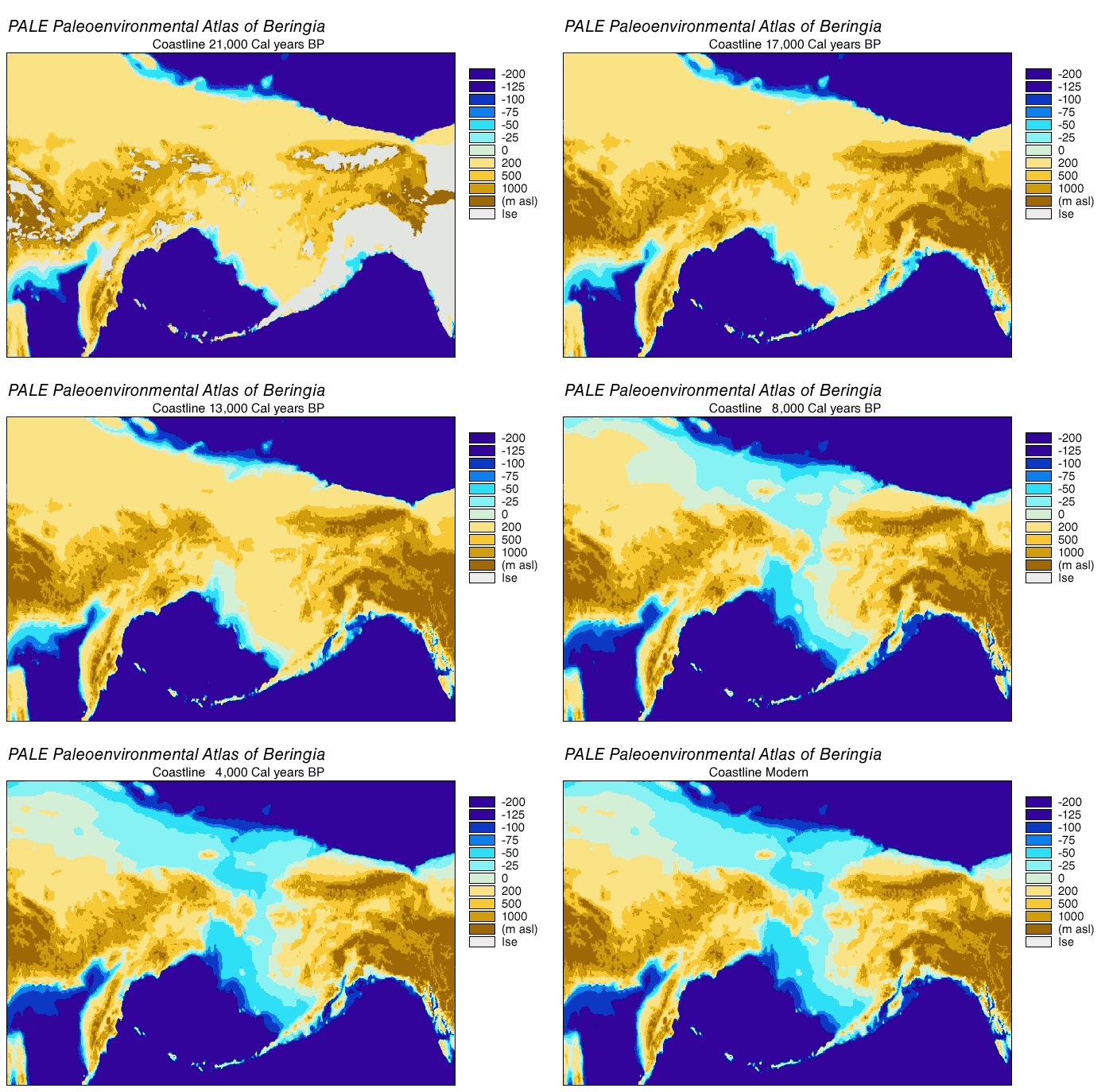
Beringia refers to the region of continental shelf and adjacent terrestrial habitats that became exposed when global sea levels fell during Pleistocene glacial cycles. At times this land connection linked present-day Alaska and eastern Siberia, providing a direct route between the continents across what is now the Bering Strait. The term embraces both the temporary exposed land bridge and the larger biogeographic province that included parts of the surrounding continents.
Image gallery
10 Images


Landscape and climate
The Bering land bridge could extend roughly a thousand miles from north to south at its maximum exposure and created a broad corridor of lowland between ice sheets. Unusually, much of this expanse remained free of continental ice: nearby mountain ranges trapped moisture, so that the platform was cold and dry rather than heavily glaciated. Sparse precipitation and reduced snowfall—sometimes described as extremely light—produced a steppe-tundra landscape influenced by air masses from the Pacific Ocean and Arctic seas.
Flora, fauna, and ecosystems
The dominant environment across the exposed shelf and its margins has often been called the grassland steppe or "mammoth steppe": a mosaic of grasses, sedges and low shrubs supporting a rich assemblage of large herbivores and their predators. Fossil and genetic evidence documents animals such as mammoths, bison, horses, elk and large carnivores moving across Beringia, and plants that adapted to cold, dry conditions formed the base of these food webs.
Human presence and migration
Archaeology and ancient DNA indicate humans occupied or passed through Beringia during the last glacial period. Some hypotheses propose a Beringian refugium or "standstill" where small human populations persisted isolated from other Asian groups for millennia before dispersing into the Americas. As continental glaciers thinned and sea level rose—particularly after about 16,500 years ago—new routes opened southward and contributed to the peopling of North and South America.
Key points and timeline
- Formation: Sea-level fall during Pleistocene glaciations exposed the shelf between continents.
- Extent: At maximum exposure it formed a broad, continuous land mass connecting Alaska and Siberia.
- Environment: Cold, dry steppe-tundra that escaped heavy glaciation because of low moisture.
- Biodiversity: Supported megafauna and provided migration routes for animals and humans.
- Later change: Post-glacial sea-level rise submerged the bridge, creating the modern Bering Strait.
Today Beringia is a subject for studies in paleoclimatology, biogeography and human prehistory. Its sediments, fossils and genetic traces help reconstruct how ecosystems responded to dramatic climate change and how humans and other species dispersed across continents. For further general information and regional studies see sources associated with Alaskan and Siberian research programs and paleoclimate archives (Alaska, Siberia, Pleistocene, ice ages, glaciation studies, precipitation records, snowfall analyses, oceanic influences, steppe ecology).
Questions and answers
Q: What is the Bering land bridge?
A: The Bering land bridge is a landmass that joined present-day Alaska and eastern Siberia during the Pleistocene ice ages.
Q: Was the Bering land bridge glaciated during the ice ages?
A: No, the Bering land bridge was not glaciated because snowfall was extremely light due to the winds from the Pacific Ocean losing their moisture over the fully glaciated nearby mountains.
Q: What is Beringia?
A: Beringia is the grassland steppe, including the land bridge, that stretched for several hundred miles into the continents on either side.
Q: Did humans live in Beringia during the ice age?
A: Yes, it is believed that a small human population of at most a few thousand survived the ice age in Beringia.
Q: How long was Beringia isolated from populations in Asia?
A: Beringia was isolated from populations in Asia for at least 5,000 years.
Q: When did the human population in Beringia start to populate the Americas?
A: The human population in Beringia started to populate the Americas sometime after 16,500 years ago when the American glaciers that blocked the way southward melted.
Q: How did the melting of the American glaciers facilitate the migration of humans from Beringia to the Americas?
A: The melting of the American glaciers released a passage for humans from Beringia to cross into the Americas.
Related articles
Author
AlegsaOnline.com Beringia: The Pleistocene land bridge linking Asia and North America Leandro Alegsa
URL: https://en.alegsaonline.com/art/10718
Sources
- doi.org : 10.1126/science.1153569
- doi.org : 10.1016/j.ajhg.2007.11.013
- doi.org : 10.1371/journal.pone.0000829
- doi.org : 10.1371/journal.pone.0001764
- www3.nationalgeographic.com : National Geographic. Atlas of the human journey. 2005
- doi.org : 10.1371/journal.pbio.0030193