
Weight (physics): force of gravity on an object
Weight is the gravitational force acting on an object. Distinct from mass, it is a vector force measured in newtons and varies with location and acceleration; common usage often conflates weight with mass.
Overview
In physics, weight is the measure of the gravitational force acting on an object or an amount of matter. It is a force, so its proper unit is the newton in the SI system. Weight depends on both the quantity of mass present and the strength of the local gravitational field. On or near the surface of the Earth, the weight of an ordinary object points approximately toward the planet's center and is often approximated by the product of mass and the standard gravitational acceleration.
Image gallery
3 Images

Physical characteristics
Weight is a vector: it has magnitude and direction. For many practical problems the magnitude is written W = m·g, where m is mass and g is local gravitational acceleration (about 9.8 m/s² at Earth's surface). Because it is a force, weight changes when the gravitational field changes (for example on the surface of the Moon) or when the object experiences acceleration. Apparent weight — what a scale shows — can differ from true gravitational weight if additional forces (such as buoyancy or acceleration) act on the object.
Measurement and common units
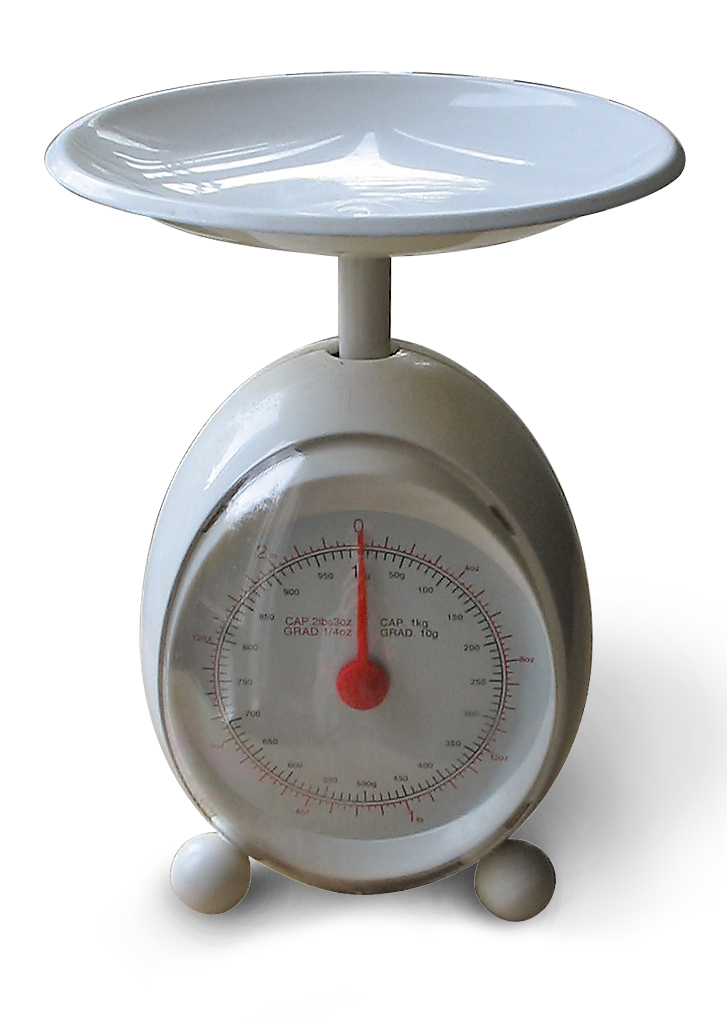
Although weight is measured in newtons, everyday language and many measuring devices report weight in units of mass such as kilograms or in customary units like pounds. This practice arises because, at a given location on Earth, weight is proportional to mass and proportionality is nearly constant for ordinary purposes. Scales calibrated in kilograms or pounds normally assume Earth's gravity; they actually measure a force but are graduated to indicate an equivalent mass under those conditions.
Weight versus mass — important distinctions
Mass is an intrinsic property of an object that quantifies how much matter it contains and its resistance to acceleration. Weight is the force produced by gravity acting on that mass. Two objects with equal mass have equal weight only when subjected to the same gravitational field. In accelerating frames (such as an elevator or a launch vehicle) an object's apparent weight can increase or decrease even though its mass remains unchanged. In orbiting spacecraft occupants experience microgravity not because mass vanishes but because both they and their vehicle are in continuous free fall about the central body.
History and practical examples
Historically, people measured weight at Earth's surface and used balance scales and later spring and electronic scales. The tendency to use mass units for weight developed because local gravity is approximately constant across habitable regions. Modern metrology distinguishes mass and weight clearly: mass standards are preserved as references, while force standards and calibrations handle weight. The concept of the center of mass is useful in analyzing how gravity acts on extended bodies and how weight-related torques can cause tipping or rotation.
Applications and notable facts
- Engineering and construction use weight to determine loads, stresses, and safe design limits.
- Buoyancy reduces apparent weight in fluids; a submerged object feels lighter by the weight of displaced fluid.
- On other worlds, such as the Moon, the same mass has a lower weight because the local gravity differs.
- Everyday confusion between weight and mass is common; teaching and labeling that clarify units and context improve communication and safety.
For further reading on related concepts — mass, gravitational acceleration, measuring instruments, and orbital mechanics — consult introductory physics texts or online resources linked in the references section via these placeholders: matter, mass, Moon, center of mass, Earth, kilograms, and pounds.
Questions and answers
Q: What is the weight of an object?
A: The weight of an object is the measure of the intensity of the force imposed on this object by the local gravitational field.
Q: How is weight different from mass?
A: Weight should not be confused with mass as weight is the measure of the force of gravity on an object whereas mass is the amount of matter present in the object.
Q: Where is the weight force directed for small objects on Earth?
A: For small objects on Earth, the weight force is directed towards the center of the planet.
Q: Where is the weight force directed for larger objects such as the Moon orbiting around the Earth?
A: For larger objects such as the Moon orbiting around the Earth, the weight force is directed towards the center of mass of the combined system.
Q: What has led to confusion between mass and weight?
A: Using the same terms to describe and measure the two different properties has led to confusion between mass and weight.
Q: Are mass and weight the same thing?
A: Mass and weight are not the same thing.
Q: Do objects with the same mass have the same weight?
A: Objects which have the same mass have the same weight. An object with twice the mass of another will also have twice the weight.
Related articles
Author
AlegsaOnline.com Weight (physics): force of gravity on an object Leandro Alegsa
URL: https://en.alegsaonline.com/art/107142