
Wedge (mechanics)
A wedge is a simple machine — a moving inclined plane — used to separate, lift, or secure objects. It converts an applied force into lateral forces; its effectiveness depends on its geometry and friction.
A wedge is a simple mechanical device that converts a force applied to its blunt end into forces perpendicular to its inclined surfaces. Functionally, a wedge acts as a moving simple machine, often described as a mobile inclined plane. By concentrating input force over a narrow edge or surface, wedges are used to split, cut, lift, or hold materials.
Image gallery
5 Images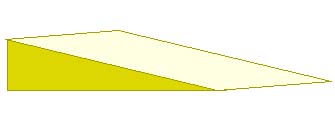


Form and principles
Typical wedge geometry includes the length of the sloping faces, the maximum thickness at the rear, and the acute angle at the front. The mechanical advantage of a wedge rises as its sloping length increases relative to its thickness: a long, thin wedge amplifies input force more than a short, steep one. In practice the ideal advantage is reduced by friction between the wedge and the material it contacts, and by deformation of the wedge or the workpiece. The basic relation between slope, thickness and force is commonly summarized by the ratio of slope length to thickest part; more precise engineering formulas may use the wedge angle and friction coefficients.
How wedges work in practice
When pushed or struck, a wedge forces material apart by redirecting the applied force sideways. This principle explains why knives and axes cut: their angled edges concentrate pressure and separate fibers as the tool moves through wood, meat, or other materials. A simple example is splitting wood with a maul or wedge; a sharp tool penetrates and then widens the crack as the wedge advances. See a basic cutting example at cutting and splitting.
History and common uses
Wedges are among the oldest human tools. Early people used stone and wooden wedges for splitting timber and shaping stone. Over time the wedge concept became a component of many implements: knives, chisels, axes, plowshares, and nail heads. In construction and machining wedges also appear as shims, clamps, and locking elements. The screw can be viewed as a related device that transforms rotational motion into linear force, while still relying on an inclined-plane principle.
Practical considerations and variations
- Single vs. double wedges: some wedges have two symmetric faces (e.g., chisels) while others have a single bevel (e.g., some knives).
- Materials and wear: harder, tougher materials hold a sharper edge and resist chipping; friction and abrasion blunt a wedge over time.
- Efficiency: friction and binding reduce delivered force; lubricants, surface finish and correct sizing improve performance. Engineers often relate mechanical performance to the slope-to-thickness ratio and frictional losses (mechanical advantage, length-to-thickness ratio).
Wedges remain fundamental in both simple hand tools and complex machinery because of their straightforward physics, versatility, and efficiency when properly designed and used.
Questions and answers
Q: What is a wedge in mechanics?
A: A wedge in mechanics is a simple machine used mainly to put in between two stones.
Q: What is the purpose of using a wedge as a tool?
A: The purpose of using a wedge as a tool is to push two things apart such as the blade of a sword and knife does when it cuts wood.
Q: Can a wedge be used for other purposes besides separating two objects?
A: Yes, a wedge can also be used to lift an object or hold an object in place.
Q: What does the mechanical advantage of a wedge depend on?
A: The mechanical advantage of a wedge depends on the ratio of its length to its thickest part.
Q: How does the mechanical advantage of a wedge affect its effectiveness?
A: The higher the ratio of length to thickest part, the greater the mechanical advantage and therefore the more effective the wedge.
Q: Are wedges commonly used in modern machines?
A: Yes, wedges are commonly used in modern machines such as in car brakes and doorstops.
Q: Can a wedge be used in conjunction with other simple machines?
A: Yes, a wedge can be used in conjunction with other simple machines such as a lever to move heavy objects or a pulley to lift heavy objects.
Related articles
Author
AlegsaOnline.com Wedge (mechanics) Leandro Alegsa
URL: https://en.alegsaonline.com/art/107105
Sources
- hyperphysics.phy-astr.gsu.edu : "Simple Machines"
- teacher.scholastic.com : "The Wedge"