
Watson (computer): IBM's natural language question‑answering system
Watson is IBM's research system that interprets natural-language questions, searches large text corpora, ranks candidate answers with confidence scores and was showcased on Jeopardy! in 2011.
Watson is an artificially intelligent system developed by IBM to interpret and answer questions posed in everyday language. Built as a research platform rather than a single product, Watson combined large-scale data retrieval, linguistic analysis and statistical ranking to produce candidate answers and an accompanying confidence estimate. The system is often described as a question-answering engine; many accounts use the phrase artificially intelligent to convey its focus on language understanding and automated reasoning.
Image gallery
3 Images
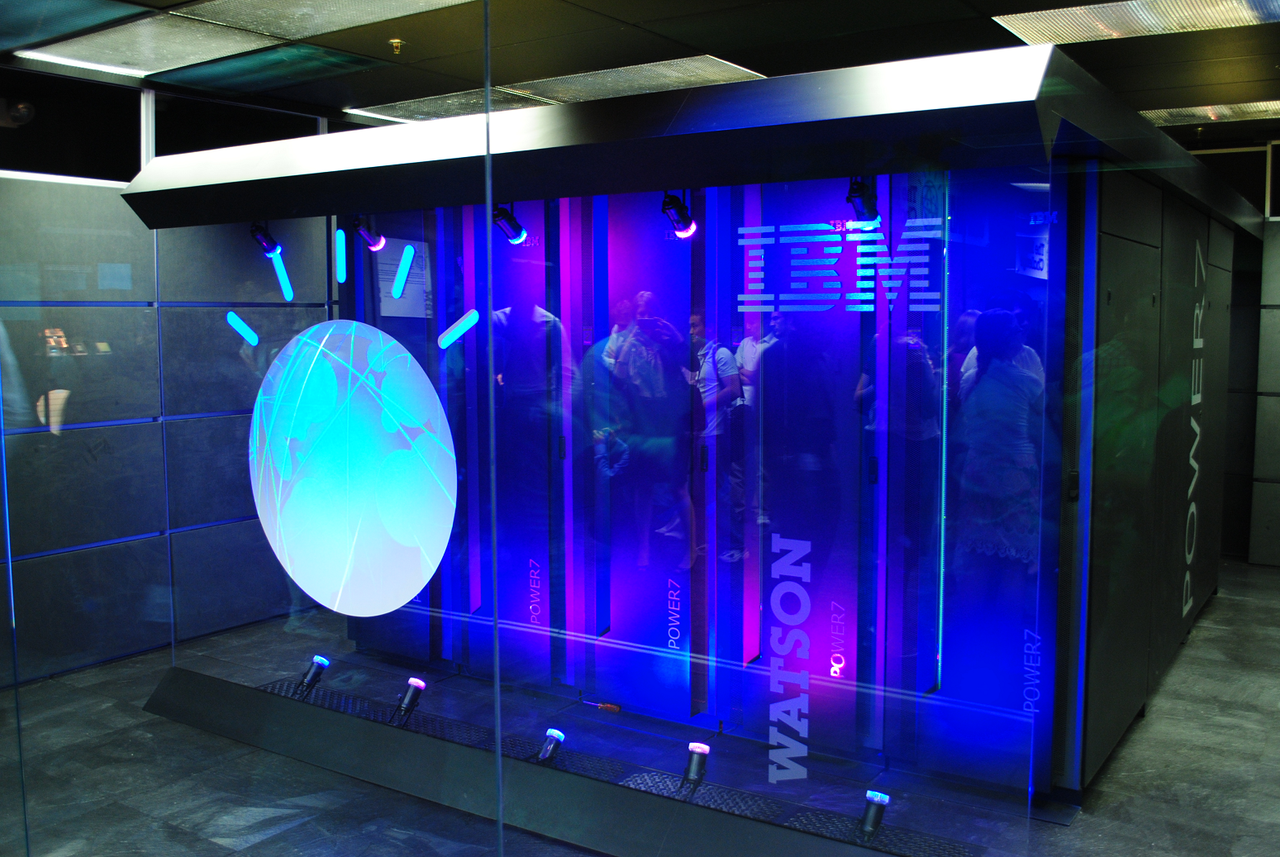

Design and capabilities
At its core Watson relied on techniques from natural language processing and probabilistic modeling to convert a textual clue into one or more hypotheses, gather supporting evidence from indexed sources, and score each hypothesis. Its pipeline included query analysis, passage retrieval, feature extraction and machine-learned ranking. Watson was optimized to handle the ambiguity and punning style of open-ended clues by generating many candidate interpretations and measuring how well each matched the available evidence.
- Input processing: parsing, named-entity recognition and question classification (natural language methods).
- Knowledge sources: large corpora and encyclopedic content, indexed for fast retrieval (Wikipedia, curated references and news).
- Evidence scoring: hundreds of features per candidate answer combined by machine-learned models to compute confidence.
- Decision logic: thresholding on confidence to decide whether to respond or abstain in a competitive setting.
Public demonstration on Jeopardy!
Watson became widely known after competing on the quiz show Jeopardy! in February 2011. IBM entered Watson to demonstrate its ability to handle the show’s short, often nuanced clues and to perform under time pressure on a television stage. The system faced champions such as Ken Jennings and Brad Rutter; it accessed a large internal knowledge base but was deliberately not connected to the live internet during play. Watson’s documented training set included hundreds of millions of pages of text — encyclopedias, news and reference works — and its confidence-weighted answers appeared on-screen to illustrate its reasoning process.
Applications and evolution
After the Jeopardy! demonstration, IBM shifted Watson’s technologies toward commercial and research applications. Teams explored use cases in business analytics, call-center automation and healthcare, where the system assisted with literature search and clinical decision support by aggregating information from encyclopedias, dictionaries and specialized sources. In medicine, pilots addressed problems such as extracting insights from electronic health records and genomic literature (medical records and genetics). Over time the AI landscape evolved and newer machine-learning approaches, including those based on deep learning, changed how language tasks are implemented and deployed.
Limitations, distinctions and legacy
Watson’s architecture emphasized explicit hypothesis generation and feature-based scoring rather than the end-to-end neural methods that later grew dominant. That taught researchers and practitioners valuable lessons about system design, data curation and human–machine interaction. Watson also highlighted practical issues such as the importance of high-quality, curated content and careful evaluation of confidence estimates in real-world settings. Named in honor of Thomas J. Watson, the system remains a notable milestone in applied natural-language AI and has influenced subsequent products and research directions.
For further reading on components and demonstrations of question-answering systems, see materials that describe encyclopedic and reference resources (thesauri), dataset construction and benchmark experiments. IBM’s work on Watson continues to be cited in discussions about hybrid systems that combine symbolic resources with statistical learning, and it is often referenced when tracing the history of question-answering and practical AI deployment (game show, artificial intelligence). More technical introductions and retrospective analyses are available through research summaries and industry reports (natural language, IBM).
Questions and answers
Q: What is Watson?
A: Watson is an artificially intelligent computer system that can answer questions asked in natural language.
Q: Who made Watson?
A: IBM made Watson.
Q: What was Watson's purpose on Jeopardy!?
A: Watson's purpose on Jeopardy! was to compete against past champions Ken Jennings and Brad Rutter.
Q: Did Watson win on Jeopardy!?
A: Yes, Watson won the first place prize of $1 million on Jeopardy!.
Q: Who was Watson named after?
A: Watson was named after Thomas J. Watson, who was the chairman and CEO of IBM from 1914 to 1956.
Q: What sources of information were used by Watson to answer questions?
A: Sources of information for Watson included encyclopedias, dictionaries, thesauri, news articles, and books.
Q: Was Watson connected to the internet during Jeopardy!?
A: No, Watson was not connected to the internet during Jeopardy!, meaning it had to use what was in its system to answer clues.
Related articles
Author
AlegsaOnline.com Watson (computer): IBM's natural language question‑answering system Leandro Alegsa
URL: https://en.alegsaonline.com/art/106887
Sources
- research.ibm.com : DeepQA Project: FAQ
- jeopardy.com : IBM's "Watson" Computing System to Challenge All Time Greatest Jeopardy! Champions
- nytimes.com : Actors and Their Roles for $300, HAL? HAL!
- theatlantic.com : Is It Time to Welcome Our New Computer Overlords?
- aaai.org : The AI behind Watson
- npr.org : Can a Computer Become a Jeopardy! Champ?