
Watermill: function, history, types, and uses
A watermill harnesses flowing water with a wheel or turbine to power mechanical processes such as grinding grain, sawing timber, or shaping metal; distinct from modern hydroelectric plants.
Overview
A watermill is a mechanical installation that converts the kinetic or potential energy of flowing or falling water into useful work. Traditionally this was accomplished with a water wheel, while later designs used a turbine. In engineering terms a watermill functions as a hydraulic engine that transmits torque through gears, shafts and belts to operate machinery. When a facility’s sole purpose is producing electrical power it is commonly called a hydroelectric plant or linked to large-scale electrical generation systems, rather than a traditional mill.
Image gallery
10 Images




Key components and common wheel types
At its simplest a watermill includes a water source, a channel or millrace to direct flow, a driving wheel or turbine, and mechanical connections to the driven equipment. Different wheel designs suit different sites and flow conditions:
- Overshot wheels—water enters at the top and uses gravity; efficient where head (height) is available.
- Breastshot wheels—water strikes near mid-height; good for moderate head and flow.
- Undershot wheels—driven by flow under the wheel; used on low-head, high-flow streams.
- Water turbines—compact, high-speed devices that replaced large wheels in many industrial settings.
Historical development
Water-powered mills are ancient technology, with examples known from the Hellenistic world and the Roman Empire. They became widespread in medieval Europe and Asia for grinding grain and other tasks, and they were a foundational technology of the pre-industrial and early industrial economies. Improvements in gearing, transmission, and turbine design during the 18th and 19th centuries expanded the range of tasks watermills could perform and raised their efficiency.
Uses and economic importance
Historically watermills were central to rural and early urban economies. Typical applications included grinding grain into flour, sawing logs into lumber, fulling and powering textile machinery, and driving bellows, hammers or rolling mills for metalworking. Watermills enabled scale and regularity of production that manual labor could not match, reducing costs and supporting population growth and craft specialization.
Distinctions, limitations and legacy
Although both watermills and hydroelectric plants harness water, they differ in purpose and technology: mills directly power mechanical processes, while hydroelectric installations convert hydraulic energy to electricity for distribution. Limitations of traditional watermills include dependence on local hydrology, seasonal variability, and the need for flow-control structures. Many historical watermills survive as cultural landmarks or have been adapted for small-scale power generation, heritage tourism, and environmental education.
Examples and further reading
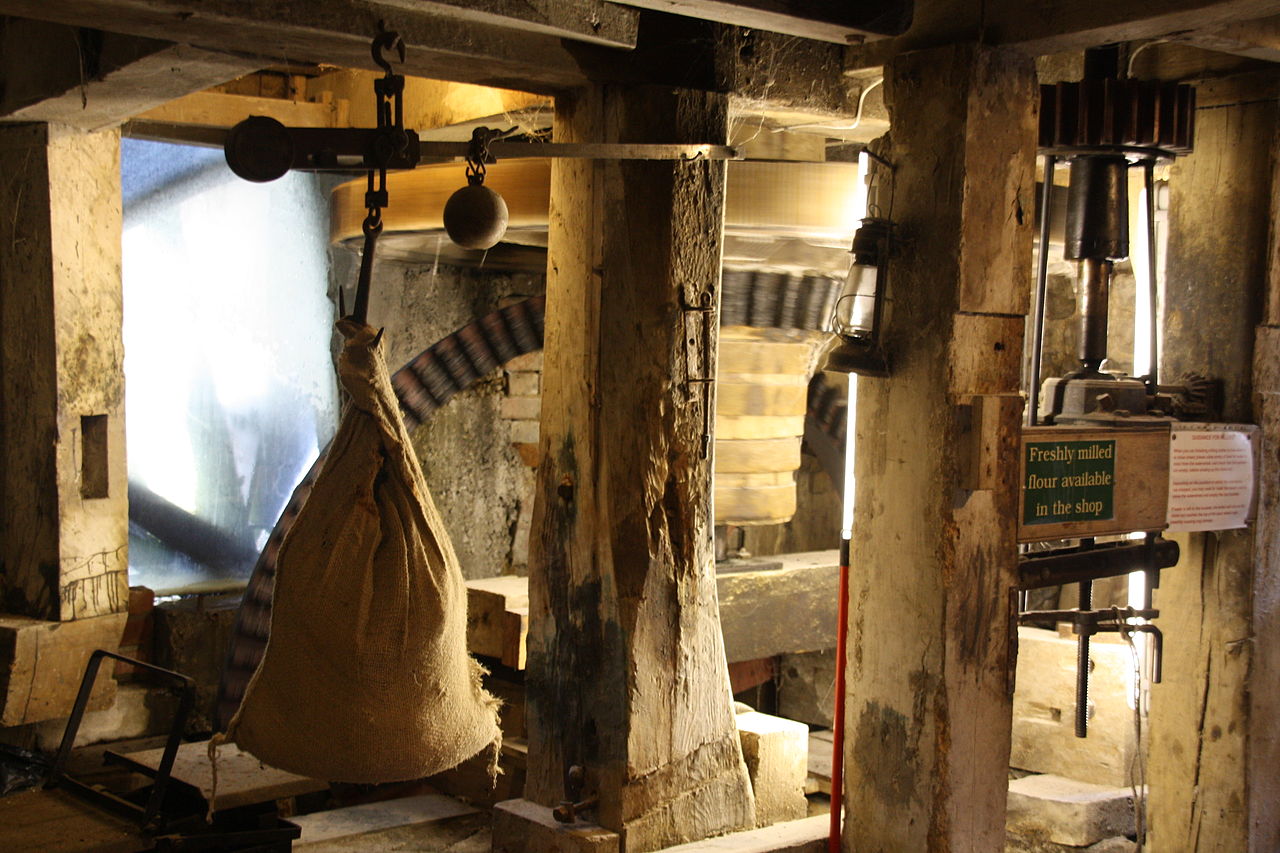
Surviving examples range from simple rural gristmills to complex multipurpose mill complexes. Museums and conservation projects demonstrate original gearing, millstones and woodworking equipment. For technical introductions and historical surveys see general resources on milling technology and regional industrial archaeology: engineered systems, wheel construction, turbine types, and modern comparisons with hydroelectric development and power generation.
Questions and answers
Q: What is a watermill?
A: A watermill is an engine that uses a water wheel or turbine to drive a mechanical process such as flour or lumber production, or metal shaping.
Q: What are some examples of mechanical processes that can be powered by a watermill?
A: Mechanical processes that can be powered by a watermill include flour or lumber production, or metal shaping such as rolling, grinding or wire drawing.
Q: Is a watermill used solely for generating electricity?
A: No, a watermill that only generates electricity is more usually called a hydroelectric plant.
Q: What other uses can a watermill have?
A: A watermill can be used to power various mechanical processes such as flour or lumber production, or metal shaping.
Q: Are all types of watermills used to generate electricity?
A: No, not all types of watermills are used to generate electricity. Some are used for other mechanical processes like flour or lumber production.
Q: What device can be used to drive a mechanical process in a watermill?
A: A water wheel or turbine is used to drive a mechanical process in a watermill.
Q: What type of plant is usually referred to as a hydroelectric plant?
A: A watermill that only generates electricity is more usually called a hydroelectric plant.
Related articles
Author
AlegsaOnline.com Watermill: function, history, types, and uses Leandro Alegsa
URL: https://en.alegsaonline.com/art/106858