
Waterloo (ABBA song)
“Waterloo” is ABBA’s 1974 breakthrough single and Eurovision winner that launched their international career; a pop single notable for its catchy hook, theatrical presentation and lasting cultural impact.
Waterloo is a pop single recorded by the Swedish group ABBA and released as the lead track from their second album, Waterloo. Issued in 1974, it was the first single credited to the quartet under the name ABBA and their first release on the Epic label in some markets and Atlantic in others. The song was issued in both Swedish and English-language versions; the Swedish single was released as a double A-side with a Swedish-language version of "Honey, Honey" while the English-language single commonly featured "Watch Out" as its B-side. The release strategy reflected the group's intent to reach domestic and international audiences simultaneously.
Image gallery
3 Images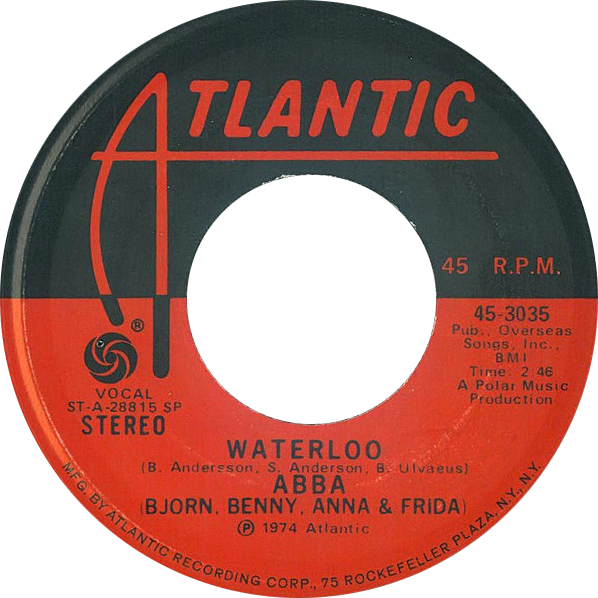


Composition and themes
Written by Benny Andersson, Björn Ulvaeus and Stig Anderson, "Waterloo" combines elements of concise pop songwriting with a flamboyant, glam-influenced arrangement. The lyrics use the historical image of Napoleon’s defeat at Waterloo as a playful metaphor for surrendering to love: the narrator compares giving in to a romantic partner with the famous military capitulation. Musically, the song is driven by a strong melodic hook, vocal harmonies and a bright production that emphasizes immediacy and stage-savvy flair.
Eurovision and immediate impact
On 6 April 1974, "Waterloo" represented Sweden at the Eurovision Song Contest and won the competition. The victory transformed ABBA from a successful local act into an international pop phenomenon and provided crucial exposure across European broadcast markets. The group's colorful costumes and energetic staging during the contest helped the performance attract wide attention and remain one of Eurovision’s most remembered moments.
Chart success and sales
Following Eurovision, the single climbed international charts and reached number one in several countries. It became a major hit across Europe, reached the Top 10 in the United States, and sold millions of copies worldwide—placing it among the best-selling singles of its era. The song’s commercial performance enabled ABBA to embark on extensive promotion and helped establish the foundation for subsequent global hits.
Legacy and cultural importance
"Waterloo" is widely regarded as one of the defining pop songs of the 1970s and a key turning point for both ABBA and the Eurovision Song Contest. At the contest’s 50th anniversary celebration it was named one of the competition’s most iconic entries. The song has been included on ABBA greatest-hits compilations, covered by numerous artists, and featured in stage and screen projects that celebrate the band’s catalogue. Its mix of theatricality and popcraft continues to be cited when discussing the group’s influence on later pop acts.
Versions, releases and notable facts
- Language versions: released in both English and Swedish to serve domestic and international markets.
- Single formats: the Swedish release acted as a double A-side with "Honey, Honey" (Swedish version); English singles typically paired it with "Watch Out."
- Anniversaries: the recording and performance have been commemorated in retrospectives and Eurovision celebrations, including formal recognition at the contest’s 50th anniversary event.
Today, "Waterloo" remains a frequent entry on playlists, anthologies and documentaries about 1970s pop music and Eurovision history. Its success illustrates how a well-crafted single can combine catchy melody, theatrical presentation and strategic release planning to create a lasting popular culture milestone.
Questions and answers
Q: What is "Waterloo"?
A: "Waterloo" is the first single from Swedish pop group ABBA's second album, Waterloo.
Q: What label was "Waterloo" ABBA's first single under?
A: "Waterloo" was ABBA's first single under the Epic and Atlantic labels.
Q: When did ABBA win the Eurovision Song Contest with "Waterloo"?
A: ABBA won the Eurovision Song Contest with "Waterloo" on April 6, 1974.
Q: What did winning the Eurovision Song Contest do for ABBA's career?
A: Winning the Eurovision Song Contest was the beginning of ABBA's path to worldwide fame.
Q: What other song was "Waterloo" released as a double A-side with in the Swedish version of the single?
A: In the Swedish version of the single, "Waterloo" was released as a double A-side with "Honey, Honey" (Swedish version).
Q: What song was usually featured on the B-side of the English version of "Waterloo"?
A: The English version of "Waterloo" usually featured "Watch Out" on the B-side.
Q: How successful was "Waterloo"?
A: "Waterloo" became a No. 1 hit in several countries, reached the U.S. Top 10, and went on to sell nearly six million copies, making it one of the best-selling singles of all time. It was also chosen as the best song in the competition's history at the 50th anniversary celebration of the Eurovision Song Contest in 2005.
Related articles
Author
AlegsaOnline.com Waterloo (ABBA song) Leandro Alegsa
URL: https://en.alegsaonline.com/art/106843
Sources
- abbasite.com : "Album waterloo « Waterloo | ABBA"
- books.google.com : Popular World Music
- books.google.com : A Song for Europe: Popular Music and Politics in the Eurovision Song Contest