
Water Lilies by Claude Monet — the series, context, and legacy
Overview of Claude Monet’s Water Lilies series: origins at Giverny, artistic development, exhibitions and collections, technique, conservation, and influence on modern art.
Overview
Claude Monet produced the Water Lilies (Nymphéas) as a long, sustained pictorial project during the final decades of his life. The corpus comprises roughly two hundred and fifty oil paintings and related studies that treat the surface of a single subject—the pond in his garden—as a field for exploring light, reflection, color and atmosphere. The paintings were executed at Monet’s flower garden at Giverny, where he shaped plantings and water features to create scenes he could revisit in changing conditions.
Image gallery
2 Images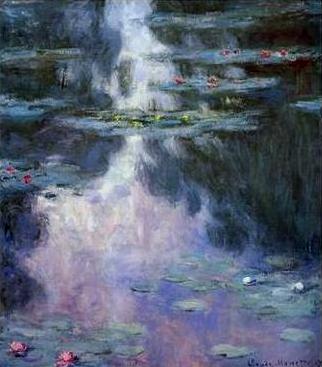

Origins and garden
As part of his plans at Giverny, Monet had a water feature and planting scheme created; the pond and its border plantings provided a controlled natural subject that he could observe across hours and seasons. He began returning to the motif in the late 1890s and, from about 1899 onward, made the pond one of the primary subjects of his work. The pond, its floating pads and blooms, and the reflections of sky and trees offered a way to reduce descriptive detail and to emphasize shifting optical effects. The construction of the pond and the planting of the water lilies were therefore both horticultural and artistic acts, enabling the repeated observation that defines the series.
Visual characteristics and technique
Monet’s approach across the series varies from relatively small, intimate canvases to very large decorative panels. Recurring motifs include rounded lily pads, scattered blossoms, and the fractured reflections of clouds, branches and architectural forms. Over time his handling grew more fluid and the compositions more immersive: horizons often disappear and the picture plane becomes a continuous field of brushwork. During the later phase of the series Monet coped with impaired vision from cataracts, a condition that influenced his palette and the modulation of tones; he also adjusted colors and occasionally revisited canvases after eyesight changes. Critics and historians observe a movement in these works toward an almost abstract language, where color relationships and surface rhythms take precedence over precise description.
Exhibitions and major installations
Monet showed groups of water-lily paintings in his lifetime; a notable early public presentation occurred in 1909 and helped secure the series’ reputation. Later he created very large decorative panels intended as immersive ensembles. Some of these large-format works were installed after his death in a purpose-designed setting at the Musée de l'Orangerie in Paris, where visitors can view them arranged to encourage an enveloping experience.
Collections and where to see them
Individual canvases and groups from the series are spread among major museums and private collections worldwide. Examples of public holdings include the Musée d'Orsay in Paris, the Metropolitan Museum of Art in New York, the Art Institute of Chicago, and other institutions that present representative phases of Monet’s work. Several museums outside France and the United States also hold important canvases and have mounted comparative displays that highlight differences of time, light and scale. For an introduction to Monet’s life and work, many visitors consult biographies and museum catalogues that discuss his late garden paintings in context, and specialist publications that consider technical studies and conservation.
Conservation and reproduction
Because the paintings vary in size, ground and varnish, conservators face choices when stabilizing and cleaning Water Lilies canvases. Several high-profile conservation campaigns over the last decades have addressed discolored varnishes and the effects of past restorations. High-quality reproductions, educational installations and immersive displays have also been used in museums to help the public appreciate the scale and subtlety of the panels without exposing originals to unnecessary light or handling.
Significance and legacy
Monet’s Water Lilies stand among the most influential cycles of the early twentieth century. By concentrating on optical sensation and the painterly surface, the series helped loosen ties between representation and abstraction and influenced several later developments in modern art. The works continue to be studied for their technique, their relationship to gardening as artistic practice, and their role in debates about perception, seriality and the limits of pictorial representation. For further reading and images, museum websites and scholarly catalogues remain the best sources for authoritative documentation and high-resolution reproductions.
- Key artists and biography pages: Monet.
- Garden and site information: Monet’s flower garden and Giverny resources.
- Medical and visual-context notes: material on cataracts and vision-related changes.
- Museums with important holdings: Musée d'Orsay, Paris institutions, Metropolitan Museum of Art, Art Institute of Chicago.
- Practical visitor information on the pond and planting: see details about the pond and the water lilies in garden guides and museum notes.
Note: The Water Lilies remain a central reference for studies of Impressionism’s later phase and for exhibitions that explore the transition toward abstraction and large-scale, immersive painting.
Questions and answers
Q: What is the name of the series of paintings by Claude Monet?
A: The series of paintings is called Water Lilies (or Nymphéas).
Q: How many oil paintings are in the series?
A: The series consists of about 250 oil paintings.
Q: Where were the paintings created?
A: The paintings were created in Monet's flower garden at Giverny.
Q: When did Monet start painting this series?
A: Monet started painting this series in 1893, after having a pond dug and planted with lilies in his garden.
Q: How long did he work on this large-scale decorative series?
A: He worked continuously for more than twenty years on this large-scale decorative series.
Q: When was the first exhibition of these works held?
A: The first exhibition was held in 1909 at the Paris gallery of his art dealer, Paul Durand-Ruel.
Q: In which museums can we find these works today?
A: These works can be found today in museums all over the world, including the Musée Marmottan Monet and the Musée d'Orsay in Paris, the Metropolitan Museum of Art in New York, the Art Institute of Chicago, the Carnegie Museum of Art and National Museum of Wales, among others.
Related articles
Author
AlegsaOnline.com Water Lilies by Claude Monet — the series, context, and legacy Leandro Alegsa
URL: https://en.alegsaonline.com/art/106797
Sources
- mfah.org : Nymphease, 1907
- metmuseum.org : Water Lilies