
Water cycle (hydrological cycle)
The continuous circulation of water through Earth's atmosphere, surface, and subsurface: processes, origin, importance for climate and life, and human impacts on its balance.
The water cycle, also called the hydrological cycle, describes the continuous movement of water on, above, and below the surface of the Earth. It is driven by solar energy and gravity and links the atmosphere, oceans, rivers, soils and groundwater. Key processes—evaporation, condensation, precipitation, runoff and infiltration—transfer water between reservoirs and regulate climate and ecosystems. For a concise overview of those processes see process summaries.
Image gallery
8 Images




Main processes and components
- Evaporation and transpiration: liquid water becomes vapor from oceans, lakes and plants.
- Condensation: water vapor cools and forms clouds and fog.
- Precipitation: rain, snow, sleet or hail returns water to the surface.
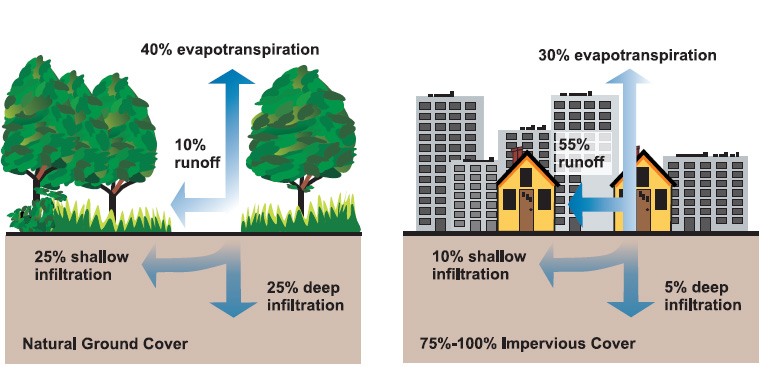
- Infiltration and percolation: surface water soaks into soil and recharges aquifers.
- Runoff and discharge: water flows overland into streams, rivers and ultimately the sea.
The cycle operates at many scales, from local catchments to global exchange between the ocean and atmosphere. Some pathways are rapid (storm runoff), others slow (deep groundwater flow). Human alterations—land use change, dams and groundwater extraction—modify where and how quickly water moves.
Origins and planetary context
Water on Earth has been present since its early history. Scientists infer that much water was incorporated during planet formation and subsequently redistributed by impacts and internal processes. Water also occurs elsewhere in the Solar System, where its presence informs planetary evolution; see research on extra‑terrestrial water at solar system water. The volatile material that supplied both rock and water to the young planet came from the protoplanetary cloud and later planetesimals (formation sources).
The hydrological cycle is essential to life: it supplies fresh water for drinking, agriculture and industry, shapes weather and climate patterns, and supports habitats from wetlands to forests. Managing water sustainably requires understanding its movement and storage at multiple scales.
Notable features and current issues
The cycle is not perfectly balanced in every region—some places experience surplus water while others face scarcity. Climate change alters evaporation rates, precipitation patterns and snowpack, intensifying droughts or floods in different regions. Monitoring networks and models help track changes; for practical guidance on local water management and climate impacts consult resource pages.
For further introductory material and pathways diagrams see process summaries and specialist overviews at formation sources and solar system water.
Questions and answers
Q: What is the water cycle?
A: The water cycle, also known as the hydrological cycle, is the process that water goes through on Earth as it evaporates, condenses, and precipitates.
Q: Why is water important?
A: Water is essential for life on Earth.
Q: Where is water present?
A: Water is present throughout the Solar System.
Q: How did the Earth get its water?
A: The source of the water on Earth was the same as the source of its rock, which came from cloud particles that condensed in the origin of the solar system.
Q: What is the source of the Earth's rock?
A: The source of the Earth's rock was cloud particles that condensed in the origin of the solar system.
Q: What is the origin of the solar system?
A: The origin of the solar system is the cloud of gas and dust that collapsed to form the sun and planets.
Q: What is another name for the water cycle?
A: Another name for the water cycle is the hydrological cycle.
Related articles
Author
AlegsaOnline.com Water cycle (hydrological cycle) Leandro Alegsa
URL: https://en.alegsaonline.com/art/106786