
Wallace Line — biogeographic boundary between Asia and Australasia
A major biogeographic boundary in the Malay Archipelago dividing mainly Asian and Australasian flora and fauna; marks the transition zone Wallacea and illustrates the role of sea barriers in evolution.
Overview
The Wallace Line is a prominent biogeographic boundary in the Malay Archipelago that separates largely Asian plant and animal communities from those of Australasia. The narrow band of islands between the two realms is often called Wallacea and contains a mixture of species from both sides together with many local endemics. The pattern was first noted by the naturalist Alfred Russel Wallace during his mid‑19th century travels and collecting in the East Indies. His observations helped establish biogeography as a scientific discipline and informed thinking about evolution and speciation.
Image gallery
4 Images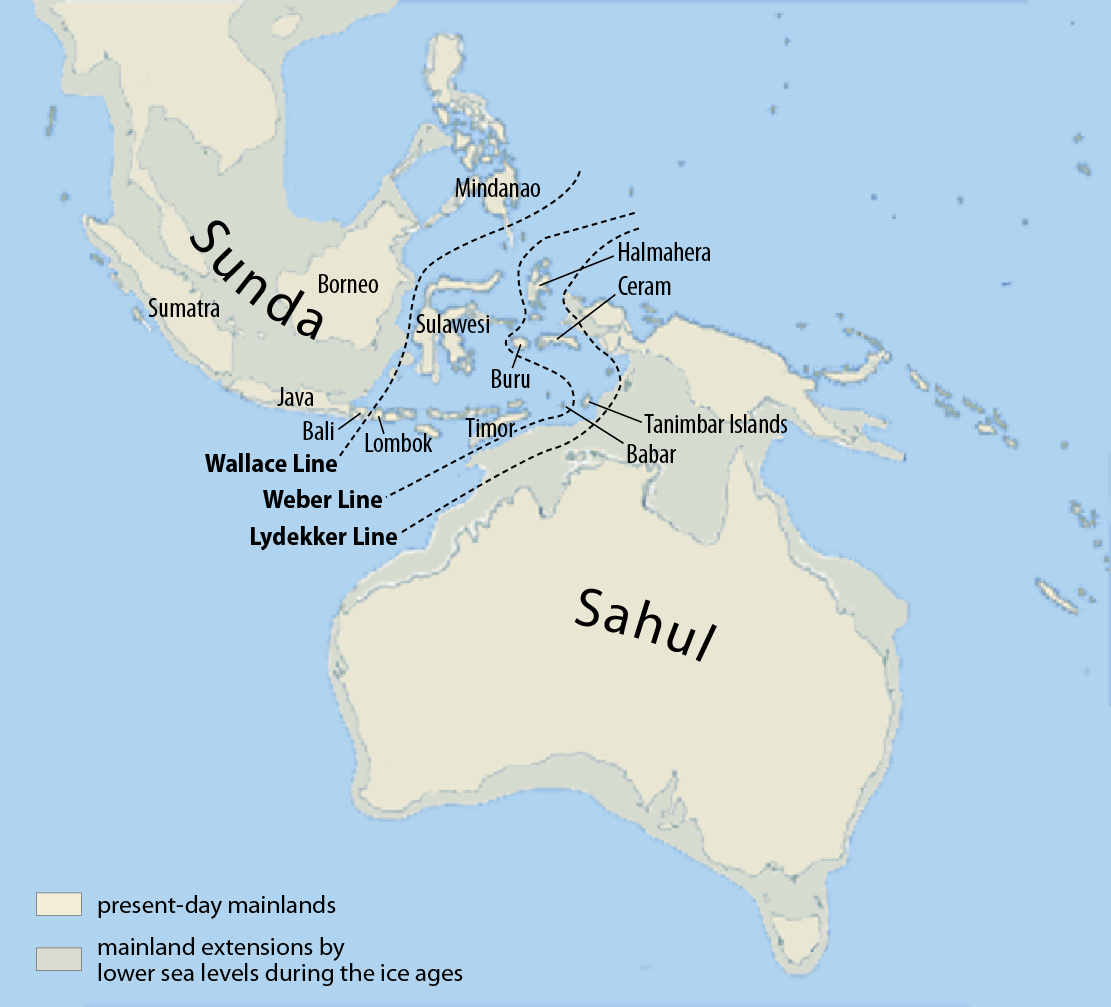


Geographic location and extent
In broad terms the Wallace Line is drawn along deep-water channels that have acted as persistent barriers to terrestrial dispersal, even during glacial periods when sea level was lower. It is traditionally placed between Borneo and Sulawesi and through the Lombok Strait between Bali (west) and Lombok (east). The distance between Bali and Lombok is only about 35 kilometres, yet faunal differences are marked. To the northwest lie the Sunda Shelf islands and continental Asia; to the southeast lie islands related to the Sahul Shelf and the Australian continent.
Wallacea and transitional patterns
Wallacea denotes the set of islands that lie between the Sunda and Sahul shelves. These islands were not connected by land bridges to either shelf during the most recent glacial lowstands, so they retained a mixture of immigrant species and evolved a high proportion of endemic taxa. The result is a complex mosaic of distribution patterns: some groups conform closely to the line, others cross it regularly, and some show a gradual turnover rather than an abrupt break.
Taxonomic contrasts
The most obvious contrasts involve terrestrial mammals and some amphibians: many placental mammals typical of mainland Asia extend onto the Sunda Shelf, while marsupials, monotremes (for example the platypus and echidnas on the Australasian side) and distinctive Australasian bird groups dominate east of the line. Bats and many birds are more capable of crossing water barriers and therefore occur on both sides; conversely, freshwater-limited amphibians and many small terrestrial mammals show strong segregation. The Crab‑eating Macaque is an example of a species whose range crosses or approaches the boundary in places.
Explanations: sea level, geology and dispersal
The principal explanation for the Wallace Line is geological: deep ocean channels between the Sunda and Sahul continental shelves prevented continuous land connections during glacial lowstands, so many terrestrial organisms that disperse poorly across seawater remained confined to their respective shelves. Plate tectonics and island histories also shaped habitat availability and routes of colonization. Over evolutionary time, isolation led to contrasting assemblages and significant endemism within Wallacea.
Related biogeographic concepts
Other lines and concepts have been proposed to describe faunal limits in the region. Lydekker's Line is often used to indicate the eastern limit of Australasian fauna near the edge of the Sahul Shelf, while the Weber Line has been suggested as an intermediate boundary reflecting a balance of Asian and Australasian elements. These are complementary ways of expressing the same general pattern of faunal turnover across the archipelago.
History and scientific importance
Alfred Russel Wallace's collections and writings in the 19th century brought attention to the abrupt changes in species composition across the archipelago. The term "Wallace's Line" was popularized soon after by other scientists. The region continues to be central to studies of island biogeography, speciation, dispersal and the effects of past climate change on biodiversity.
Conservation and current issues
Wallacea and adjacent regions host high biodiversity and many endemic species, but they face threats from habitat loss, hunting, invasive species and development. Conservation planning often uses the biogeographic distinctions highlighted by the Wallace Line to prioritize areas of research and protection. Because species respond differently to fragmentation and human pressures, integrated strategies are required to conserve representative ecosystems on both sides of the boundary.
Further reading and resources
- Biogeographic realms overview
- Asian fauna and flora
- Australasian biota
- Alfred Russel Wallace biography
- Geography of Indonesia
- Borneo natural history
- Sulawesi (Celebes) ecosystems
- Bali island ecology
- Lombok island information
- Bird distribution patterns
- Bat biogeography
- Crab‑eating macaque (example species)
- Thomas Huxley and early terminology
Understanding the Wallace Line is useful for both historical perspectives on natural history and for modern conservation and ecological research. It remains a clear example of how geography and sea barriers can shape the distribution and evolution of life.
Questions and answers
Q: What is the Wallace Line?
A: The Wallace Line is a boundary that separates the ecozone of Asia and the Australasian ecozone.
Q: What is the transitional zone called?
A: The transitional zone is sometimes called Wallacea.
Q: Who is the line named after?
A: The line is named after Alfred Russel Wallace.
Q: Where does the line run through Indonesia?
A: The line runs through Indonesia, between Borneo and Sulawesi (Celebes); and through the Lombok Strait between Bali (in the west) and Lombok (in the east).
Q: Why do many bird species observe the line?
A: Many bird species observe the line because many birds do not cross even the smallest stretches of open ocean water.
Q: Are there any mammals that can be found on both sides of the line?
A: An exception is the Crab-eating Macaque, but most mammals are generally limited to one side or the other.
Q: Who first used the term 'Wallace's Line'?
A: The term 'Wallace's Line' was first used by Huxley in 1868.
Related articles
Author
AlegsaOnline.com Wallace Line — biogeographic boundary between Asia and Australasia Leandro Alegsa
URL: https://en.alegsaonline.com/art/106278