
Waldpolenz Solar Park — 40 MW Photovoltaic Power Plant in Saxony, Germany
Waldpolenz Solar Park is a c.40 MW photovoltaic power plant east of Leipzig in Saxony, Germany. Built with thin‑film PV technology and reported investment near €130 million, it demonstrated utility‑scale solar in central Europe.
Overview
The Waldpolenz Solar Park is a utility‑scale photovoltaic (PV) power installation located to the east of Leipzig in Germany. With an installed capacity of around 40 megawatts (MW), the site occupies several dozen hectares of former agricultural land and was among the larger European PV installations when it was commissioned in the late 2000s. The project combined modern thin‑film PV modules, central inverters and grid connection infrastructure, and required coordinated planning with regional grid operators.
Image gallery
3 Images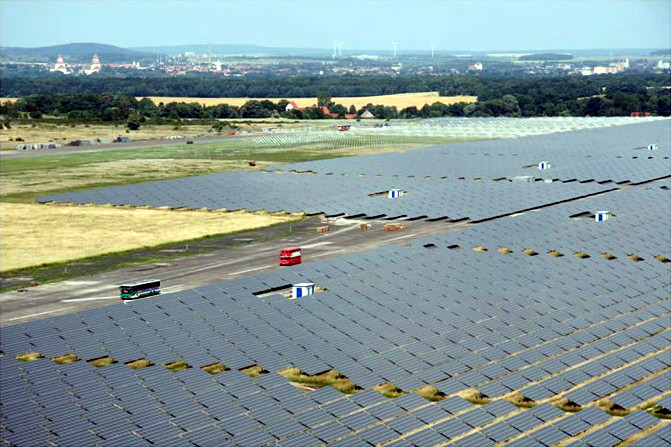


Design and technology
The plant was built largely using thin‑film photovoltaic modules, a class of technology that includes materials such as cadmium telluride (CdTe). Thin‑film modules can offer advantages in performance under diffuse light and at certain operating temperatures compared with some crystalline silicon designs. Modules are arranged in arrays with inverters that convert direct current (DC) to alternating current (AC) for delivery to the distribution network. Site layout considered row spacing, tilt, shading, access for maintenance and equipment placement.
History and development
Developed during a period of rapid expansion in solar installations in Germany, Waldpolenz was planned and financed by private investors and industry partners as part of broader efforts to scale up renewable electricity generation. At the time of construction the total investment has been reported at approximately €130 million, covering panels, civil works, grid connection and site preparation. The project illustrated how utility‑scale PV could be sited on lower‑value agricultural land while meeting regulatory and permitting requirements.
Operations and performance
As an operating facility, Waldpolenz supplies electricity to the regional grid and contributes to local renewable energy targets. Plant operators monitor seasonal yield, module performance and maintenance needs to optimise output. Performance depends on local irradiance, weather patterns and the specific characteristics of the thin‑film modules used; such monitoring provides data useful for comparisons between technologies in temperate climates.
Environmental and social aspects
Large PV parks like Waldpolenz are evaluated for land use, biodiversity effects and visual impact. Where possible, operators and planners incorporate measures such as ecological buffer zones, habitat management and access routes to reduce potential negative impacts. During construction the project generated local employment and, once in operation, provides long‑term generation without direct fuel consumption or emissions at the site.
Location and grid integration
The facility is located in the administrative district of Muldentalkreis within the federal state of Saxony. Its proximity to Leipzig and regional transmission lines simplified grid connection and logistics. Integration of intermittent PV generation requires coordination with distribution system operators and can involve measures such as curtailment rules, forecasting and, where available, complementary balancing resources.
Significance and legacy
Waldpolenz served as an early demonstration of large‑scale thin‑film PV deployment in central Europe and contributed to the learning curve that reduced costs and improved practices for subsequent projects. It remains a reference point for planners and researchers studying the operational characteristics and land‑use implications of utility‑scale solar in temperate climates.
Further information
For general background on solar generation and PV technology consult an overview of solar power topics and published material on photovoltaic technology. Regional context and planning documents can be found through resources on the Leipzig region or local energy authorities. Technical reports and operator publications provide the most current operational data and details on grid integration practices.
Questions and answers
Q: Where is the Waldpolenz Solar Park located?
A: The Waldpolenz Solar Park is located to the east of Leipzig in Germany.
Q: What kind of power plant is the Waldpolenz Solar Park?
A: The Waldpolenz Solar Park is a photovoltaic (PV) power plant.
Q: How many megawatts of solar power does the Waldpolenz Solar Park have?
A: The Waldpolenz Solar Park is a 40-megawatt solar power system.
Q: What technology does the Waldpolenz Solar Park use?
A: The Waldpolenz Solar Park uses new technology.
Q: Where is the district of Muldentalkreis located?
A: The district of Muldentalkreis is located in the state of Saxony in eastern Germany.
Q: How much did the Waldpolenz solar park cost to invest in?
A: The investment cost for the Waldpolenz solar park is around Euro 130 million.
Q: What kind of renewable energy resource does the Waldpolenz Solar Park use?
A: The Waldpolenz Solar Park uses solar power as a renewable energy resource.
Related articles
Author
AlegsaOnline.com Waldpolenz Solar Park — 40 MW Photovoltaic Power Plant in Saxony, Germany Leandro Alegsa
URL: https://en.alegsaonline.com/art/106219
Sources
- renewableenergyaccess.com : "Phase One of 40 MW German Solar Park Begun"