
Waits (town musicians)
Municipal musicians known as waits served British towns from medieval times into the 19th century as timekeepers, watchmen and civic players; continental equivalents include Stadtpfeifer and Pifferi.
The term "waits" (or "waites") refers to organized bands of municipal musicians historically attached to important towns and cities, most famously in Britain. From the later Middle Ages through the early 1800s they fulfilled a set of civic functions that combined music, signalling and public service. Similar traditions existed elsewhere in Europe, where municipal players were known by local names such as the German Stadtpfeifer or the Italian Pifferi.
Image gallery
2 Images
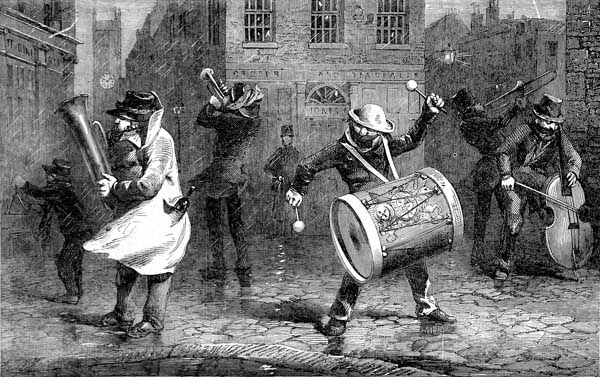
Roles and duties
Waits performed several practical and ceremonial tasks. One of their routine duties was to sound the hours or particular times of day from elevated positions such as church towers, helping townspeople keep time before widespread personal clocks. They also acted as night watchmen, looking out from towers for fire or other dangers and alerting the population—an important civic safeguard in an era with little or no organized police. In addition, waits played for markets, civic processions, openings of town councils and other municipal events, and they were sometimes hired for private occasions like weddings or funerals.
Instruments, dress and organization
As municipal performers their ensemble and equipment emphasized projection and public presence. They commonly used bright, penetrating air instruments rather than soft strings—broadly described as wind instruments—so that music carried across streets and squares. Typical instruments included the loud reed shawm (shawm), early trombones or sackbuts, trumpets and various drums. Town waits were paid employees or retainers, often wearing distinctive livery; senior players sometimes bore chains of office set with the town's arms to denote their official status.
Variations and continental practice
The exact duties and repertory of waits varied by place and period. In Germany, for example, the Stadtpfeifer combined civic and ecclesiastical work: on ordinary days they might supply shawms or trombones (trombones) for town and church events, while on feast days the ensemble could include trumpets (trumpets) and drums (drums) to mark the celebration. Such local differences reflected municipal needs, available players and changing musical tastes over centuries.
History, decline and legacy
The institution of waits grew from medieval urban administration and persisted into the modern era, but it gradually declined as municipal structures and public services changed. Reforms in the early 19th century—especially those that reorganized borough corporations—diminished or abolished many ancient civic offices, and by about 1835 traditional waits had largely disappeared as regular town employees in Britain. Despite this, the name survived in seasonal and popular contexts: groups of carol singers are still commonly called "Christmas waits," keeping the association between communal singing and the festive season.
Importance and modern echoes
Waits are significant for historians of music, urban life and municipal government because they illustrate how music once served practical civic needs as well as ceremonial ones. The tradition influenced the development of town bands, military bands and civic music services. In some places enthusiasts and historical societies have revived or commemorated waits in present-day civic ceremonies; elsewhere the legacy lives on only in place names, museum displays and the continuing phrase "Christmas Waits" or the notion of singing carols in the streets.
- Overview: municipal musical corps tied to town government and public duty.
- Typical duties: timekeeping, night watch, ceremonies, market and festival music.
- Typical instruments: loud winds and percussion suited to outdoor performance.
- Legacy: name persists in seasonal traditions and occasional historical revivals.
Questions and answers
Q: What were British town musicians called?
A: British town musicians were called waites or waits.
Q: Were waits found in other countries besides Britain?
A: Yes, some other countries in Europe also had waits. They were called Stadtpfeifer in Germany and Pifferi in Italy.
Q: What was one of the main duties of a wait?
A: One of their most important jobs was to play at certain times of day so that people knew what the time was.
Q: How did they alert people to the time of day?
A: They often played from the top of church towers.
Q: Did they have any other duties besides playing music?
A: Sometimes they were also guards, watching from the towers so that they could spot any danger. They were like watchmen, making sure everything was all right (there was no police at that time). They woke people up in the mornings by playing music in the streets.
Q: What instruments did they usually play?
A: Mostly they were loud wind instruments such as the shawm.
Q: When did waits stop existing in Britain?
A: There were no more waits after 1835 in Britain.
Related articles
Author
AlegsaOnline.com Waits (town musicians) Leandro Alegsa
URL: https://en.alegsaonline.com/art/106164