
Volterra — Etruscan hill town in Tuscany with medieval and Roman heritage
Volterra is a hilltop town in Tuscany, Italy, known for its Etruscan origins, medieval centre, alabaster craft, Roman remains and preserved historic architecture under Medici and Florentine influence.
Volterra is a compact hilltop town in central Tuscany whose long history ties it to Etruscan civilization and later medieval and Renaissance Italy. The settlement commonly called Volterra appears in many guides as an example of an Italian town that preserves successive layers of ancient, Roman and medieval urban fabric within a clearly defined hilltop core. For a concise local overview see Volterra.
Image gallery
10 Images



Location and landscape
Perched on volcanic tuff, Volterra overlooks the surrounding valleys and has historically benefited from defensible topography and local stone resources. The town lies within the administrative region that forms part of central Italy, and its position made it a regional centre from the pre-Roman period through the Middle Ages. Visitors note narrow streets, extensive walls and panoramic viewpoints that reflect this elevated setting.
Historical development
Volterra originated as an important Etruscan centre and later incorporated Roman urban features such as baths and a theatre. In the Middle Ages it functioned as an independent commune with typical civic institutions. Over time Volterra came under the political sway of Florence and was affected by the expansion of Florentine power and the rule of ruling families, notably the Medici. Its history therefore illustrates the layers of Etruscan, Roman, communal and Florentine influence on a single site; general narratives of these phases can be found in local histories and archaeological summaries.
Architectural and archaeological highlights
- Etruscan remains and sections of ancient defensive walls, which reveal early urban planning and funerary practices.
- Roman-era structures such as a small theatre and thermal remains scattered beneath later buildings.
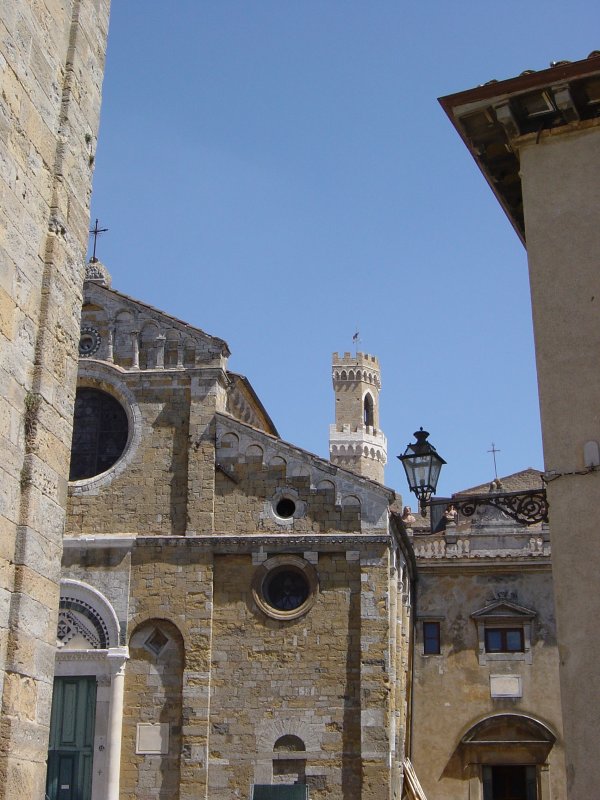
- Medieval civic buildings, including a prominent town hall and narrow piazzas; the town retains a medieval street pattern.
- Religious buildings, most notably the cathedral complex and baptistery; see the town cathedral entry for further detail: Volterra Cathedral.
Volterra's public museums house Etruscan artefacts and local collections that document the town's long occupation. These institutions present funerary urns, inscriptions and sculptural material that are typical of Etruscan urban sites, and they help contextualise visible ruins in the townscape.
Economy, crafts and modern cultural relevance
The town has a traditional craft economy built around alabaster carving: local workshops transform the soft calcium carbonate stone into decorative and utilitarian objects, sustaining a niche artisan trade that attracts collectors and tourists. Volterra also hosts cultural events and benefits from heritage tourism, which supports hospitality and small-scale retail.
In contemporary culture the town has appeared in novels and films that draw on its atmospheric streets and ancient setting. Its preserved historic centre and museum collections make Volterra a frequent subject for visitors interested in Etruscan archaeology as well as medieval and Renaissance architecture. For discussions of the Florentine period and broader political context see sources on Florentine influence and Medici governance.
Many guidebooks and regional sites provide practical information for visitors, while specialist studies treat Volterra's archaeological and art-historical significance in greater depth. For further general reference see regional overviews and municipal introductions available through the town's official resources and cultural institutions.
Questions and answers
Q: Where is Volterra located?
A: Volterra is located in the Tuscany region of Italy.
Q: In which province is Volterra situated?
A: Volterra is situated in the province of Pisa.
Q: What was Volterra in ancient times?
A: Volterra was once one of the 12 cities in Etruria.
Q: Was Volterra an independent city in the middle ages?
A: Yes, Volterra was an independent city in the middle ages.
Q: Who conquered Volterra after the middle ages?
A: Volterra was conquered by the Florentines and then the Medicis after the middle ages.
Q: Does Volterra have its own cathedral?
A: Yes, Volterra has its own cathedral.
Q: On what type of hill was Volterra built?
A: Volterra was built on top of an ancient volcanic hill.
Related articles
Author
AlegsaOnline.com Volterra — Etruscan hill town in Tuscany with medieval and Roman heritage Leandro Alegsa
URL: https://en.alegsaonline.com/art/105888