
Virgo Supercluster (Local Supercluster)
A nearby collection of galaxy groups and clusters that includes the Virgo Cluster and the Local Group; spans roughly 33 Mpc (~110 million ly) and sits within the larger Laniakea complex.
Overview
The Virgo Supercluster, often called the Local Supercluster, is a large-scale concentration of galaxy groups and clusters in which our own Local Group resides. It is a feature of the nearby cosmic web and serves as a practical reference for studies of local cosmography and galaxy environments.
Image gallery
6 Images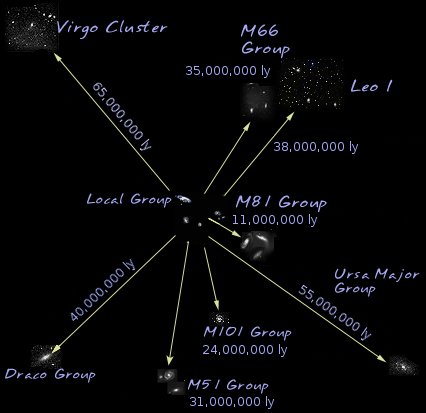


Structure and scale
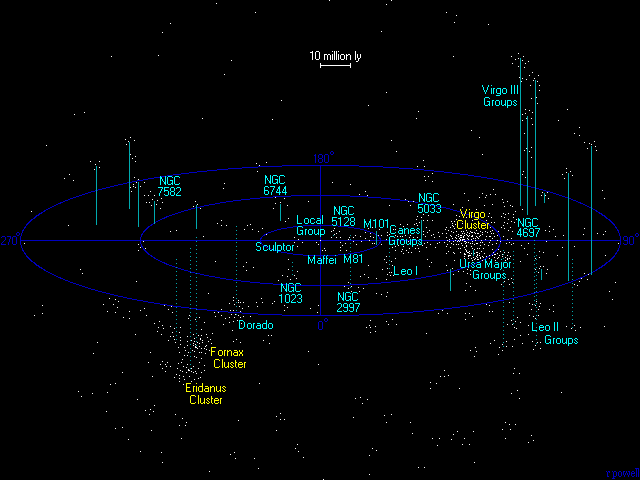
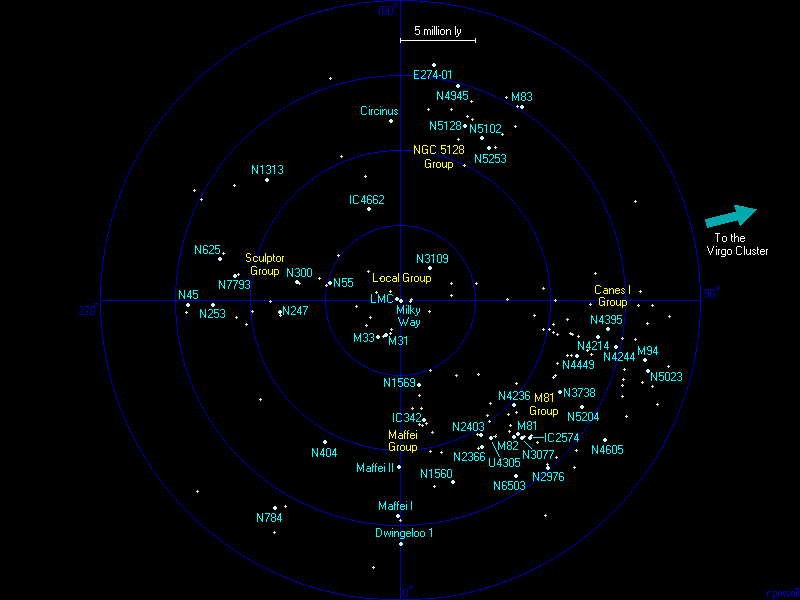
The supercluster is anchored by the rich Virgo Cluster and includes the Local Group (the Milky Way, Andromeda, Triangulum and their satellite galaxies). Its characteristic diameter is commonly given as about 33 mega parsecs (roughly 110 million light‑years), although the precise boundary depends on how one defines membership.
Components and contents
The Virgo Supercluster contains numerous galaxy groups and clusters, from relatively small associations to the massive Virgo Cluster itself. It therefore hosts hundreds to thousands of galaxies, including spirals, ellipticals and irregulars, and many smaller satellite systems. As part of the hierarchy of cosmic structure, it is one example of a nearby supercluster.
History and mapping
The concept of a Local or Virgo Supercluster emerged mid-20th century as redshift surveys and galaxy catalogs revealed a nonuniform distribution of galaxies. Subsequent mapping and distance‑velocity studies refined its shape and membership. In recent decades researchers have shown that the Virgo Supercluster occupies a region within a still larger flow field sometimes named Laniakea.
Significance and examples
Studying the Virgo Supercluster helps astronomers understand galaxy evolution in different environments, measure peculiar velocities (the motions of galaxies relative to cosmic expansion), and chart the distribution of mass locally. The Local Group provides a close example for detailed study, while the Virgo Cluster illustrates dense cluster dynamics.
Notable facts and context
- The supercluster is one of many similar concentrations in the observable universe, and its exact membership varies with the definition used.
- Because definitions differ, the Virgo Supercluster can be treated either as a distinct structure or as part of larger assemblies identified by modern surveys.
- Its study links traditional cataloging of nearby galaxies with contemporary large‑scale structure research.
Questions and answers
Q: What is the Virgo Supercluster?
A: The Virgo Supercluster is a large galaxy cluster that contains the Virgo Cluster and the Local Group.
Q: How many galaxies and clusters are in the Virgo Supercluster?
A: At least 100 galaxies and clusters are in the Virgo Supercluster.
Q: What is the diameter of the Virgo Supercluster?
A: The diameter of the Virgo Supercluster is 33 megaparsecs (110 million light-years).
Q: Is the Virgo Supercluster unique in the observable universe?
A: No, the Virgo Supercluster is one of millions of superclusters in the observable universe.
Q: What is the Virgo Cluster?
A: The Virgo Cluster is a cluster of galaxies within the Virgo Supercluster.
Q: What is the Local Group?
A: The Local Group is a group of galaxies within the Virgo Supercluster that includes the Milky Way and Andromeda galaxies.
Q: How far away is the Virgo Supercluster from Earth?
A: The Virgo Supercluster is about 110 million light-years away from Earth.
Related articles
Author
AlegsaOnline.com Virgo Supercluster (Local Supercluster) Leandro Alegsa
URL: https://en.alegsaonline.com/art/105555
Sources
- cfa.harvard.edu : The geometry of the Local Supercluster
- ui.adsabs.harvard.edu : 1981BASI....9....1D
- arxiv.org : astro-ph/0107104
- ui.adsabs.harvard.edu : 2003ApJ...596...19K
- doi.org : 10.1086/377574
- arxiv.org : astro-ph/0508669
- ui.adsabs.harvard.edu : 2006Ap&SS.302...43H
- doi.org : 10.1007/s10509-005-9006-7
- ui.adsabs.harvard.edu : 1982ApJ...257..389T
- doi.org : 10.1086/159999
- ui.adsabs.harvard.edu : 2007A&A...476..697E
- doi.org : 10.1051/0004-6361:20078037