
Virgo Cluster
A nearby rich cluster of galaxies in the constellation Virgo; central to the Virgo Supercluster and home to many well-known galaxies such as M87 and M49.
Overview
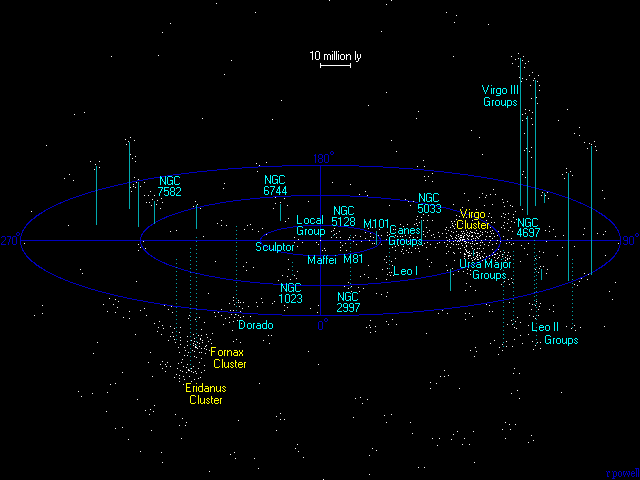
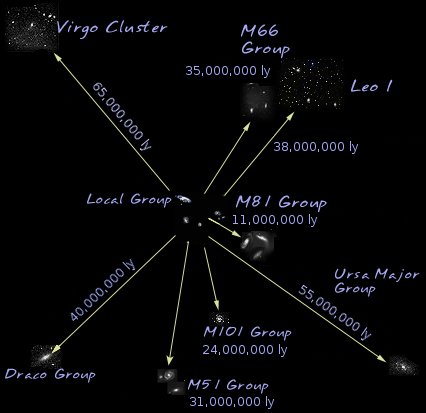
The Virgo Cluster is a prominent cluster of galaxies located in the constellation Virgo. It lies at a distance of roughly 53.8 million light‑years (about 16.5 million parsecs) from Earth. As the most conspicuous concentration of galaxies in the nearby universe, the Virgo Cluster forms the dense core of the larger Virgo Supercluster, to which the Local Group of galaxies belongs as an outlying component.
Image gallery
6 Images


Structure and membership
The cluster contains on the order of a thousand to a few thousand galaxies (commonly cited values range from about 1,300 up to perhaps 2,000 members). Its total mass, including dark matter and hot intracluster gas, is substantial — of order 10^15 solar masses within several megaparsecs — and has been estimated in large surveys (see mass measurements). Virgo is not a single smooth object but a complex system made of several subgroups: a main concentration around the giant elliptical Messier 87 and other subclusters centered on bright ellipticals such as Messier 49.
History and discovery
Many of the brighter Virgo members were noted by 18th‑century observers and included in Charles Messier's catalogue as nebulae: for example, Messier 87 (a massive elliptical) and Messier 49 were among the objects recorded. At the time they were described as nebulous patches without resolvable stars (non‑cometary nebulae). The recognition that these nebulae were distant galaxies rather than objects within the Milky Way came in the early 20th century, a change in understanding that transformed extragalactic astronomy. Historical catalog entries and identifications are discussed in sources tied to catalogues such as the NGC and Messier lists, and in later compilations (historical studies).
Observational properties and importance
Virgo is the nearest rich galaxy cluster and therefore plays an outsized role in studies of galaxy evolution, dynamics, and the intergalactic medium. It is a prime target for optical and radio surveys, for X‑ray observations of the hot intracluster gas, and for studies of environmental effects such as ram‑pressure stripping and galaxy harassment. The cluster's gravity also affects local motions: galaxies in our region show a component of infall toward Virgo, sometimes referred to as Virgocentric infall. Detailed maps of Virgo help calibrate distance indicators and cosmological measurements.
Notable members and distinguishing facts
- Messier 87 (M87) — a giant elliptical with a relativistic jet and a very massive central black hole imaged by the Event Horizon Telescope; often discussed in literature about active galactic nuclei (M87).
- Messier 49 (M49) — one of the brightest ellipticals in the cluster and historically cited as the brightest Virgo member (M49).
- Other well‑known members include galaxies listed in the NGC and Messier catalogues; many are visible in small telescopes and have been studied since the 18th and 19th centuries.
The Virgo Cluster remains a focal point for both amateur observation and professional research. Its mix of bright ellipticals, spirals, and dwarf galaxies, together with abundant hot gas and complex substructure, make it an ideal laboratory for understanding how environment shapes galaxy properties across cosmic time. For introductory reference and catalogs see items linked above (general description, distance, parsec conversion, perspective from Earth, constellation, astronomical context, supercluster, Local Group relation, mass estimates, catalog entries, M87 details, M49 details, Messier catalogue, historical terminology, further reading).
Questions and answers
Q: What is the Virgo Cluster?
A: The Virgo Cluster is a cluster of galaxies.
Q: Where is the center of the Virgo Cluster located?
A: The center of the Virgo Cluster is 53.8 ± 0.3 million light years (16.5 ± 0.1 million parsecs) away from Earth in the constellation Virgo.
Q: What is the Virgo Supercluster?
A: The Virgo Supercluster is a larger supercluster of galaxies of which the Virgo Cluster forms the heart, and our Local Group is an outlying member.
Q: How many member galaxies does the Virgo Cluster have?
A: The Virgo Cluster has about 1300 (and perhaps up to 2000) member galaxies.
Q: What is the mass of the Virgo Cluster?
A: The mass of the Virgo Cluster is about 1.2×10¹⁵ solar masses out to 8 degrees of the cluster's center or a radius of about 2.2 million parsecs.
Q: What were the two brightest galaxies in the Virgo Cluster discovered in the late 1770s and early 1780s?
A: The two brightest galaxies in the Virgo Cluster that were discovered in the late 1770s and early 1780s were the giant elliptical galaxy Messier 87 and brightest member Messier 49.
Q: What is the brightest member of the Virgo Cluster?
A: The brightest member of the Virgo Cluster is the elliptical galaxy Messier 49.
Related articles
Author
AlegsaOnline.com Virgo Cluster Leandro Alegsa
URL: https://en.alegsaonline.com/art/105553
Sources
- arxiv.org : astro-ph/0702510
- ui.adsabs.harvard.edu : 2007ApJ...655..144M
- doi.org : 10.1086/509598
- astronomy.swin.edu.au : Virgo Cluster
- arxiv.org : astro-ph/0106261
- ui.adsabs.harvard.edu : 2001A&A...375..770F
- doi.org : 10.1051/0004-6361:20010833
- seds.org : M91