
Viking Invasion of Britain (865) — the Great Heathen Army
The Great Heathen Army was a large Viking force that arrived in England in 865 and shifted Norse activity from raids to prolonged conquest and settlement, reshaping Anglo-Saxon political and cultural life.
Overview
The term "Great Heathen Army" refers to a coalition of Viking forces that landed in England in 865 and remained for several years with the intent of territorial conquest rather than seasonal raiding. Contemporary and later accounts describe a string of campaigns that targeted multiple Anglo-Saxon kingdoms and ultimately produced areas of sustained Norse settlement. The invasion marks a turning point in the Viking presence in Britain: from hit-and-run raids to permanent political and social influence. For discussion of settlement patterns see Norse settlement and the Great Heathen Army.
Image gallery
4 Images


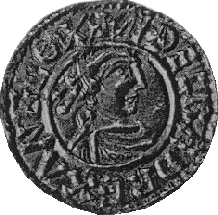
Composition and leadership
The army was largely composed of Scandinavian warriors, commonly described as Danes in Anglo-Saxon sources. Leaders named in medieval chronicles and later Norse tradition include figures who have become semi-legendary. Historians treat specific names and genealogies cautiously, but agree the force was sizable, organized, and capable of overwintering and campaigning across several regions. For background on the Danish element, consult accounts of Danish Viking activity.
Campaign and major actions
The Great Army first appears in sources as arriving in the region of East Anglia and then moving into neighboring kingdoms. Unlike earlier raiders, it stayed through winters, took fortified towns, and engaged in pitched battles and sieges. Key events commonly cited include the capture of York, campaigns in Northumbria and Mercia, and prolonged pressure on Wessex. The invasion disrupted the existing Anglo-Saxon polities and forced new strategies of resistance. For context on the Anglo-Saxon kingdoms that confronted the army, see Anglo-Saxon England and on the initial landing region see East Anglia.
- Arrival and overwintering in eastern England
- Capture of strategic towns and shifts in control
- Negotiations, battles, and eventual settlement in parts of England
Outcomes and legacy
The most enduring consequence of the invasion was the foundation of large zones where Scandinavian law, custom, and language had influence—often summarized as the Danelaw. Norse settlers integrated with local populations, influencing place names, legal practices, material culture, and linguistics. The army thus accelerated a process of cultural exchange that shaped later medieval England.
Sources and interpretation
Knowledge of the Great Heathen Army relies on a mix of contemporary chronicles, later sagas, and archaeological evidence. The Anglo-Saxon Chronicle is a principal written source but reflects the viewpoint of English compilers and sometimes compresses or omits details. Archaeology—settlement patterns, burial finds, and place-name studies—complements the texts and helps map how and where Norse communities became established. Modern historians balance these strands to form cautious reconstructions of events and impact.
Notable distinctions
Unlike episodic Viking raids of earlier decades, the Great Heathen Army represents a deliberate campaign aimed at conquest and colonization. Its arrival and actions were a key factor in transforming the political map of England in the late 9th century and in creating long-term Scandinavian influence across parts of the island.

Questions and answers
Q: What is the Viking invasion of Britain?
A: The Viking invasion of Britain in 865 AD is when a large force of Danish Vikings attacked Anglo-Saxon England with the intention of conquering all of England.
Q: What is the Great Heathen Army or Great Danish Army or Great Viking Army?
A: The Great Heathen Army, Great Danish Army, or Great Viking Army is what the Viking invasion of Britain in 865 AD is sometimes called.
Q: What did previous Viking invasions of Britain aim for?
A: Previous Viking invasions of Britain were aimed at looting.
Q: Did the Great Viking Army stay in Britain for a long time?
A: Yes, unlike earlier Viking raiders, the Great Viking Army stayed for many years in Britain, aiming to conquer all of England.
Q: When did the Great Viking Army appear in East Anglia?
A: The Great Viking Army appeared in East Anglia in 865 AD.
Q: What was the purpose of the Viking invasion of Britain in 865 AD?
A: The purpose of the Viking invasion of Britain in 865 AD was to conquer all of England.
Q: Did the Viking invasion of Britain lead to permanent or semi-permanent settlement?
A: Yes, the Viking invasion of Britain in 865 AD led to semi-permanent settlement.
Related articles
Author
AlegsaOnline.com Viking Invasion of Britain (865) — the Great Heathen Army Leandro Alegsa
URL: https://en.alegsaonline.com/art/105139