
Victory Through Air Power (1943 film)
A 1943 Walt Disney wartime film adapting Alexander P. de Seversky’s book to argue for strategic air power, mixing animation and live-action as Allied propaganda and policy advocacy during World War II.
Overview
Victory Through Air Power is a 1943 animated feature produced by Walt Disney that adapts Alexander P. de Seversky’s 1942 book of the same name. Unlike Disney’s contemporaneous family entertainment, this film blends traditional animation with live-action segments and direct argument to present a case for strategic air warfare. De Seversky himself appears in the film to deliver portions of the argument and explain technical and geopolitical points to viewers.
Image gallery
2 Images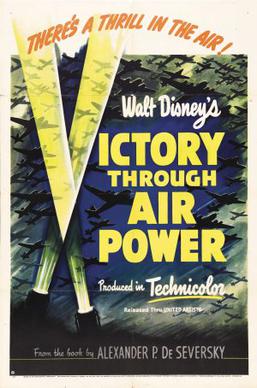

Form and content
The film departs from Disney’s usual narrative musicals and character-driven cartoons, using animation as a didactic tool rather than for pure entertainment. Stylized sequences visualize ideas about aircraft, bombing, logistics and aerial strategy, while documentary-style live footage and on-camera commentary provide a more explicit policy appeal. The score and editing emphasize urgency and clarity rather than comedy or fantasy. In this sense the work functions as both an animated film and a persuasive short documentary.
Historical context and production
Made after the United States’ entry into World War II, Victory Through Air Power belongs to a body of films created or adapted by Hollywood to support the Allied cause. During the war years Disney studios produced a range of material for training, information and public morale; this picture falls into the category often described as wartime propaganda. Contemporary reports and later accounts indicate the film was screened beyond commercial theaters—reaching military and governmental audiences—and it is often noted that figures such as Winston Churchill and Franklin D. Roosevelt were shown the film and found its arguments noteworthy.
Reception and influence
Critically, the film generated mixed responses: some praised its clarity and persuasive animation techniques, while others questioned the tone and propagandistic intent of adapting a polemical book into a popular medium. It did receive recognition from the film industry, earning an Academy Award nomination for Best Music Score of a Dramatic or Comedy Picture. More broadly, Victory Through Air Power is cited as an early example of animation being used explicitly for strategic communication rather than entertainment alone.
Key elements and legacy
- Based on Alexander P. de Seversky’s 1942 book advocating strategic air superiority.
- Combines animated explanatory sequences with live-action appearances by de Seversky.
- Produced in the wartime period when studios, including Disney, contributed to the Allied information effort.
- Recognized by the Academy with a nomination for its musical score (Academy Award).
- Often discussed as an instance of film influencing public opinion and policymakers during the conflict.
Today the film is remembered for its unusual role within Disney’s catalog and for showing how animated techniques can be repurposed for argument and instruction in a time of national emergency.
Questions and answers
Q: What is Victory Through Air Power?
A: Victory Through Air Power is a 1943 Walt Disney Technicolor animated movie.
Q: What is the book that the movie is based on?
A: The movie is based on the 1942 book Victory Through Air Power by Alexander P. de Seversky.
Q: Who is Alexander P. de Seversky?
A: Alexander P. de Seversky is the author of the 1942 book Victory Through Air Power and also appears in the movie.
Q: Was Victory Through Air Power a typical Disney animated movie?
A: No, it was not a typical Disney animated movie of the time.
Q: Did Victory Through Air Power receive any award nominations?
A: Yes, the movie received an Academy Award nomination for Best Music Score of a Dramatic or Comedy Picture.
Q: Why were Disney studios changed after December 8, 1941?
A: The studios were changed into a propaganda machine for the United States government after December 8, 1941.
Q: What was the purpose of Victory Through Air Power and other World War II movies?
A: While most World War II movies were made for training, movies such as Victory Through Air Power were made to build public morale among the U.S. and Allied powers.
Related articles
Author
AlegsaOnline.com Victory Through Air Power (1943 film) Leandro Alegsa
URL: https://en.alegsaonline.com/art/105016
Sources
- toonopedia.com : "Victory Through Air Power."
- skylighters.org : "Disney goes to war."