
Vibration isolation: principles, devices, and practical applications
Techniques and devices that reduce transmission of vibratory energy between a vibrating source and its supports; covers components, methods, applications from tools to buildings, and key distinctions.
Overview
Vibration isolation is the practice of reducing or preventing the transfer of vibratory energy between a source and the object or structure that supports it. By interrupting the path through which mechanical vibrations travel, isolators protect equipment, improve comfort and safety for users, and limit structural damage. The field overlaps with broader strategies of vibration control but focuses specifically on decoupling and attenuation.
Image gallery
8 Images




Common components and methods
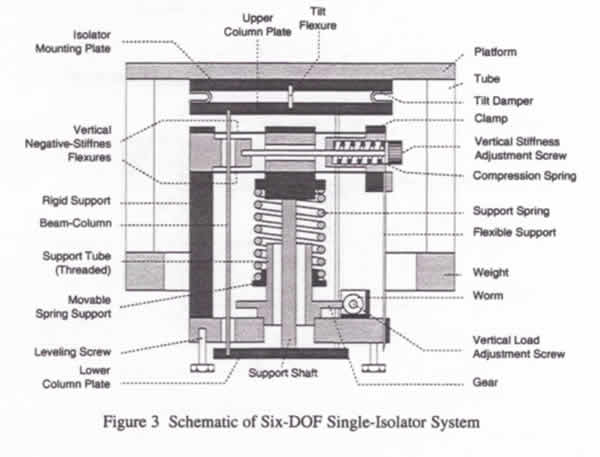
Isolation is accomplished through devices and materials that change the dynamic interaction between masses, stiffnesses and damping. Typical elements include:
- Springs and elastomer mounts — provide low stiffness to reduce transmitted force at certain frequencies.
- Dampers — convert vibrational energy into heat, reducing resonance peaks.
- Mass blocks and inertia bases — add mass to lower natural frequency or absorb energy.
- Pads and tuned isolators — designed for specific equipment frequencies (e.g., engines, compressors).
How it works
Performance is often described by transmissibility: the ratio of output vibration to input vibration across frequency. Below a structure's natural frequency, isolation is limited; near resonance vibration can be amplified unless damping is present; above it, properly designed isolators reduce transmission. Selection balances stiffness, damping, load capacity and environmental factors such as temperature and aging.
History and large-scale use
Concepts of isolation date to simple supports and padding in early machinery; advances in materials and structural engineering expanded applications to buildings and bridges. When applied to heavy structures, the approach is commonly called base isolation, a seismic design technique that decouples a structure from ground motion during earthquakes. Notable uses include isolated buildings and retrofitted bridges to improve resilience.
Applications and notable distinctions
Vibration isolation is used across industry: hand tools and appliances to reduce operator fatigue, precision instruments to improve measurement accuracy, industrial machinery to protect foundations, and civil structures to mitigate seismic forces. It differs from simple soundproofing or absorption because its primary goal is interrupting mechanical transmission paths rather than merely absorbing airborne noise. Effective designs consider the system as a whole—source, path and receiver—and often combine isolation with damping and isolation-enhancing layouts.
Understanding the frequency content of the source, expected loads and environmental constraints is essential to choose the right isolator type and achieve reliable long-term performance.
Questions and answers
Q: What is vibration isolation?
A: Vibration isolation is a system of devices that helps to separate a mechanical or structural object from its vibrating supports to reduce shaking.
Q: How does vibration isolation work?
A: Vibration isolation works by using a system of devices that helps to decouple a mechanical or structural object from its vibrating supports, such as using spring mounts.
Q: What kind of objects can benefit from vibration isolation?
A: Any object that experiences shaking or vibration, such as saw handles or buildings and bridges, can benefit from vibration isolation.
Q: What is base isolation?
A: Base isolation is a type of vibration isolation used for heavy objects like buildings and bridges.
Q: What is the purpose of vibration isolation?
A: The purpose of vibration isolation is to reduce the amount of shaking or vibration that an object experiences, which can improve performance or reduce discomfort for operators.
Q: Is vibration isolation part of vibration control?
A: Yes, vibration isolation is a branch of protective techniques within the broader field of vibration control.
Q: Can vibration isolation be used for electronic devices?
A: Yes, vibration isolation can be used for electronic devices to protect them from vibration and other types of mechanical shock.
Related articles
Author
AlegsaOnline.com Vibration isolation: principles, devices, and practical applications Leandro Alegsa
URL: https://en.alegsaonline.com/art/104867
Sources
- commons.wikimedia.org : Vibration isolation
- physics-animations.com : Passive and Active Vibration Isolation Systems