
Vehicle Assembly Building: Kennedy Space Center's giant rocket factory
The Vehicle Assembly Building (VAB) at Kennedy Space Center is a landmark industrial structure used to stack, integrate and prepare large rockets and spacecraft for launch.
Overview
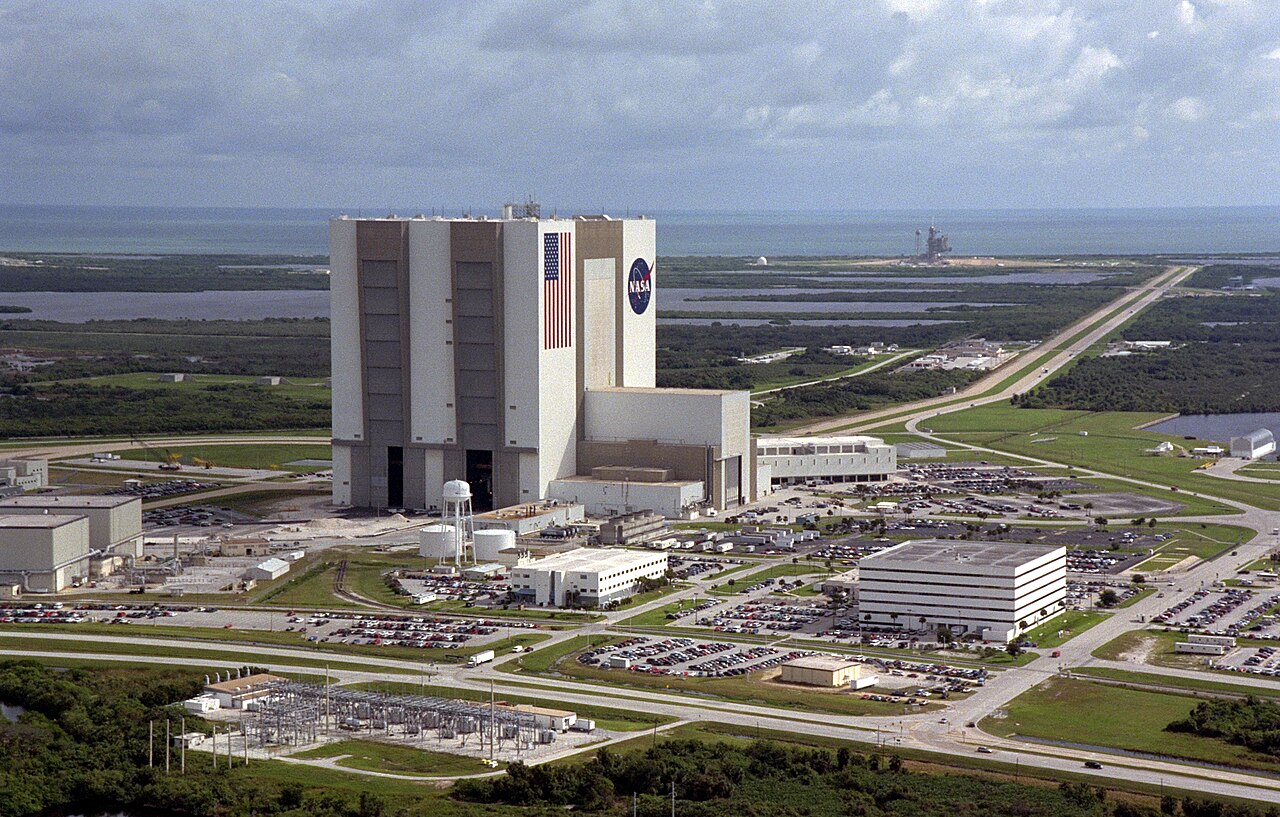
The Vehicle Assembly Building (VAB) is a purpose-built industrial structure at the John F. Kennedy Space Center in Florida. Designed to join rocket stages, spacecraft and related hardware in a vertical orientation, the VAB supports the final assembly and pre-launch processing of the United States' largest launch vehicles. Its size and specialized interior allow fully stacked vehicles to be prepared on mobile launch platforms and rolled out to the pad sheltered from weather until final operations.
Image gallery
10 Images




Design and principal features
The VAB is notable for its immense volume and internal working space. Constructed from a steel and concrete framework, it rises to a height that accommodates multi-stage rockets assembled end-to-end. Inside are tall, unobstructed bays with overhead handling systems, multiple levels of work platforms that can be repositioned around the vehicle, and large doors that permit the completed stack to be transferred to a crawler-transporter for transport to the launch complex.
- High bays: The building contains multiple high bays—large vertical workspaces configured to hold rockets and support equipment while technicians integrate stages, payloads and payload fairings.
- Cranes and platforms: Heavy-lift cranes and adjustable platforms allow precise mating of components and access at all elevations of the vehicle.
- Mobile launch support: Completed assemblies are placed onto mobile launch platforms so the entire stack can be moved to the pad as a single unit.
History and development
Construction of the VAB began in the early 1960s and the facility was completed in the mid-1960s during a period of rapid expansion of the U.S. space program. It was created to support the Saturn V rockets of the Apollo era and later adapted to process Space Shuttle stack configurations and subsequent launch vehicle designs. Over time the interior systems, tooling and platforms have been modernized to accommodate different vehicle shapes and sizes while preserving the original structural volumes.
Today the VAB remains a central element of launch processing at the Kennedy complex. It has been used for major programs including the Saturn V, the Space Shuttle, and more recent heavy-lift vehicles. For more on the center that hosts the building, see the Kennedy Space Center information page: Kennedy Space Center.
Uses, operations and importance
Beyond stacking and mating, the VAB provides a controlled environment for final checkouts, installation of payloads, and integration of ground support connections. The ability to assemble rockets vertically before taking them to the pad simplifies testing and reduces exposure of sensitive hardware to weather. It supports coordinated workflows involving engineers, technicians and launch operations personnel, and remains instrumental in maintaining national launch capability.
Distinctive facts and legacy
The VAB is recognized as one of the largest single-story buildings in the world by internal volume. Its exterior is also widely seen: murals and painted insignia on the façade are among the most prominent painted symbols on any industrial building. Adjacent structures such as the Launch Control Center are connected to the VAB, facilitating integrated launch processing. For a technical perspective on its construction and scale, see engineering and construction details.
Because of its size and the scale of operations it supports, the Vehicle Assembly Building has become an enduring symbol of large-scale spaceflight manufacturing and launch preparation, reflecting both the industrial challenges and the programmatic flexibility required to support multiple generations of rockets and spacecraft.
Questions and answers
Q: What is the Vehicle Assembly Building?
A: The Vehicle Assembly Building is an industrial building at the John F. Kennedy Space Center.
Q: What is the purpose of the Vehicle Assembly Building?
A: The Vehicle Assembly Building is designed to assemble pre-made rocket stages, spacecraft, and related parts vertically onto a mobile launch platform.
Q: What kind of rockets have been assembled in the Vehicle Assembly Building?
A: The Saturn V, Space Shuttle, Ares-I rockets, and the upcoming Space Launch System have been assembled in the Vehicle Assembly Building.
Q: When was construction of the Vehicle Assembly Building completed?
A: Construction of the Vehicle Assembly Building was completed in 1966.
Q: How tall is the Vehicle Assembly Building?
A: The Vehicle Assembly Building is 525 feet (160 meters) tall.
Q: How many assembly areas does the Vehicle Assembly Building have?
A: The Vehicle Assembly Building has four large assembly areas called high bays.
Q: What is the size of the internal volume of the Vehicle Assembly Building?
A: The Vehicle Assembly Building contains 3,665,000 m3 of internal volume.
Related articles
Author
AlegsaOnline.com Vehicle Assembly Building: Kennedy Space Center's giant rocket factory Leandro Alegsa
URL: https://en.alegsaonline.com/art/104465