
Valley of the Kings — The Theban necropolis in Egypt
Ancient New Kingdom burial ground on the Nile’s west bank near Luxor, famed for its rock-cut royal tombs, decorated chambers, the discovery of Tutankhamun, and ongoing excavation and conservation.
The Valley of the Kings (Arabic: Wādī al Mulūk) is a dry, walled valley on the west bank of the Nile opposite modern Luxor. Used primarily during Egypt's New Kingdom (roughly the 16th–11th centuries BCE), it served as the burial place for many pharaohs, members of the royal family and some high officials. The site is part of the larger Theban Necropolis and is widely known for its rock-cut tombs, wall paintings and the remarkable artefacts recovered by archaeologists.
Image gallery
10 Images


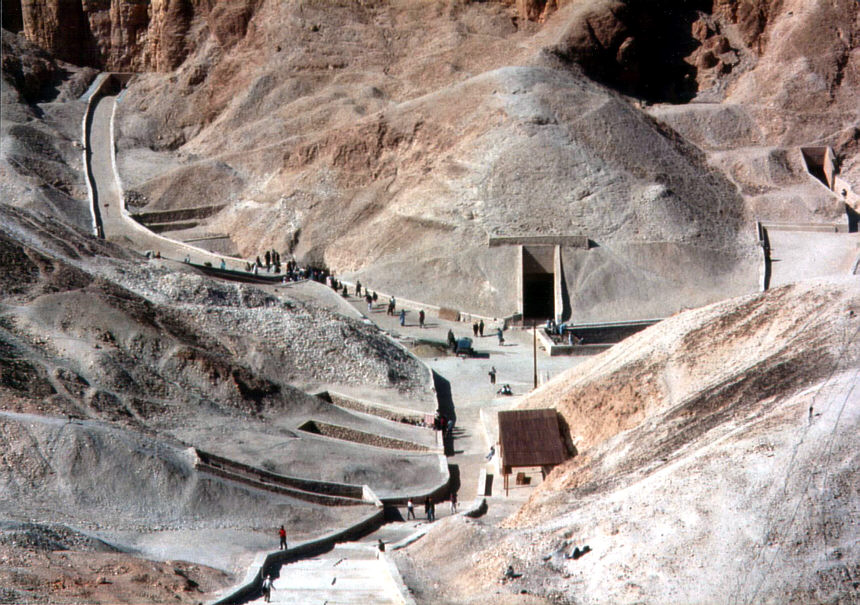


Location and physical layout
The valley occupies a range of limestone hills and consists of two principal depressions commonly referred to as the East Valley and the West Valley. Tombs are cut directly into bedrock and typically descend along corridors into one or more chambers. Their layouts vary from a simple shaft and burial chamber to extensive, multi-room complexes. The geology and arid climate helped preserve painted decoration and organic remains for millennia until the modern era.
Tomb architecture, decoration and funerary practice
Tombs are often decorated with funerary texts and scenes drawn from Egyptian religious literature, intended to protect and guide the deceased in the afterlife. Decorations include episodes from the Book of the Dead and other mortuary books, along with depictions of gods, symbolic motifs and the deceased king in ritual contexts. Royal interments originally included coffins, canopic equipment, furniture, clothing, jewellery and offerings, though many tombs were robbed in antiquity.
Notable burials
- Ramesses II — one of the most famous New Kingdom rulers with multiple monuments.
- Thutmose I — an early royal burier in the valley.
- Tutankhamun — his largely intact tomb, found in 1922, drew worldwide attention.
- Other pharaohs and royal family members who used the valley include rulers and princes of successive dynasties.
- High officials and nobles with close royal connections were also interred in nearby tombs.
- Other important royal tombs include those associated with Seti I and Ramesses III, noted for their elaborate decoration and preservation.
History of exploration and major discoveries
European explorers and Egyptologists mapped and excavated the valley from the late 18th century onward. The most publicly famous discovery was the near-intact tomb of Tutankhamun, uncovered by Howard Carter in 1922, which contained a wealth of burial goods and provided new insights into royal funerary practice. Systematic recording, clearance and study of tombs continued through the 19th and 20th centuries and remain active today.
Conservation, management and tourism
The Valley of the Kings was inscribed as part of the Theban Necropolis World Heritage Site in 1979. Conservation teams confront problems such as visitor impact, changes in humidity, salt crystallization, past restoration methods and the local water table. To manage visitation and protect fragile decoration, authorities restrict access to certain tombs, rotate open tombs, and operate an interpretation and visitor centre to improve preservation while allowing public access.
Ongoing research
Archaeological work in and around the valley continues: teams document tomb architecture, record wall paintings and inscriptions, stabilise structures, and apply scientific methods such as imaging and material analysis. New fieldwork sometimes reveals additional shafts, burials or evidence of ancillary activity, contributing to a fuller picture of how the site was used and modified over time.
Further resources and practical information
For contextual information consult resources on the valley's topography and local names (Arabic toponymy), maps and plans (site maps), and general histories of New Kingdom Egypt (historical context). Catalogues and studies list known tombs (tomb catalogue) and identify individual burials (royal interments, nobles). Visit planning and access details are available from local site management pages (conservation and visitor management), and interpretive material at the visitor centre (World Heritage information). For scholarly publication and excavation reports, see specialist resources on archaeological finds and analysis (research and finds, Tutankhamun studies, geographical setting, relation to Luxor, individual tomb studies, royal monuments).
Questions and answers
Q: What is the Valley of the Kings?
A: The Valley of the Kings is a valley in Egypt where tombs were built for Pharaohs and powerful nobles from the 16th to 11th centuries BC.
Q: Who is buried in the Valley of the Kings?
A: Some of the people buried in the Valley of the Kings include Ramesses II, Thutmose I, and Tutankhamun.
Q: Where is the Valley of the Kings located?
A: The Valley of the Kings is located on the west bank of the Nile across from Luxor, in Egypt.
Q: Why is the Valley of the Kings famous?
A: The Valley of the Kings is famous because it is one of the most famous archaeological sites in the world.
Q: When did the Valley of the Kings become a World Heritage Site?
A: The Valley of the Kings became a World Heritage Site in 1979, along with the rest of the Theban Necropolis.
Q: Is exploration, excavation and conservation still ongoing in the Valley of the Kings?
A: Yes, exploration, excavation and conservation continues in the Valley of the Kings.
Q: Has a new tourist centre been recently opened in the Valley of the Kings?
A: Yes, a new tourist centre has recently been opened in the Valley of the Kings.
Related articles
Author
AlegsaOnline.com Valley of the Kings — The Theban necropolis in Egypt Leandro Alegsa
URL: https://en.alegsaonline.com/art/104071