
Adolf Anderssen — 19th-century German chess master and problemist
German chess master Adolf Anderssen (1818–1879) was a leading player of the mid-19th century, famed for sacrificial attacking play, tournament victories and influential games such as the 'Immortal' and 'Evergreen'.
Adolf Anderssen (6 July 1818 – 13 March 1879) was a German chess master and mathematics teacher who became one of the most celebrated players of the mid-19th century. Born in Breslau (now Wrocław, Poland), Anderssen gained international recognition through major tournament wins and brilliant, sacrificial attacking games. He is often cited among the strongest players active between 1851 and 1870 and was respected as an elder statesman of chess in his later years.
Image gallery
4 Images

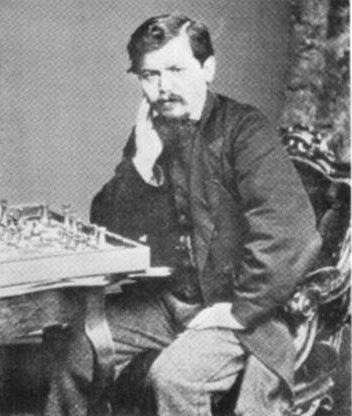

Career highlights and tournaments
Anderssen won several important international events that raised his reputation across Europe. Notable victories include the inaugural London tournament of 1851 and later triumphs in London 1862 and Baden-Baden 1870. These results established him as a dominant tournament player of his era; the Baden-Baden event in particular featured many of the leading masters of the day and is comparable in strength to modern high-level tournaments. For more on his public recognition and standing, see contemporary accounts.
- London 1851: breakthrough win that brought him international fame; see summaries at London 1851.
- London 1862: further affirmation of his tournament strength.
- Baden-Baden 1870: one of his last major tournament victories; further details at Baden-Baden 1870.
Matches and contemporary rivals
Although Anderssen excelled in tournaments, he suffered important match defeats. In 1858 he lost a match to Paul Morphy, who was then regarded as the strongest player in the world; readers can consult a match summary at Morphy 1858. In 1866 Anderssen was narrowly defeated by Wilhelm Steinitz, a pivotal figure who later advanced positional and defensive ideas; that match is discussed at Steinitz 1866. These encounters show both Anderssen's high level and the changing currents in chess theory.
Style, composition and notable games
Anderssen's style is remembered for daring combinations and bold sacrificial attacks rather than deep positional manoeuvres. He composed chess problems as well as playing over the board, and several of his games became classics because of their imaginative tactical ideas. Two of his best-known encounters are the "Immortal Game" (1851) and the "Evergreen Game" (1852), which are still studied for their tactical brilliance and aesthetic appeal. His approach influenced the romantic school of chess that prized artistic mating patterns and material sacrifices to achieve decisive victory.
Legacy and significance
Beyond results, Anderssen is notable for bridging generations: he was an amateur in the modern sense (having a professional career outside chess) yet he dominated many events and advised younger players. He remained active into his late 50s, placing highly at Leipzig 1877, and was admired for his personal character as well as his play. Today he is remembered both for specific celebrated games and for representing the creative, attacking school that defined mid-19th-century chess.
For further exploration of his life and games, consult the linked resources above or collections of historical games and problems that showcase Anderssen's tactical gifts and lasting impact on chess culture.
Questions and answers
Q: Who was Karl Ernst Adolf Anderssen?
A: Karl Ernst Adolf Anderssen was a German chess master and teacher of mathematics who was recognized as the best player in the world for much of the time between 1851 and 1870.
Q: What tournaments did he win?
A: He won three great international tournaments - the first in London 1851, then London 1862, and Baden-Baden 1870.
Q: Did he ever lose any matches?
A: Yes, he lost matches in 1858 to Paul Morphy and narrowly to Steinitz in 1866.
Q: What other activities besides playing chess was Anderssen known for?
A: He was also a chess problem composer.
Q: How successful was Anderssen at tournament play?
A: He became the most successful tournament player in Europe, winning over half of the events he entered - including the Baden-Baden 1870 tournament which is comparable to modern strong GM tournaments.
Q: What is Anderssen famous for today?
A: He is still famous for his brilliant sacrificial attacking play, particularly in the 'Immortal Game' (1851) and 'Evergreen Game' (1852).
Q: How did others view him during his lifetime?
A: Others viewed him as an elder statesman of the game to whom they turned for advice or arbitration.
Related articles
Author
AlegsaOnline.com Adolf Anderssen — 19th-century German chess master and problemist Leandro Alegsa
URL: https://en.alegsaonline.com/art/1040