
Valencian pilota (Pilota Valenciana): traditional handball of the Valencian Community
Valencian pilota is a traditional handball sport from Spain's Valencian Community. Played with the hand, it has several regional variants, distinctive courts, close spectatorship and deep cultural roots.
Overview
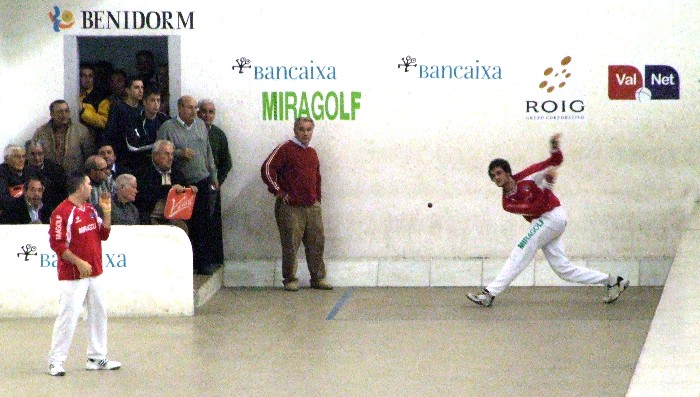
Valencian pilota (literally “pilota” = ball in Valencian) is a family of handball sports played in the Valencian Community in eastern Spain. The game is defined by striking a small, hard ball with the bare or almost bare hand, often with minimal protection. It is not played against a single wall as in some other ball games; instead two opposing players or teams face each other across a defined playing area, which may be an indoor court or a street. Rules, team sizes and scoring vary by locality, but the core ideas—direct returns, hand contact and an active spectator presence—are common to all forms.
Image gallery
9 Images




Variants and courts
Several regional variants exist, each with its characteristic court and way of playing. Typical types include:
- Escala i corda: played in a covered court called a trinquet; a rope (corda) divides the sides and the game uses a complex scoring system.
- Raspall: also played in a trinquet or adapted space; players strike the ball after it bounces low, often near the ground.
- Llargues: traditionally played in streets or long rectangular grounds, with teams attempting to send the ball beyond the opposing side.
- Galotxa and frontó: local forms with distinctive court walls or street layouts.
Court types named in local usage include the trinquet (an enclosed, often historic hall), the carrers (streets adapted for play) and the open-frontó for wall-based variants that coexist with the face-to-face traditions.
Rules, equipment and play
Basic rules change by variant, but matches typically pit two sides against one another, with teams ranging from two to five players. The ball—called the pilota—is constructed to be durable and lively; players generally use their bare hand, though professionals sometimes add minimal protection or tape. Scoring systems differ: some use point progressions similar to the traditional "quinzes" scoring found in related European games, while others count games and rounds in different ways. Spectators are often very close to play, especially in street games and in certain trinquet layouts, and crowd interactions can affect the flow of a match.
Origins and cultural importance
The precise origins of Valencian pilota are not fully documented, but the sport is related to medieval and early modern handball games played across Europe. Scholars note affinities with the French Jeu de paume and other historical ball games that evolved into modern racket and handball sports. Over centuries the practice became localized in the Valencian region and developed distinctive rules and venues. Today it remains a strong element of regional identity, present at local festivals, taught in clubs and schools, and maintained by amateur players and organized competitions.
Notable features and distinctions
Valencian pilota is notable for how many different local customs it preserves within a single sporting family. The combination of bare-hand striking, the variety of court types, and the proximity of spectators gives the sport a communal, festival-like character not typical of stadium sports. It coexists with other European handball traditions but is distinguished by its particular vernacular terminology, the historical trinquet halls, and the persistence of street-based play in some towns.
Further reading and resources
For introductions to the language and terminology, see resources about the Valencian language and local sporting culture. For general context on handball traditions across Europe consult sources on historical games such as the Jeu de paume. For definitions and broader handball classifications, refer to handball overviews at relevant handball references. To learn more about the Valencian region where the sport developed, see materials connected to the Valencian Community. For linguistic notes on the term pilota, consult language guides at Valencian language resources.
Questions and answers
Q: What is Pilota Valenciana?
A: Pilota Valenciana is a traditional handball sport played in the Valencian community.
Q: What is the meaning of pilota?
A: Pilota means ball in Valencian.
Q: Where are the origins of Pilota Valenciana?
A: The origins of Pilota Valenciana are unknown, but it seems to be related to the French Jeu de paume.
Q: What do the rules of Pilota Valenciana involve?
A: The rules of Pilota Valenciana vary from area to area but the common trait is that the ball is struck with a bare or almost bare hand.
Q: How many players are there per team in Pilota Valenciana?
A: There can be two up to five players in each team, depending on the particular version played.
Q: How is Pilota Valenciana played?
A: Pilota Valenciana is not played against a wall. Instead, two individuals or teams are placed face to face separated either by a line on the ground or a net.
Q: What is the characteristic that makes Valencian pilota distinctive?
A: A distinctive trait of Valencian pilota is that the spectators are often seated or standing very close to the court, which means that they may be impacted by the ball and become an (unwilling) part of the game.
Related articles
Author
AlegsaOnline.com Valencian pilota (Pilota Valenciana): traditional handball of the Valencian Community Leandro Alegsa
URL: https://en.alegsaonline.com/art/103978