
Väinämöinen — Wise singer and culture hero of Finnish mythology
Väinämöinen is a central figure in Finnish folklore and the Kalevala: a primordial singer-magician whose songs shape the world. This article explains his origins, powers, principal stories, and cultural significance.
Overview
Väinämöinen is one of the principal figures of Finnish myth and the national epic, the Kalevala. Presented as a primeval, wise old man, he is primarily known for his mastery of song and incantation. Through poetry and music he influences nature, wins contests of wit, and takes part in the creation and early shaping of the world. His character blends shamanic, poetic and heroic traits common to north-eastern Baltic-Finnic oral tradition.
Image gallery
9 Images


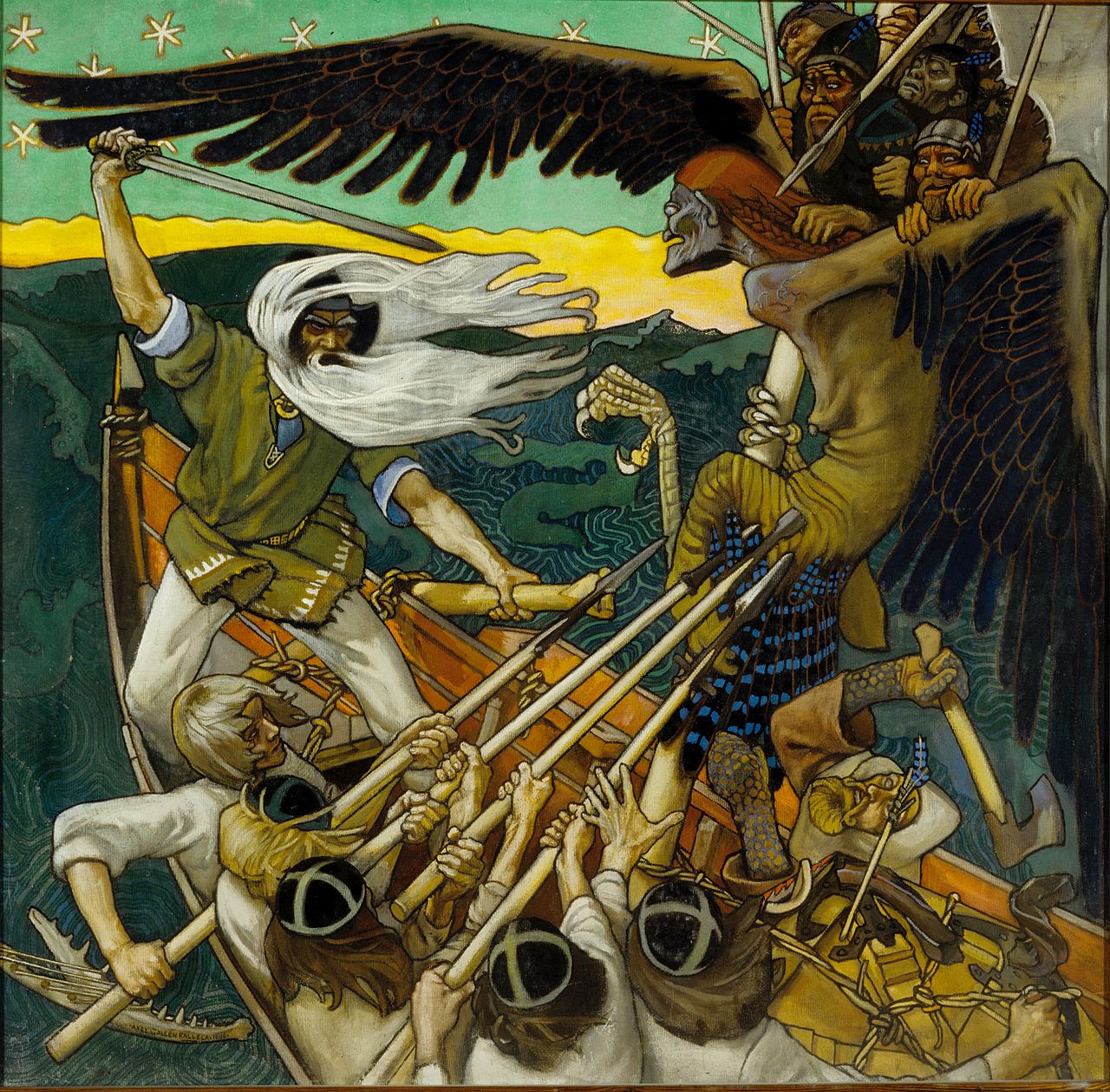


Mythic origins
The traditional stories describe Väinämöinen as a quasi-primordial being born at the beginning of creation. In the best-known account, the virgin spirit Ilmatar (a personification of air and the sea) becomes pregnant and carries the child for many years. A water-bird builds a nest, and when its eggs fall and break, pieces of shell and yolk become the earth, sky, sun, moon and stars. Väinämöinen emerges as a fully formed adult, already possessing deep wisdom and the power of song. These narratives appear in the collected oral poems compiled by Elias Lönnrot in the 19th century.
Traits, powers, and iconography
Väinämöinen's primary power is the magic of words and music. His songs can calm storms, move water, and bind or unmake rivals—an idea that reflects a broader Eurasian tradition in which spoken formulae and ritual song have real force. He is commonly associated with the kantele, a plucked string instrument; one famous tale recounts him fashioning a kantele from a pike's jawbone. Artists and storytellers often depict him as an elderly, bearded minstrel or sage.
Key episodes
- Contest with the youth Joukahainen: a poetic duel whose outcome shows Väinämöinen's verbal superiority and leads to Joukahainen's humiliation and near-drowning.
- Creation of the kantele: his skill at making and playing the instrument produces extraordinary music that moves people and beasts.
- Quest for the Sampo: while the Sampo itself is forged by the smith Ilmarinen, Väinämöinen plays a central role in the struggle over this mysterious talisman of prosperity.
- Departure and promise to return: at the close of the epic Väinämöinen sails away and foretells he may return when his songs are needed.
Stories and sources
Most of what is known about Väinämöinen derives from the Kalevala, compiled and edited by Elias Lönnrot from oral runes collected across Finland and Karelia. The poems preserved multiple variants of tales, and Lönnrot wove them into a continuous epic that influenced Finnish national identity in the 19th century. Scholarly work links Väinämöinen to older shamanic figures and to other Indo-European and Uralic singer-heroes; for general introductions see further reading and collections of runic songs at primary sources.
Cultural significance and legacy
Väinämöinen has been a recurring subject in Finnish art, music, literature and political symbolism. Composers, painters and writers have drawn on his image to explore national history and identity. In contemporary culture he appears in adaptations ranging from classical compositions and novels to popular media. For modern interpretations and scholarly discussion, consult overviews at academic summaries and curated collections at cultural archives. His figure illustrates how oral poetry and ritual expression can become foundational to a people's literary and mythic self-understanding.
Questions and answers
Q: Who is Väinämöinen in Finnish mythology?
A: Väinämöinen is an important person in Finnish mythology.
Q: What was Väinämöinen known for?
A: Väinämöinen was known for his wisdom, magic, heroism, and many adventures.
Q: How was Väinämöinen worshipped?
A: As a god, Väinämöinen was worshipped for his magic in his songs.
Q: What happened when Väinämöinen sang?
A: When Väinämöinen sang, hills shook and water moved. He was even able to use his songs to make his enemy, Joukahainen, sink into a swamp.
Q: How was Väinämöinen born?
A: Väinämöinen was born before Earth, floating in the sea. His mother, Ilmatar, carried him for 30 years after getting pregnant by water and wind.
Q: What happened when a bird made a nest on Ilmatar's knee?
A: When a bird (Sotka) made a nest on Ilmatar's knee, it hatched six eggs made of iron and one pure gold. The burning nest caused Ilmatar to move her knee, and the eggs flew into the sky and on the earth, breaking into pieces and creating the Earth and sky, stars, sun, and moon.
Q: Was Väinämöinen only a hero or also a god?
A: Väinämöinen was not only a hero, but also a god.
Related articles
Author
AlegsaOnline.com Väinämöinen — Wise singer and culture hero of Finnish mythology Leandro Alegsa
URL: https://en.alegsaonline.com/art/103885