
V12 engine — design, history, and applications
A V12 is a 12-cylinder internal combustion engine arranged in two banks forming a V. Known for smoothness and power, it’s used in luxury cars, racing, aviation, and heavy machinery.
Overview
A V12 is a type of internal combustion engine with 12 cylinders arranged in two banks of six that meet at an angle to form a "V". Each cylinder contains a piston connected to a common crankshaft, and the engine can be configured to run on a variety of fuels such as gasoline, diesel or natural gas. The multiple cylinders and even firing intervals make the V12 one of the smoothest internal combustion layouts, prized where vibration, refinement and continuous power delivery are important.
Image gallery
10 Images


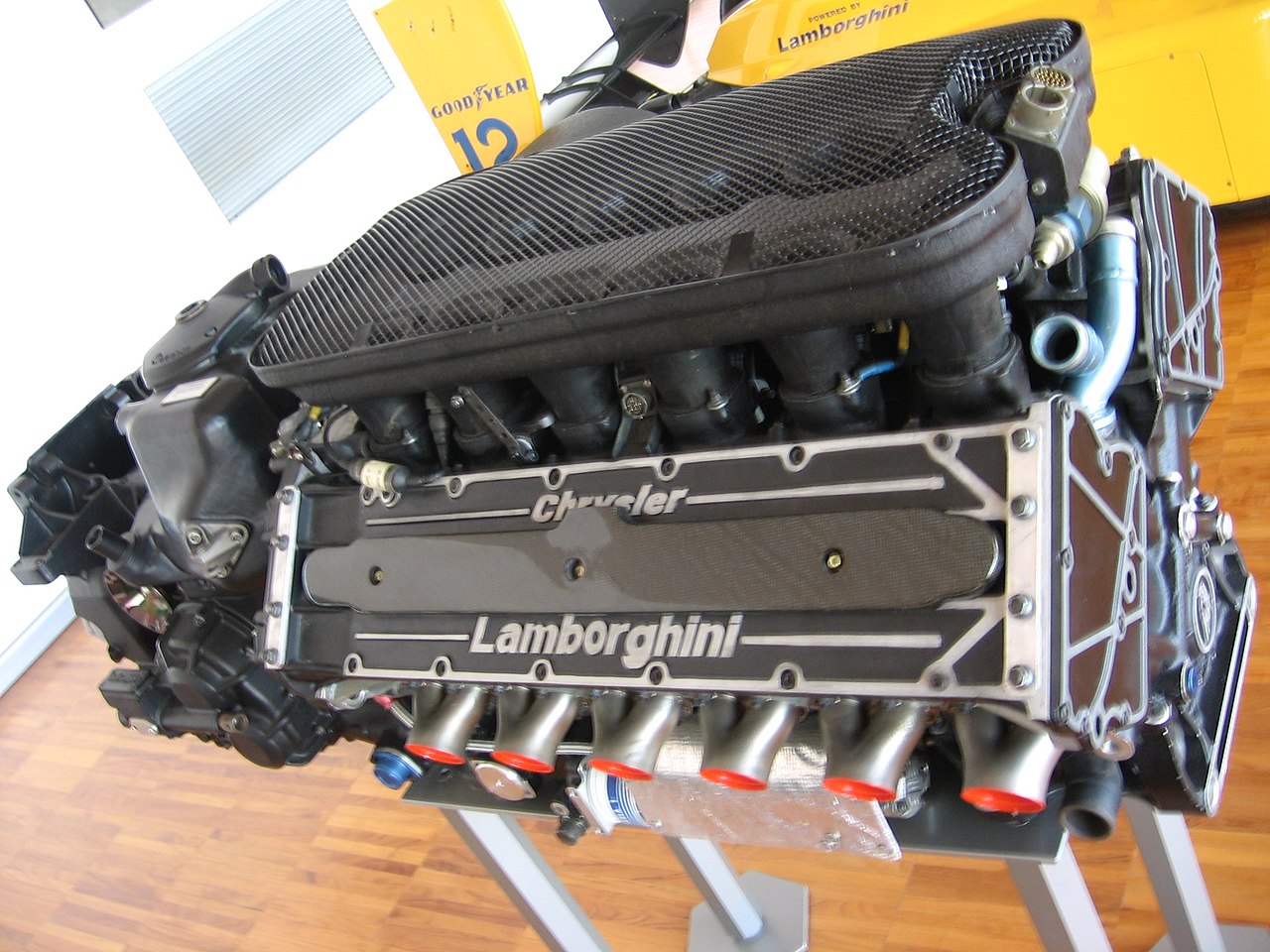


Design and mechanical characteristics
Physically, a V12 combines features of two straight-six banks sharing a crankshaft. The angle between the banks varies by design: many roadgoing V12s use 60° because this angle yields compact packaging and compatible firing geometry, while other installations sometimes use different angles to meet aerodynamic, packaging or center-of-gravity goals. With twelve cylinders, firing events occur frequently in the engine cycle, which reduces torsional vibration and produces near-continuous torque delivery. Because primary and secondary forces can cancel out with appropriate crankshaft design, most V12s do not require additional balance shafts to achieve smoothness.
History and notable developments
V12 layouts have a long history in both transport and stationary applications. Early and mid-20th century aircraft used liquid-cooled V12 aero engines for their combination of power and smoothness; some of the most recognizable piston aero engines were V12 types. In the automotive world, V12s became synonymous with high-end sporting and luxury cars: manufacturers used them to offer high power outputs and refined running characteristics. Over the decades the design evolved with advances in metallurgy, fuel delivery, ignition systems and electronic engine management, allowing higher specific outputs and cleaner operation compared with earlier examples.
Uses and examples
V12 engines appear where smooth, continuous power and prestige are desired. Typical uses include:
- Luxury and grand touring automobiles, where the V12’s refinement supports a quiet, vibration-free experience.
- High-performance and racing cars, particularly in eras and categories where naturally aspirated power and balance were advantageous.
- Aeronautical applications, historically in piston-engined aircraft where the compact power of a V12 helped meet performance needs.
- Large marine and industrial engines, where multiple cylinders contribute to durability and steady torque for long-running duties.
Advantages and disadvantages
Advantages of the V12 layout include exceptional smoothness, frequent firing intervals that give linear power delivery, and the ability to produce high overall displacement without excessively large individual cylinders. These traits make V12s well suited for refinement-focused vehicles and heavy-duty continuous-power installations.
Disadvantages are primarily cost, complexity, size and weight. A V12 requires more components—valves, camshafts, fuel injectors and associated ancillaries—so it is more expensive to produce and maintain than smaller layouts. Fuel consumption and packaging constraints also limit the use of V12s where economy, compactness or light weight are priorities.
Distinctions and notable facts
Compared with an inline-six, the V12 can be packaged into a shorter engine bay while retaining similar mechanical balance and smoothness; compared with a V8, it typically offers even smoother operation and higher cylinder count at the expense of complexity. A 180° V12 configuration is sometimes called a flat-12, which alters center-of-gravity and intake/exhaust routing. Many manufacturers and historians regard the V12 as a symbol of engineering refinement and a benchmark for luxury and high-performance propulsion.
For further technical summaries and historical overviews see additional resources: engine fundamentals, cylinder arrangements, and detailed discussions on piston and cranktrain design. For fuel and powerplant comparisons consult material on crankshaft dynamics, gasoline systems, diesel applications, and alternative fuels.
Questions and answers
Q: What is a V12 engine?
A: A V12 engine is an internal combustion engine with 12 cylinders, with six cylinders on each side forming a "V" shaped angle.
Q: How are the two banks of cylinders in a V12 engine positioned in relation to each other?
A: In most V12 engines, the two banks of cylinders are at a 60° angle to each other.
Q: What type of fuels can power a V12 engine?
A: A V12 engine can be powered by different types of fuels, including gasoline, diesel, and natural gas.
Q: Why doesn't a V12 engine need balance shafts?
A: A V12 engine doesn't need balance shafts because each cylinder bank is basically a straight-6, which has perfect balance no matter which V angle is used.
Q: What are the advantages of having a V12 engine with a 45°, 60°, 120°, or 180° angle between the two banks of cylinders?
A: A V12 engine with any of these angles has even firing and is smoother than a straight-6, which provides a smooth running engine for a luxury car.
Q: How can a V12 engine be made lighter in a racing car?
A: In a racing car, the V12 engine can be made much lighter to make the engine more responsive and smoother.
Q: What is the benefit of using a V12 engine in a large heavy-duty engine?
A: In a large heavy-duty engine, a V12 can run slower, which prolongs engine life.
Related articles
Author
AlegsaOnline.com V12 engine — design, history, and applications Leandro Alegsa
URL: https://en.alegsaonline.com/art/103816