
V-2 rocket (Vergeltungswaffe 2): Germany's wartime ballistic missile
The V-2 (Vergeltungswaffe 2) was the first long-range guided ballistic missile. Developed in Nazi Germany, it pioneered liquid‑fuel rocketry and influenced postwar space and missile programs.
Overview
The V-2, formally Vergeltungswaffe 2 (Vergeltungswaffe 2), was a German surface‑to‑surface ballistic missile developed during World War II. Designed at the Peenemünde research center (Peenemünde), it became the first large‑scale, long‑range guided rocket deployed as a weapon. Operational launches against Allied cities began in 1944; the weapon was intended to strike targets such as London and Antwerp. Its supersonic speed, commonly cited as around four times the speed of sound (Mach 4), meant that it could not be intercepted by the air defenses of the time.
Image gallery
10 Images




Design and technical characteristics
The V-2 was a liquid‑fueled rocket powered by an alcohol‑and‑liquid‑oxygen engine with turbopump feed. Guidance used gyroscopes and aerodynamic control surfaces for the boost and early ballistic guidance during flight. Typical descriptions note a cylindrical fuselage with stabilizing fins and a conical warhead section. The missile was capable of a high‑altitude ballistic trajectory; several test launches crossed the boundary commonly used to define space, and the program demonstrated technologies later essential to spaceflight.
Operational history
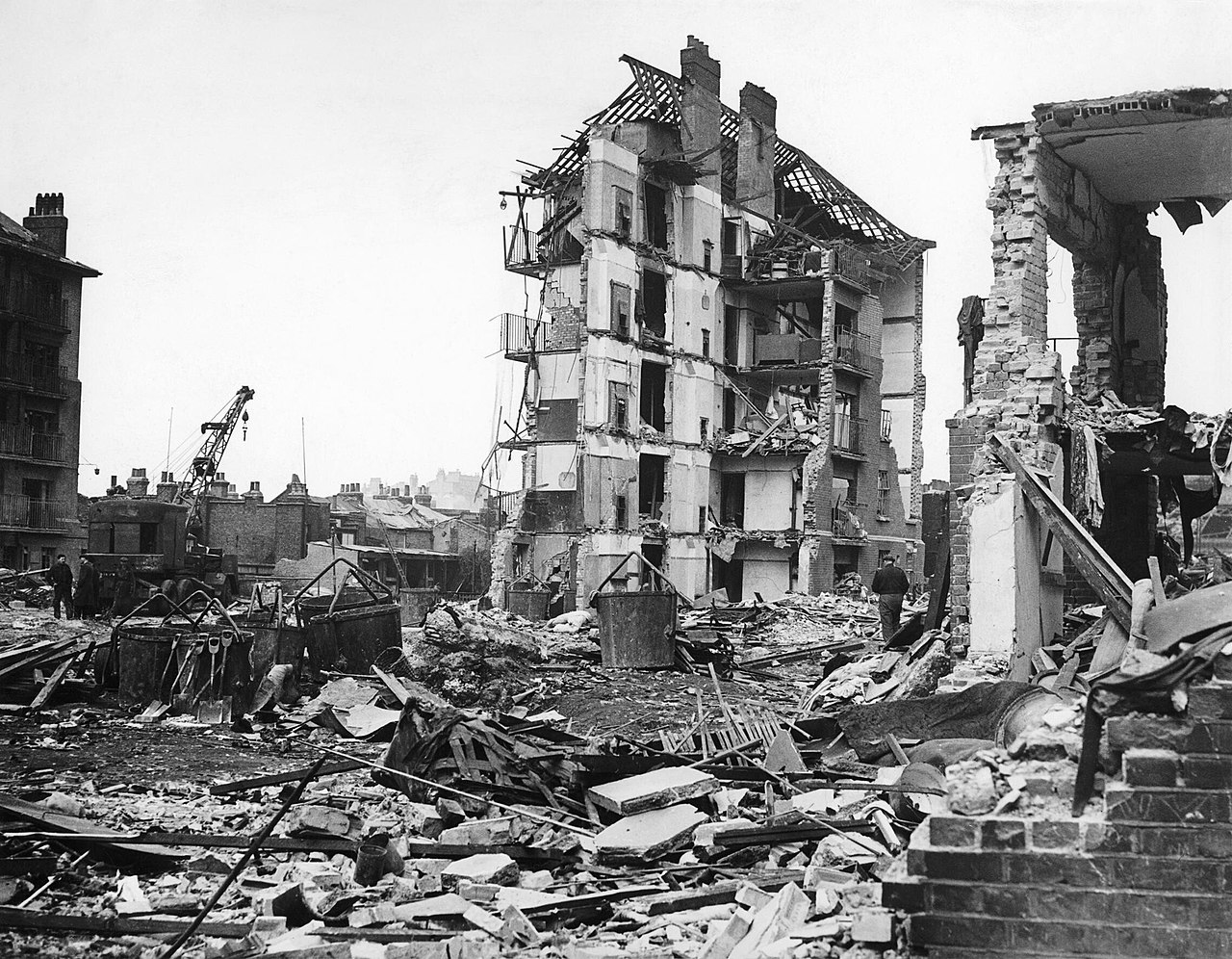
Early development and testing took place at Peenemünde on the Baltic coast. The first notable test flight occurred in October 1942; later, from 1944, production and operational use increased. The first V‑2 attacks used as weapons struck European cities in 1944, with some early impacts reported in Paris and London. Around 3,000 V‑2s were launched by German forces during the war, causing several thousand civilian and military deaths (widely reported figures cite roughly 7,250 fatalities) and significant destruction. Production and deployment involved severe forced labour practices, especially in underground factories, a tragic and well‑documented element of the program.
Postwar capture and influence
After Germany’s defeat, captured V‑2 rockets, components and personnel were recovered by both Allied and Soviet teams. Personnel from the Peenemünde group, led by Wernher von Braun (Wernher von Braun), surrendered to U.S. forces and were brought to the United States where many contributed to early American rocketry and space efforts. Experimental and research launches of assembled V‑2s were conducted at White Sands Proving Ground beginning in 1946, with the first American‑assembled V‑2 flying in April 1946; a series of test flights continued into the early 1950s. Captured technology and expertise also informed Soviet missile development, making the V‑2 a direct ancestor of both Cold War-era ballistic missiles and later space launch vehicles.
Legacy and notable facts
- The V‑2 is often described as the first man‑made object to reach space because some flights passed above the 100 km mark used by many definitions of space.
- Its development marked a transition from simple rockets to guided, high‑speed ballistic weapons and established engineering approaches still in use in modern launch vehicles.
- Use of the V‑2 left a complex legacy: a technical milestone in rocketry and a weapon whose production and deployment were linked to wartime atrocities.
Further reading and resources
For detailed technical descriptions and full operational histories consult specialized histories and archival resources. Background material on Peenemünde research (Peenemünde), wartime deployments (World War II), contemporary reports on the German armed forces (Wehrmacht), and biographies of leading engineers (Wernher von Braun) provide context. Additional curated sources and primary documents can be found via institutional archives and museum collections (Vergeltungswaffe 2, Antwerp, Mach 4, Paris).
Questions and answers
Q: What is the V-2 rocket?
A: The V-2 rocket was the world's first ballistic missile and the first human object to fly in space.
Q: When was the first successful launch of the V-2 rocket?
A: The first successful launch was from Peenemünde on 3 October, 1942.
Q: Why was the V-2 rocket designed by Nazis?
A: The V-2 rocket was designed by Nazis to bomb London, Antwerp and other European cities.
Q: Was it easy to shoot down the V-2 rocket?
A: No, it was impossible to shoot down the V-2 rocket because it travelled at four times the speed of sound.
Q: How many V-2s were used by the German Wehrmacht against Allied targets in World War II?
A: Over 3,000 V-2s were used by the German Wehrmacht against Allied targets in World War II.
Q: Who used captured V-2 rockets to start their space and missile programs?
A: The victors of World War II used captured V-2 rockets to start their space and missile programs.
Q: Who helped the US to develop their rocket program?
A: The team of German rocket scientists from Peenemünde, led by Wernher von Braun, helped the US to develop their rocket program.
Tags
Related articles
Author
AlegsaOnline.com V-2 rocket (Vergeltungswaffe 2): Germany's wartime ballistic missile Leandro Alegsa
URL: https://en.alegsaonline.com/art/103802