
UY Scuti — one of the largest known red supergiants
UY Scuti is a pulsating red supergiant (or hypergiant) in Scutum, notable for an extremely large and uncertain radius, great luminosity, and its use in studies of late-stage massive stellar evolution.
Overview
UY Scuti is an evolved massive star classified as a red supergiant and sometimes described as a red hypergiant. It is a pulsating variable located in the small southern constellation Scutum (Scutum), lying in the plane of the Milky Way Galaxy. It is widely cited as one of the largest known stars in our Galaxy because of its enormous photospheric radius and high luminosity, although both size and brightness estimates carry substantial uncertainties.
Image gallery
5 Images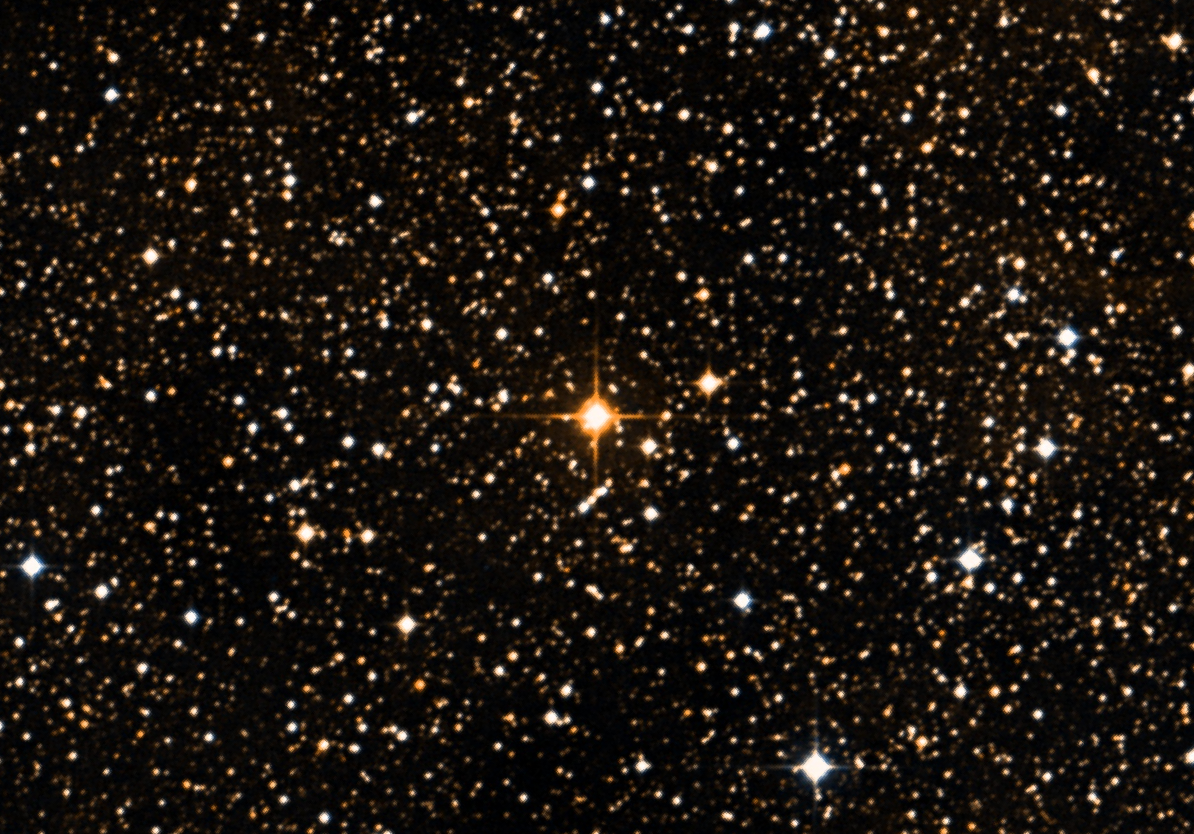




Measurements and radius estimates
Estimates of UY Scuti's size combine angular diameter measurements, distance determinations and models of an extended atmosphere and surrounding dust shell. A commonly quoted characteristic is a median radius near 1,700 times that of the Sun. That figure corresponds to a diameter of the order of 2.4 trillion m (roughly 1.5 billion mi), or about 15.9 AU.
Distance and uncertainties
UY Scuti is several thousand light‑years away from Earth. A commonly referenced distance is approximately 2.9 kiloparsecs (about 9,500 light‑years) and is often given as ~2.9 kilo parsecs. The star's apparent angular size, bolometric luminosity and derived physical radius depend strongly on the adopted distance, corrections for interstellar extinction and the definition of the stellar radius in the presence of an extended, dusty and pulsating atmosphere. Published values therefore include significant uncertainties and ranges rather than precise single numbers.
Photosphere, atmosphere and circumstellar material
The observable surface or photosphere of UY Scuti is surrounded by an extended atmosphere and circumstellar envelope produced by strong mass loss. Molecular layers, dust formation zones and episodic ejections can make the effective size wavelength dependent: infrared measurements typically probe deeper layers than optical observations. These complications mean that different techniques and wavelengths produce somewhat different radius estimates.
Solar System comparisons
To visualise the scale, many accounts compare UY Scuti's radius with planetary orbits. If placed at the center of the Solar System using one commonly quoted radius, its photosphere would extend past the orbit of the inner giant planets and reach near the orbit of Jupiter, engulfing the inner planets. Some stronger radius determinations suggest an extent approaching the orbit of Saturn, though such statements depend on how the star's outer layers are defined and are not universally agreed.
Variability and pulsation
As a pulsating variable, UY Scuti shows changes in brightness and effective temperature associated with radial pulsations and atmospheric dynamics. These variations influence instantaneous measurements of angular diameter and luminosity; long‑term and multiwavelength monitoring are required to characterise the pulsation period, amplitude and the relation between brightness and radius changes.
Evolution and fate
UY Scuti exemplifies a late evolutionary phase of a massive star that has exhausted core hydrogen and subsequently heavier fuels, expanded and cooled at the surface and experienced strong mass loss. Over time such stars shed much of their envelope through steady winds and episodic outbursts. The expected final outcome for a star of this type is a core‑collapse event—typically a supernova—though exact details depend on the star's remaining core mass, prior mass loss and interactions with any companion.
Observations and scientific importance
Although intrinsically very luminous, UY Scuti's large distance and interstellar reddening make it relatively faint at optical wavelengths; it is primarily studied in the infrared, by radio observations of circumstellar material and with optical/infrared interferometry that can resolve the angular size. Astronomers use UY Scuti and similar objects to test models of stellar structure at extreme radii, to study mass‑loss mechanisms in evolved massive stars and to investigate how such stars contribute chemically enriched material to the interstellar medium.
Quick facts
- Type: red supergiant / hypergiant.
- Variability: pulsating variable.
- Constellation: Scutum (Scutum).
- Galaxy: Milky Way Galaxy.
- Luminosity: extremely high; see specialized references for bolometric values (luminosity).
- Representative radius: ~1,700 times the Sun (Sun reference).
- Representative diameter: ~2.4 trillion m (~1.5 billion mi), ~15.9 AU (diameter).
- Distance: ~2.9 kilo parsecs (~9,500 ly) from Earth.
- Surface: extended photosphere with circumstellar envelope and molecular layers.
- Solar System analogy: photosphere would reach near or beyond the orbit of Jupiter and in some estimates affect the orbit of Saturn.
Because published values vary with method and assumptions, readers seeking detailed numerical tables, error estimates and the latest interferometric results should consult specialist observational papers and catalogues. Further technical resources and observational studies are available in the astronomical literature and targeted databases (stellar classification, variable star catalogues, Galactic surveys).
Questions and answers
Q: What is UY Scuti?
A: UY Scuti is a red supergiant or red hypergiant star, and one of the largest known stars in the Milky Way Galaxy.
Q: What kind of star is UY Scuti?
A: UY Scuti is a pulsating variable star in the constellation Scutum.
Q: How large is UY Scuti compared to the Sun?
A: UY Scuti has an estimated average median radius of 1,708 times that of the Sun, which means its diameter is about 2.4 trillion meters, or 1.5 billion miles, or 15.9 astronomical units; its volume is 5 billion times that of the Sun.
Q: What is UY Scuti's distance from Earth?
A: UY Scuti is about 2.9 kiloparsecs, or 9,500 light years, away from Earth, making it one of the nearest known hypergiants.
Q: What would happen if UY Scuti were placed at the center of the Solar system?
A: If UY Scuti were placed at the center of the Solar system, its photosphere would engulf the orbit of Jupiter, and possibly Saturn.
Q: What is notable about UY Scuti's luminosity?
A: UY Scuti is one of the most luminous stars of its kind.
Q: Is UY Scuti well-known?
A: Yes, UY Scuti is well-known.
Related articles
Author
AlegsaOnline.com UY Scuti — one of the largest known red supergiants Leandro Alegsa
URL: https://en.alegsaonline.com/art/103772
Sources
- aavso.org : aavso.org/vsx/index.php?view=detail.top&oid=34154
- aanda.org : aanda.org/articles/aa/abs/2013/06/aa20920-12/aa20920-12.html
- adsabs.harvard.edu : adsabs.harvard.edu/doi/10.1086/191488