
Utatsusaurus: an early ichthyopterygian from the Lower Triassic
Utatsusaurus, a basal ichthyopterygian from the earliest Lower Triassic, is a slender, nearly 3 m marine reptile known from Japan and Canada. It shows transitional features between land ancestors and later ichthyosaurs.
Overview
Utatsusaurus is one of the earliest and most primitive recognized members of the group of marine reptiles known as ichthyopterygians. It lived during the very beginning of the Lower Triassic, roughly 250–245 million years ago, in the wake of the end-Permian extinction. Individuals approached about three metres in length and had an elongated, streamlined body that indicates adaptation to a marine lifestyle while retaining several primitive anatomical traits.
Image gallery
10 Images

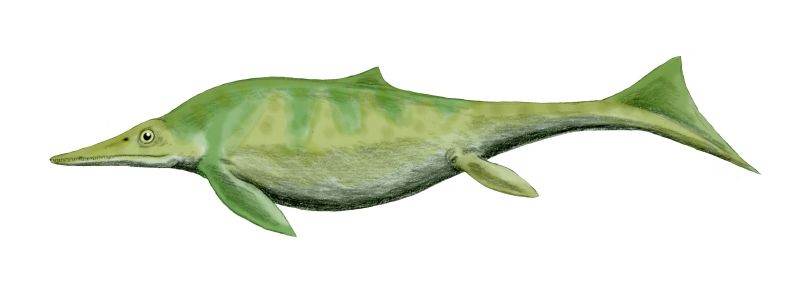


Anatomical features and appearance
Utatsusaurus shows a mix of primitive and derived characters that illustrate an early step in the transition from land-dwelling ancestors to highly specialized ichthyosaurs. Notable features include a relatively long and tapering snout, a broad skull, and a long low tail fin rather than the distinct crescent-shaped fluke seen in later forms. Unlike later ichthyosaurs, Utatsusaurus lacked a prominent dorsal fin. Its limbs were more paddle-like than fully terrestrial limbs but not as modified as in later, highly marine ichthyosaurs.
Key characteristics
- Length: nearly 3 m (about 9 ft).
- Body: slender, elongate trunk with a long low tail fin.
- Cranium: broad skull with a gently tapering snout.
- Fins and limbs: limbs show intermediate paddle-like adaptations.
- Absence of a dorsal fin, unlike more derived ichthyosaurs.
Evolutionary significance
Utatsusaurus occupies a basal position within ichthyopterygians and is often described as a primitive or basal ichthyosauriform. It preserves transitional anatomical traits that document the shift from terrestrial locomotion to obligate swimming. The creature's morphology suggests that early ichthyopterygians relied primarily on whole-body undulation for propulsion, in contrast to the thunniform (tail-driven) swimming used by many later ichthyosaurs.
Fossil record and geographic distribution
Fossils of Utatsusaurus were first discovered near the town that gave it its name and are known from strata of the earliest Lower Triassic. Well-documented finds come from what is now the Miyagi Prefecture in Japan, and fragmentary material of comparable age has been reported from the coast of British Columbia in Canada. These occurrences indicate a relatively wide, possibly nearshore distribution in the post-extinction seas of the early Triassic.
Paleobiology: diet and locomotion
Based on jaw shape and tooth structure, Utatsusaurus was probably a piscivorous (fish-eating) predator or generalist feeder, hunting small fishes and cephalopods in shallow marine environments. Its long, flexible body and low tail fin point to anguilliform or subcarangiform swimming, where waves of lateral motion along the trunk produced thrust. Limb elements would have helped with steering rather than providing the primary source of propulsion.
Discovery, naming and notable history
The genus was named for Utatsu (Utatsu-cho), the locality in Japan where the first specimens were recovered. The remains provided early and important evidence of the post-extinction marine faunas that repopulated the oceans. Notably, specimens curated in regional collections survived modern events: the 2011 Tōhoku earthquake and tsunami damaged local infrastructure and museums, but key Utatsusaurus material was not lost in that disaster.
Distinctions and context
Utatsusaurus is distinct from later, more derived members of the group often referred to informally as ichthyosaurs (ichthyosaur). It represents an early experiment in marine adaptation rather than the highly convergent fish-like body plans that evolved later. Because of its combination of primitive and derived traits, Utatsusaurus remains an important taxon for understanding early ichthyopterygian evolution and the pace of marine recovery after the Permian extinction.
For more detailed treatments of anatomy, stratigraphy and comparisons with contemporaneous marine reptiles, see specialist literature and regional fossil databases (search portals often use the specimen records from institutions that hold the original material).
Questions and answers
Q: What is Utatsusaurus?
A: Utatsusaurus is the earliest-known form of an ichthyopterygian, which lived in the Lower Triassic period about 250–245 million years ago.
Q: How long was Utatsusaurus?
A: Utatsusaurus was nearly 3m (about 9 feet) long with a slender body.
Q: Where were the first specimens of Utatsusaurus found?
A: The first specimens of Utatsusaurus were found in the city of Utatsu-cho.
Q: In which countries have fossils of Utatusauraus been discovered?
A: Fossils of Utatusauraus have been discovered in both Japan and Canada, specifically Miyagi Prefecture, Japan and British Columbia, Canada.
Q: What makes it one of the most primitive types of ichthyosaur?
A: It has transitional features between its ancestral land-dwelling forms and more derived ichthyosaurs that make it one of the most primitive types of ichthyosaur.
Q: How did this animal swim compared to later forms?
A: Unlike more advanced forms, it had no dorsal fin and had a broad skull with a snout that gently tapered compared to more rounded ones seen in later forms. Its tail also had a long low fin, suggesting that it swam by undulation rather than using its paddles and tail like later forms did.
Q: Was any damage done to local museums during 2011 Tōhoku earthquake and tsunami?
A: Fortunately, no damage was done to local museums as the specimens were not there at the time when 2011 Tōhoku earthquake and tsunami occurred.
Related articles
Author
AlegsaOnline.com Utatsusaurus: an early ichthyopterygian from the Lower Triassic Leandro Alegsa
URL: https://en.alegsaonline.com/art/103722
Sources
- dx.doi.org : 10.1038/30473
- dx.doi.org : 10.1146/annurev.earth.33.092203.122707
- dx.doi.org : 10.1080/02724634.2013.756495