
Urartian language
Overview of the Urartian language: classification, scripts, corpus, history of scholarship, linguistic features, and debates such as the proposed hieroglyphic system.
The Urartian language was spoken in the kingdom known as Urartu, centered around the Lake Van region in the highlands of eastern Anatolia. It is best attested in monumental and administrative inscriptions from the early first millennium BCE and is reconstructed chiefly from cuneiform texts carved on stone, metal, and clay. These inscriptions document royal building projects, dedicatory formulas, and administrative records produced by a literate elite.
Linguistically, Urartian belongs to the Hurro-Urartian family and is not part of the Semitic or Indo-European families. It is typically described as an agglutinative, suffixing language with ergative alignment and subject–object–verb word order. Grammars reconstructed from the surviving corpus show case marking and a verbal system built from predictable affixes rather than the fusional patterns typical of its Indo-European neighbors.
The primary writing medium is a modified form of Assyrian cuneiform adapted to represent Urartian phonology. Scholars work from corpora of royal inscriptions and short administrative texts; some bilingual or Akkadian-influenced records help clarify meanings. A minority of researchers have proposed that a native hieroglyphic sign system also existed, but this claim remains controversial and is not accepted by most specialists in the field.
Research history spans several centuries: early explorers and epigraphers recorded and published inscriptions during the 19th and 20th centuries, and systematic philological work continued into the present. Debates concern phonology, precise syntactic reconstruction, and the extent to which Urartian influenced or left traces in neighboring languages and place names. Modern studies draw on comparative work with Hurrian and on archaeological context to interpret texts.
The language is significant for understanding political and cultural relations in the ancient Near East, especially interactions between Urartu and Assyria. Its inscriptions provide evidence about administration, religion, and landscape organization in a mountainous frontier region. Although no direct modern descendants are known, Urartian contributes to the study of ancient language contact, historical toponymy, and the development of writing traditions in Anatolia.
Notable open questions include the full inventory of vocabulary, the role of loanwords, and the debated existence of a contemporaneous hieroglyphic tradition. Individual scholars have attempted various decipherments and theoretical connections — for example, a later hypothesis linking hieroglyphic signs to an early Armenian stage has been proposed but remains outside mainstream consensus. For further resources and primary corpora, consult specialist publications and digital corpora listed below.
Image gallery
3 Images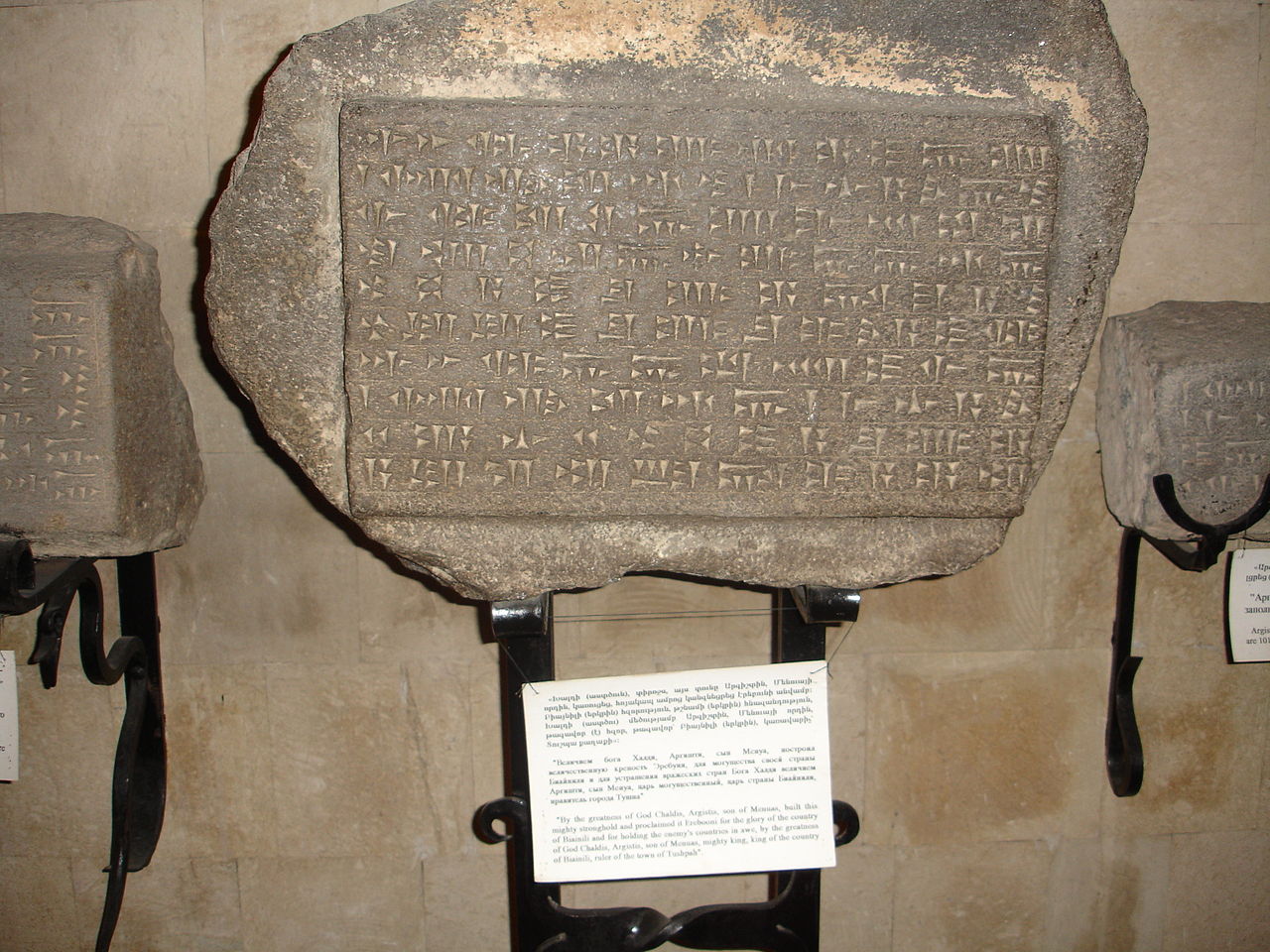


Further reading and resources
- Introductory overview
- Corpus and inscription catalogues
- Archaeological context around Lake Van
- Hurro-Urartian comparative studies
- Typological descriptions of Urartian grammar
- Language contact with Indo-European and Semitic neighbors
- Treatments of the cuneiform orthography
- Epigraphic editions and translations
- Debates on a possible hieroglyphic tradition
- Recent scholarly reviews and bibliographies
- Case studies and lexical databases
- Regional historical summaries
Questions and answers
Q: What is the name of the language spoken by the people of Urartu?
A: The language spoken by the people of Urartu is called Urartian.
Q: Where was ancient kingdom of Urartu located?
A: The ancient kingdom of Urartu was located in northeast Anatolia (present-day Turkey), in the region of Lake Van.
Q: Is Urartian a Semitic or Indo-European language?
A: No, Urartian is not a Semitic or Indo-European language; it is a member of the Hurro-Urartian family.
Q: Is there any evidence that suggests that besides cuneiform inscriptions, there may have been another writing system used by the people of Urartu?
A: Yes, there is a hypothesis that suggests that besides cuneiform inscriptions, there may have been a native hieroglyphic writing system used by the people of Urartu.
Q: Who attempted to decipher some of these hieroglyphs?
A: Armenian scientist Artak Movsisyan published a partial attempt deciphering some of these hieroglyphs.
A:: What did he conclude about them?
A: He concluded that they were written in an early form of Armenian.
Related articles
Author
AlegsaOnline.com Urartian language Leandro Alegsa
URL: https://en.alegsaonline.com/art/103545