
United States Secret Service
Federal agency responsible for protecting national leaders and investigating financial crimes, founded to combat counterfeiting and now operating protective and investigative missions nationwide.
The United States Secret Service is a federal law enforcement agency that combines two principal missions: protection of national leaders and the investigation of crimes against the nation’s financial systems. The Service operates as a component of the broader U.S. government and is best known for safeguarding the President of the United States and other designated persons. Its work spans visible public protective duties and technical, investigative work that traces corruption of monetary and digital financial instruments.
Image gallery
10 Images


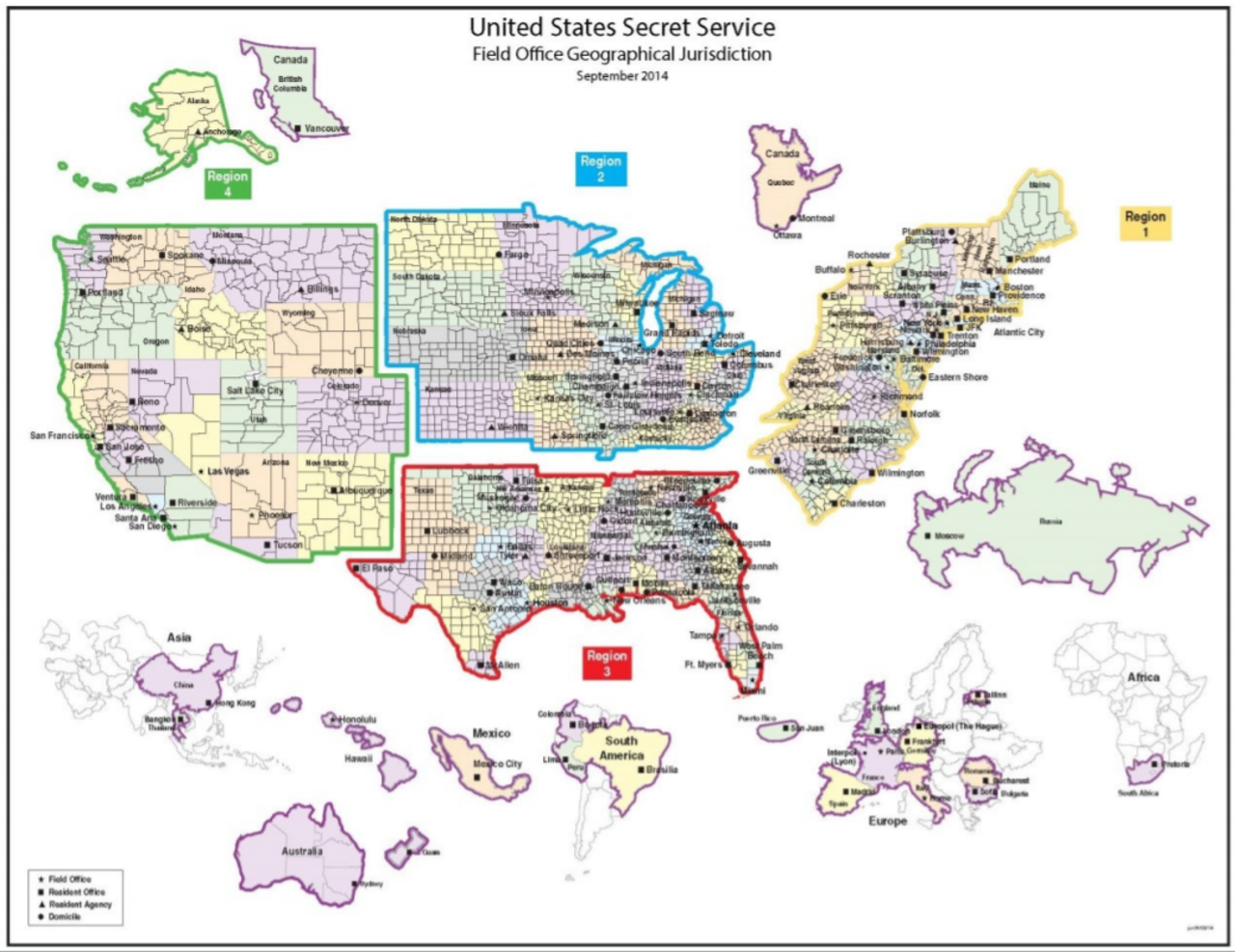

Primary responsibilities
The Secret Service performs two core functions that shape its organization and daily activities:
- Protective mission: protecting the President, Vice President, their families, major presidential and vice presidential candidates, visiting foreign heads of state, and other designated individuals. Protection also extends to major events of national significance and certain national special security events.
- Investigative mission: investigating counterfeiting of United States currency and a range of financial crimes, including fraud, electronic crimes that target the nation’s financial infrastructure, and other offenses that threaten the integrity of U.S. currency and payment systems.
Organization and personnel
The Secret Service is staffed by a mix of special agents, Uniformed Division officers, and civilian employees. Special agents generally conduct protective details and complex investigations, while the Uniformed Division provides security for the White House, the Vice President’s residence, the Treasury Building, and other facilities. Agents frequently operate in plainclothes to blend into public settings, and they use advance teams, protective intelligence, and motorcade operations to secure principals and events. The agency employs several thousand people, including both law enforcement and support personnel.
History and development
The agency was established in the aftermath of the Civil War initially to suppress widespread counterfeiting of currency. Over time its protective role expanded, particularly after high-profile attacks on elected officials. For much of its history it operated within the Department of the Treasury; in the early 21st century, following a major reorganization of federal homeland security structures, the Secret Service became part of the Department of Homeland Security while retaining its dual missions.
How protection and investigations are carried out
Protective operations involve layered security measures: advance scouting of venues, coordination with local law enforcement, controlled access to events, and continuous personal security for protectees. The investigative side combines traditional financial forensics with modern cyber investigations into payment systems, electronic fraud schemes, and counterfeiting operations. Training is centralized and rigorous, covering firearms, emergency medicine, protective tactics, and investigative techniques at a federal training facility.
Notable distinctions and public perception
The Secret Service is distinctive among federal agencies for maintaining both a high-visibility protective role—often seen at public ceremonies and around the President—and a specialized investigative mission focused on safeguarding the nation’s financial instruments. Agents’ efforts are frequently invisible to the public because much preventive work is conducted out of sight; at the same time, their visible presence at events underscores the agency’s central public safety role.
While often associated with bodyguard work, the Secret Service’s investigative remit remains a critical element of its identity and mission, continuing the agency’s original purpose of protecting the integrity of American money and payment systems.
Questions and answers
Q: What is the United States Secret Service?
A: The United States Secret Service is a government agency responsible for investigating counterfeiting and protecting important government leaders.
Q: What is counterfeiting?
A: Counterfeiting is the act of making fake money.
Q: What is the main job of the United States Secret Service?
A: The main job of the United States Secret Service is to protect important government leaders.
Q: Who are some people that the Secret Service protects?
A: The Secret Service protects people like the President, Vice President, members of the United States Cabinet, people who are running for high office, and the family members of these people, and leaders from other countries who are visiting the United States.
Q: Why is it often difficult to recognize Secret Service agents?
A: It is often difficult to recognize Secret Service agents because they dress to blend in wherever they are.
Q: How many people does the United States Secret Service employ?
A: The United States Secret Service employs about a total of 5,000 people.
Q: Would a United States President be seen in public without Secret Service agents protecting them?
A: No, a United States President would never be seen in public without Secret Service agents protecting them at all times.
Related articles
Author
AlegsaOnline.com United States Secret Service Leandro Alegsa
URL: https://en.alegsaonline.com/art/103100
Sources
- time.com : "A Brief History Of: The Secret Service - TIME"