
Umayyad conquest of Hispania: origins, campaign, and legacy
The military and political expansion of the Umayyad realm into the Iberian Peninsula beginning in 711, the collapse of the Visigothic kingdom, establishment of Muslim rule in al-Andalus, and long-term consequences.
Overview
The Umayyad conquest of Hispania refers to the rapid expansion of forces linked to the Umayyad Caliphate across the Iberian Peninsula (called Hispania in many medieval sources) beginning in 711. In a brief series of campaigns the military advance overthrew the existing Visigothic Kingdom and created the political framework that later became known as al-Andalus. The episode marks the westernmost advance of Muslim-ruled polities into what is now Europe and set the stage for centuries of cultural and political interaction.
Image gallery
7 Images




Main actors and forces
The invading contingents were largely composed of North African troops, many of whom were Berbers recently converted to Islam and integrated into Umayyad armies. Commanders who appear in contemporary and near-contemporary sources led landings near the southern shore of Iberia, traditionally at a point associated with Gibraltar. Local Visigothic resistance fractured along dynastic and regional lines, which contributed to the speed of the Muslim advance. Later political developments in Iberia were influenced by the fall of the Umayyad regime in Damascus, after which a branch of the Umayyad family established a new polity in Córdoba.
Campaign, consolidation and administration
The initial military phase involved several pitched battles and sieges; leadership and loyalty shifted frequently as Muslim commanders negotiated with, subdued, or replaced local elites. Conquered territories were reorganized under new administrative practices that mixed military governorship with local taxation and landholding arrangements. Over time these arrangements evolved into the Emirate and later the Caliphate centered on Córdoba, creating a durable Muslim presence known collectively as al-Andalus.
Notable engagements and contemporaneous responses
- Early landings and decisive battles in the 710s that dismantled central Visigothic authority.
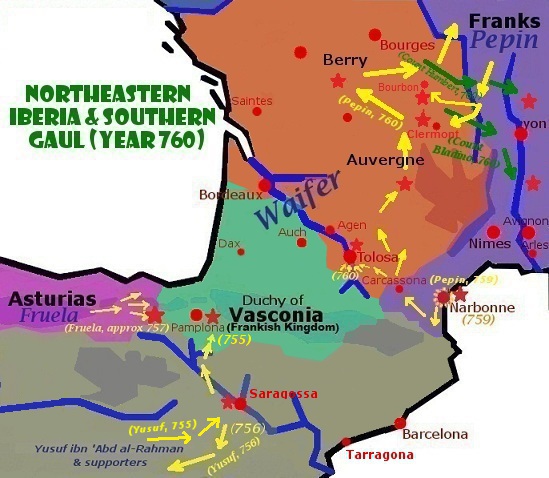
- Pushes northward and into southern Gaul led to clashes with Frankish rulers; one famous encounter associated with halting further expansion in Gaul involved Charles Martel.
- The long-term Christian effort to retake Iberian territory is labeled the Reconquista, which culminated centuries later at the Battle of Granada.
Importance and legacy
The conquest reshaped Iberian society: it introduced new legal, agricultural, linguistic and intellectual currents and created a frontier zone of cultural exchange and conflict. The presence of diverse communities—Muslim, Christian, and Jewish—under varied arrangements produced hybrid institutions and a rich material culture. Over the following centuries, political fragmentation and contestation produced regional states, alliances, and rivalries that defined medieval Iberian history.
Distinctions and historiography
Historians distinguish the short military phase of conquest from the longer processes of settlement, conversion, and state formation that followed. Interpretations of motives, chronology and social impact have evolved as scholars reassess sources from multiple languages and traditions. For accessible summaries and primary-source collections consult works that treat the Umayyad Caliphate, the geography of Hispania, and studies of the al-Andalus period. Further reading and online resources can be found through academic portals and specialized collections on medieval Iberia and North Africa.
Principal figures and episodes often highlighted by scholars include:
- Leaders of the initial expedition and the role of Berber contingents.
- Collapse of central Visigothic rule and regional realignment.
- Establishment of an Umayyad polity in Iberia after the fall of the dynasty in Damascus.
For further context and source material, many modern surveys and translations refer readers to specialized bibliographies and archival collections identified by the placeholders above.
Questions and answers
Q: What was the Umayyad conquest of Hispania?
A: It was the expansion of the Umayyad Caliphate over Hispania (modern-day Spain and Portugal) from 711 to 788.
Q: Who set up the Emirate of Cordova after the conquest?
A: Abd ar-Rahman I set up the Emirate of Cordova after the conquest.
Q: What is al-Andalus?
A: Al-Andalus is the name for Muslim-ruled Iberia (modern-day Spain and Portugal) from 756 to 788.
Q: What was the westernmost expansion of the Umayyad Caliphate?
A: The conquest of Hispania was the westernmost expansion of the Umayyad Caliphate.
Q: Who defeated the Umayyads in the Battle of Tours?
A: Charles Martel defeated the Umayyads in the Battle of Tours.
Q: Who made up the conquering army in Hispania?
A: The conquering army was made up mainly of Berbers from north-western Africa who had only recently come under Muslim influence.
Q: What was the period from 710 to 1492 called?
A: The period from 710 to the fall of the last Islamic state in the Battle of Granada in 1492 is called the Reconquista.
Related articles
Author
AlegsaOnline.com Umayyad conquest of Hispania: origins, campaign, and legacy Leandro Alegsa
URL: https://en.alegsaonline.com/art/102728